


Quick Answer: What Was the Qing Dynasty?
The Qing (清, Qīng) was China’s last imperial dynasty. Its rulers came from the Manchu (满洲, Mǎnzhōu) community of the northeast. The dynasty took its name in 1636, established its court in Beijing in 1644 and ended with the imperial abdication in 1912.[11][13][15]
- Rule: A conquest dynasty combined inherited civil government with institutions that protected its ruling group’s position.
- Society: Farming households, artisans and merchants sustained a large economy with important regional differences.
- Culture: Court commissions, scholarly painting and commercial books reached different audiences.
- Change: Nineteenth-century wars and rebellions were followed by reforms and revolution.
The Qing governed many peoples; neither its subjects nor its cultural life formed one uniform community.
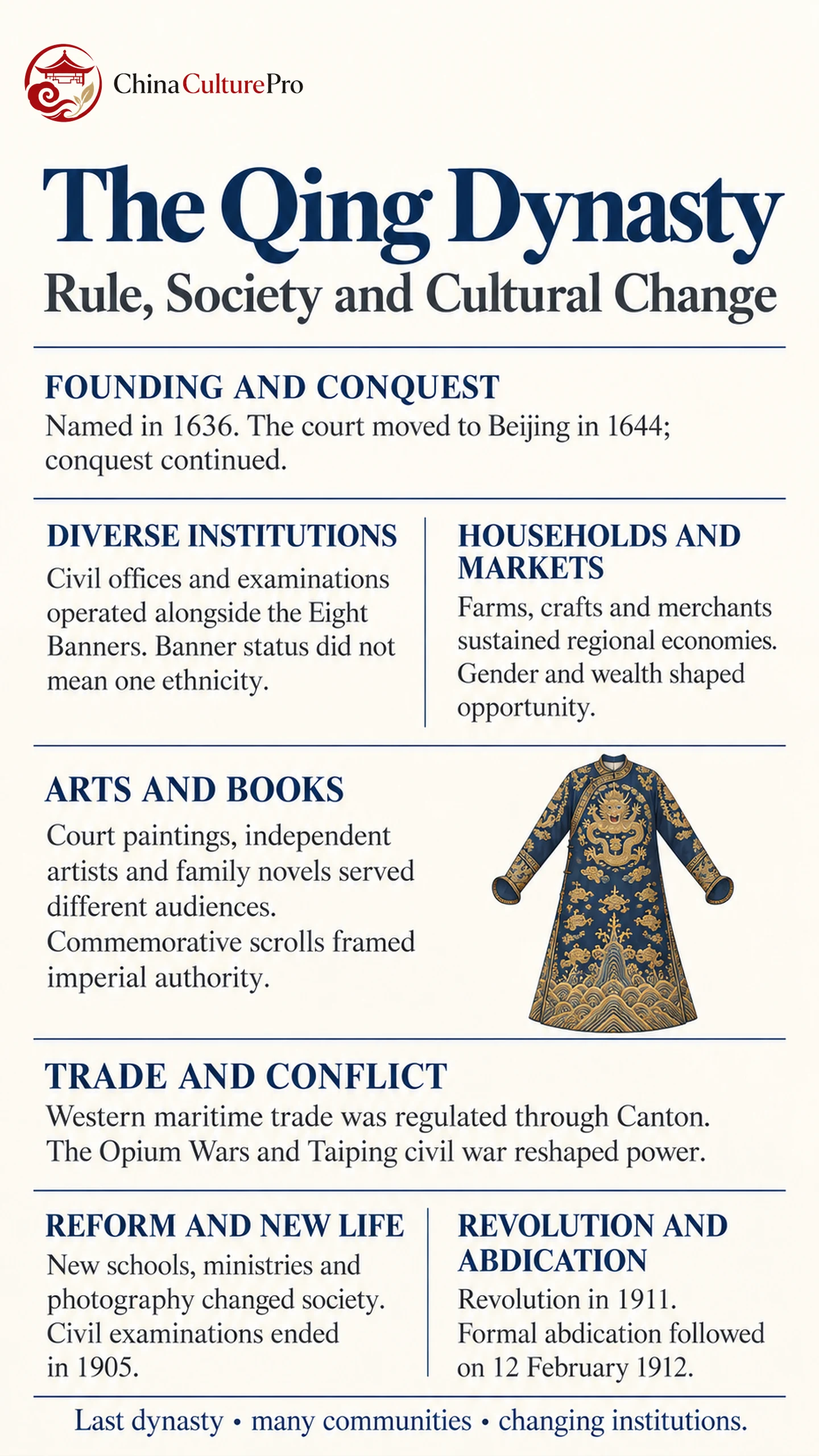
Qing history connects palace ritual with village work, international commerce and new arguments about government. A robe, a family novel and an abdication document reveal different parts of that history. Reading them together makes the period easier to understand than a sequence of emperors alone.
Founding, Conquest and the Dates of Qing Rule
In 1636, Huang Taiji (皇太极, Huáng Tàijí) adopted Qing as his dynasty’s name. His state already existed beyond the northeastern frontier of the Ming (明, Míng), the dynasty then ruling from Beijing. The change of name preceded the takeover of the capital.[15]
The decisive Beijing transition came in 1644, after a rebellion brought down the Ming court there. Qing forces entered the city and established an imperial court.[15] Campaigns against competing regimes continued, so 1644 marks a change at the capital, not the instant completion of conquest.[1] The Ming dynasty article explains the preceding crisis; the dynasty timeline places both regimes in sequence.
This distinction explains why a Qing history may start with 1636 or 1644. One date identifies the dynastic name; the other identifies the Beijing-based imperial regime. Always check which event a timeline is dating.
Governing a Diverse Empire
Qing rulers retained civil offices and examinations familiar to Han Chinese (汉人, Hànrén) elites while maintaining separate institutions associated with their conquest state. Bilingual administrative records show that adopting Chinese governmental practices did not mean abandoning the court’s other political identities.[1]
The Eight Banners (八旗, bāqí) organized military service and registered households, with their own administrative hierarchy. Banner forces included Manchu, Mongol and Han units. Banner membership was an institutional status, not a synonym for a single ethnicity. Surviving official seals make this system visible at the level of local organization.[2]
Kangxi (康熙, Kāngxī), Yongzheng (雍正, Yōngzhèng) and Qianlong (乾隆, Qiánlóng) are three familiar emperors of the seventeenth and eighteenth centuries. These are reign names, rather than their personal names. The court promoted Manchu language and martial skills alongside its wider claims to imperial legitimacy; Manchu culture provides the cultural background.[3]
Dress and grooming also carried political force. Ranked court clothing distinguished status, while the imposed male queue hairstyle made submission to the dynasty publicly visible. The history of Manchu clothing helps explain why a Qing court robe differs from later twentieth-century fashions. Cultural adaptation and coercion belonged to the same imperial history.[3]
Court ritual likewise had several settings. Confucian state ceremonies coexisted with Manchu shamanic observances and Tibetan Buddhist rites. These practices addressed different claims to authority; using Chinese civil institutions did not make the empire culturally uniform.[1][3]
Farms, Markets and Household Lives
Most people lived outside the palace world. Agriculture remained central, but households also produced textiles and other goods for sale. Merchants connected local markets with distant buyers; waterways moved bulky cargo and linked important commercial centers. Rural life and commercial activity were closely connected.[4]
Payments used both copper cash and silver, with different roles in everyday transactions and larger obligations. This matters when reading a tax account or a merchant’s ledger: money did not mean one uniform coin circulating at one fixed value. The history of Chinese currency supplies that longer context.[4]
Family authority and gender shaped access to resources and education. Moral literature placed demanding expectations on women, yet elite women also formed a reading public. Their literacy complicates the assumption that women were simply absent from literary culture; it does not establish equal opportunities across social classes.[6]
For household history, connect those expectations with family traditions and genealogical records. Such records and conduct books answer different questions: one may establish recognized descent, while another prescribes how relatives should behave. Neither alone describes every household’s daily life.
Painting, Books and Court Culture
Qing painting included court commissions, artists who reworked prestigious older models and painters whose distinctive styles expressed more personal positions. An imperial commission and an independently made landscape could share materials without serving the same audience. The Chinese painting guide explains the broader vocabulary.[7]
Painted records of imperial southern inspection tours offer a particularly useful example. Their crowded streets and waterways contain information about places and work, but the scrolls also commemorate imperial authority. They are composed political images, not neutral photographs of everything happening along a route.[13]
The eighteenth-century novel Dream of the Red Chamber (红楼梦, Hónglóu Mèng), associated with Cao Xueqin (曹雪芹, Cáo Xuěqín), explores love, status and the fortunes of a wealthy household. It circulated in manuscript and print, combining vernacular storytelling with poetry. Read Dream of the Red Chamber for its literary world, while remembering that a crafted family narrative is not a census of Qing society.[6]
These examples reveal several cultural settings at once: imperial patronage, scholarly practice and a market for books. A single label such as “Qing art” can conceal those different relationships between makers, patrons and readers.
Foreign Trade, War and Internal Rebellion
The Qing economy participated in long-distance exchange. The Canton trade system, conventionally dated 1757–1842, concentrated regulated Western maritime commerce at Guangzhou through licensed merchant intermediaries. It did not close every route linking the empire to neighboring societies. Maritime trade history places that regulated channel within a much larger network.[5]
The Opium Wars (鸦片战争, Yāpiàn Zhànzhēng), in 1839–1842 and 1856–1860, changed the balance of power. Defeat brought treaty ports and foreign legal privileges that constrained Qing sovereignty. These conflicts involved military coercion and commercial interests, rather than a simple encounter between an isolated society and outside knowledge.[9]
At the same time, the Taiping Rebellion (太平天国, Tàipíng Tiānguó) devastated large areas during the 1850s and 1860s. Civil war overlapped with pressure on land, food insecurity and other rebellions. Provincial military organization became increasingly important as the court struggled to suppress its opponents.[9]
Foreign intervention and internal upheaval therefore need to be studied together. War damaged communities and state finances, while responses to rebellion changed the distribution of military power. No single battle explains the dynasty’s eventual end.
Reform, New Media and Social Change
Defeat by Japan in 1894–1895 sharpened demands for institutional change. Reformers disagreed about how much to alter and how quickly; preserving imperial rule and transforming government were not always opposite aims.[9]
Empress Dowager Cixi (慈禧太后, Cíxǐ Tàihòu) helped suppress the reform movement of 1898 and supported the Boxers before the foreign intervention of 1900. Yet her government subsequently pursued reforms in administration, education and the banner system. The Cixi article examines that combination of repression and institutional change, which a portrait of unvarying opposition to reform misses.[10]
The civil service examinations were abolished in 1905. For families that had invested in classical study as a route to office, this changed an established relationship between learning and official advancement. The imperial examinations article explains the system that was being dismantled.[1]
New schools and ministries belonged to this changing political world. Photography, introduced from the 1840s, also supplied new ways to make portraits and circulate images. Some women gained access to education abroad and participated in reformist or revolutionary circles. These developments had uneven reach, but late Qing cultural life was changing before the monarchy ended.[8][10]
Revolution in 1911 and Abdication in 1912
The Xinhai Revolution (辛亥革命, Xīnhài Gémìng) accelerated after the Wuchang uprising on 10 October 1911. Provinces broke with the court, turning political opposition into a crisis of imperial survival. This is why 1911 occupies such a prominent place in accounts of the dynasty’s fall.[12]
The formal abdication followed on 12 February 1912, in the name of the child emperor Puyi (溥仪, Pǔyí). Negotiations between imperial and revolutionary interests produced a settlement that included preferential terms for the former ruling household. The surviving edict marks the legal end of Qing imperial rule.[11]
Abdication did not immediately create a stable political order or erase family practices, artistic traditions and social inequalities. For the next stage, the Chinese history overview follows the transition into the republican period. Political institutions could change abruptly while other parts of cultural life followed longer trajectories.
FAQs About the Qing Dynasty
Why do Qing histories begin in either 1636 or 1644?
1636 dates the adoption of the Qing dynastic name. 1644 dates the establishment of the Qing court in Beijing after the fall of the preceding court there. They identify different events, rather than competing dates for one event.[15]
Did the Qing dynasty end in 1911 or 1912?
1911 dates the revolution that undermined imperial rule. The formal abdication edict was issued on 12 February 1912, so 1912 is the clearest endpoint when dating the monarchy itself.[11][12]
Were all Qing subjects Manchu?
No. The empire governed many communities, including a large Han Chinese population. Even banner organization included Manchu, Mongol and Han units; political status and ethnic identity should not be treated as interchangeable.[2]
Are the Qin and Qing dynasties the same?
No. The Qin (秦, Qín) dynasty ruled in 221–206 BCE. Qing uses a different Chinese character and belongs to the seventeenth through early twentieth centuries. See the Qin dynasty article for the much earlier unification.[14]
Sources
[1] Academia Sinica. Archives of the Grand Secretariat
[2] National Museum of China. Banner Organization Seals
[3] National Library of Australia. Emperors
[4] Columbia University. The Grandeur of the Qing Economy
[5] Harvard Business School Baker Library. The Canton Trade and the Hong Merchants System
[6] National Library of Australia. Literature
[7] The Metropolitan Museum of Art. The Qing Dynasty: Painting
[8] British Museum. China’s Hidden Century: Large Print Guide
[9] Columbia University. Key Points across East Asia: 1750–1919
[10] University of Washington Press. Manchus and Han: Cixi and the Peculiar Institution
[11] National Museum of China. Abdication Edict of the Xuantong Emperor Puyi
[12] Palace Museum. The Xinhai Revolution
[13] Columbia University. The Grandeur of the Qing: Introduction
[14] Smithsonian National Museum of Asian Art. Qin Dynasty
[15] Palace Museum. The Qing Court Moves to Beijing