

Quick Answer: What Was the Maritime Silk Road?
The Maritime Silk Road (海上丝绸之路, Hǎishàng Sīchóu Zhī Lù) was a network of sea routes linking Chinese ports with Southeast Asia, South Asia and other ports around the Indian Ocean. Traders carried ceramics, silk and many other goods. Seasonal winds and the services of ports helped organize when and where ships could sail.[1][2][5][6]
- Ports: Guangzhou (广州, Guǎngzhōu) and Quanzhou (泉州, Quánzhōu) connected inland producers and coastal markets with overseas traders at different times.[1][3]
- Cargo: The ninth-century wreck near Belitung carried Chinese ceramics in a ship built in a western Indian Ocean tradition.[4][5]
- Exchange: Objects, buildings and inscriptions record connections that extended to design, religion and community life.[3][5]
The term covers many voyages and periods. The ports and the people using them changed over time.[1][3][4]
A cargo of Chinese ceramics found near an Indonesian island points to a long voyage, but its story also begins inland, where the bowls and jars were made. On the maritime routes, workshops, river traffic and seaports all mattered. That chain of production and movement connects the sea to wider Chinese history.[3][4][5]
How Sea Routes and Monsoons Shaped Trade
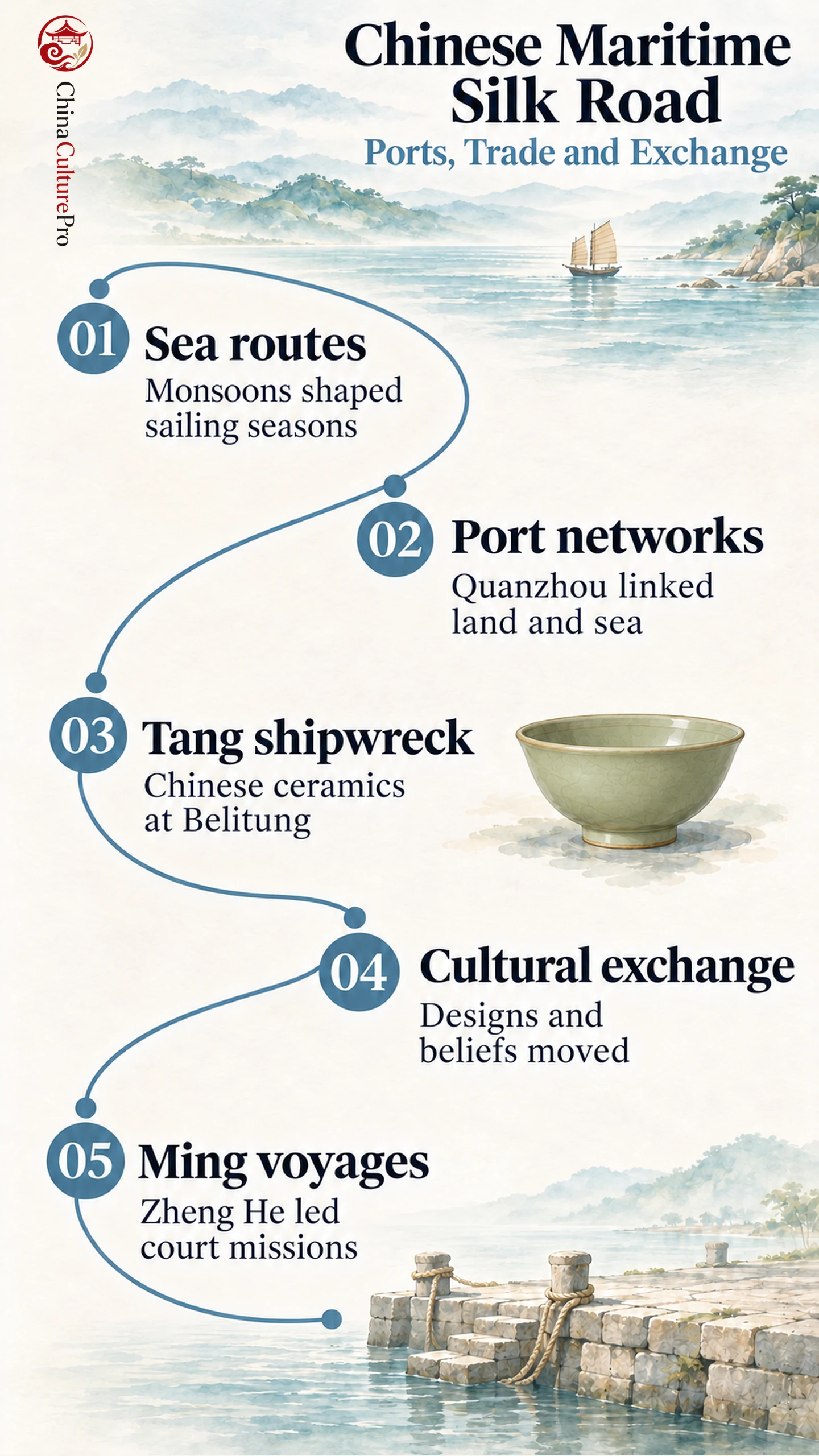
From the Chinese coast, vessels could reach Southeast Asian ports and take on goods bound farther west. Routes across the Indian Ocean linked South Asia with places as far apart as the Gulf and East Africa. Each passage belonged to a larger network, and a cargo could travel across several legs. The sea routes also overlapped with the inland connections described in the broader history of the Silk Roads.[1][2][5]
In the western Indian Ocean, the prevailing winds tend to shift with the seasons. In the western part of the ocean, northeasterly winter winds and the broadly reversed summer winds made different passages practical at different times. Historical mariners timed voyages around these conditions. If the wind for a return journey was months away, crews and merchants might spend time at an intermediate or destination port. The routes therefore depended on places to wait, trade and resupply as well as on conditions at sea.[2][6]
What Chinese Ports Connected
Along China’s coast, Guangzhou and Ningbo served different regional networks and access routes inland. The ports combined landing places and storage with access to inland goods and buyers. In Song–Yuan Quanzhou, waterways and overland transport connected the coastal city with sites producing ceramics and iron. Its bridges, stone docks and administrative remains are part of the record of a working port system.[1][3]
Quanzhou flourished as an emporium between the tenth and fourteenth centuries, during the Song and Yuan periods. The remains show how manufacturing, transport and sales could connect in the same region. A kiln far from the shore could still serve maritime customers if merchants and carriers could move its products to docks and warehouses.[3]
What the Belitung Wreck Reveals
A merchant vessel wrecked near Belitung in what is now Indonesia in the ninth century. Its hull used a sewn-plank construction associated with western Indian Ocean vessels. The cargo and hull came from different traditions. The wreck adds a western Indian Ocean vessel to a history that also includes Chinese sailing ships carrying goods from coastal ports.[4][5]
Changsha wares (长沙窑, Chángshā Yáo) made up much of the cargo. The Asian Civilisations Museum reports more than 50,000 hand-painted bowls from Changsha, alongside finer goods such as Yue celadons and northern white wares. The cargo brought together goods made in several regions of China. The number and range of bowls give a sense of what a merchant could buy and transport in a single shipment. The wreck’s location and the origins of its cargo help reconstruct a voyage that ended off Belitung. The intended destination remains uncertain.[4][5]
How Goods and Communities Carried Ideas
A blue-and-white dish from the wreck offers one example of design crossing regions. The Asian Civilisations Museum identifies its lozenge motif as one favored in the Middle East. The museum also suggests that the cobalt may have come from Iran. The dish suggests how a Chinese workshop could respond to tastes overseas. Its material and decoration belong to the longer history of Chinese ceramics and export wares.[5]
Cultural ties also took visible form in port cities. The eleventh-century Qingjing Mosque (清净寺, Qīngjìng Sì) and Islamic tombs survive within the Quanzhou heritage property. These sites help document religious communities in a port known as Zayton in Arabic and Western texts. Trade records and port buildings show what passed through a city, while religious sites help show who lived and worshipped there.[3]
Where Trade and Diplomacy Overlapped
Official missions used some of the same sea connections as merchants. In the early Ming, Zheng He (郑和, Zhèng Hé) led fleets across parts of Southeast Asia and the Indian Ocean. These voyages belonged to court diplomacy and the practices discussed under the Chinese tributary system. Archaeological finds such as the Belitung wreck show the much earlier history of commercial voyages. Putting the two cases together gives the network a longer chronology. The Ming voyages show what a court could organize, while the cargo from Belitung preserves a commercial shipment from several centuries earlier.[4][5][7]
FAQs About the Chinese Maritime Silk Road
Was the Maritime Silk Road one fixed route?
It comprised linked routes across different seas and ports. Sailors and merchants chose routes according to season, destination and the conditions of trade.
What did ships carry besides silk?
Cargo could include ceramics, metals, spices, wood, glass and textiles. The goods varied by port and voyage.
Did Zheng He start the Maritime Silk Road?
His early Ming voyages used maritime networks that had already operated for centuries. The Belitung wreck provides evidence of long-distance trade in the ninth century.
Sources
[1] UNESCO World Heritage Centre. The Chinese Section of the Silk Roads, Tentative List
[2] Library of Congress. Winds of Exchange in the Indian Ocean
[3] UNESCO World Heritage Centre. Quanzhou: Emporium of the World in Song-Yuan China
[4] Smithsonian National Museum of Asian Art. Shipwrecked: Tang Treasures and Monsoon Winds
[5] Asian Civilisations Museum. Tang Shipwreck
[6] Qatar Digital Library. Muscat and the Monsoon
[7] Columbia University, Asia for Educators. The Ming Voyages