

Quick Answer: How Did Chinese Porcelain Develop?
Chinese potters developed several traditions of making hard, high-fired ceramics. Porcelain varied by material, kiln, glaze and market. Jingdezhen (景德镇, Jǐngdézhèn) became a major center, while other regions retained their own styles.
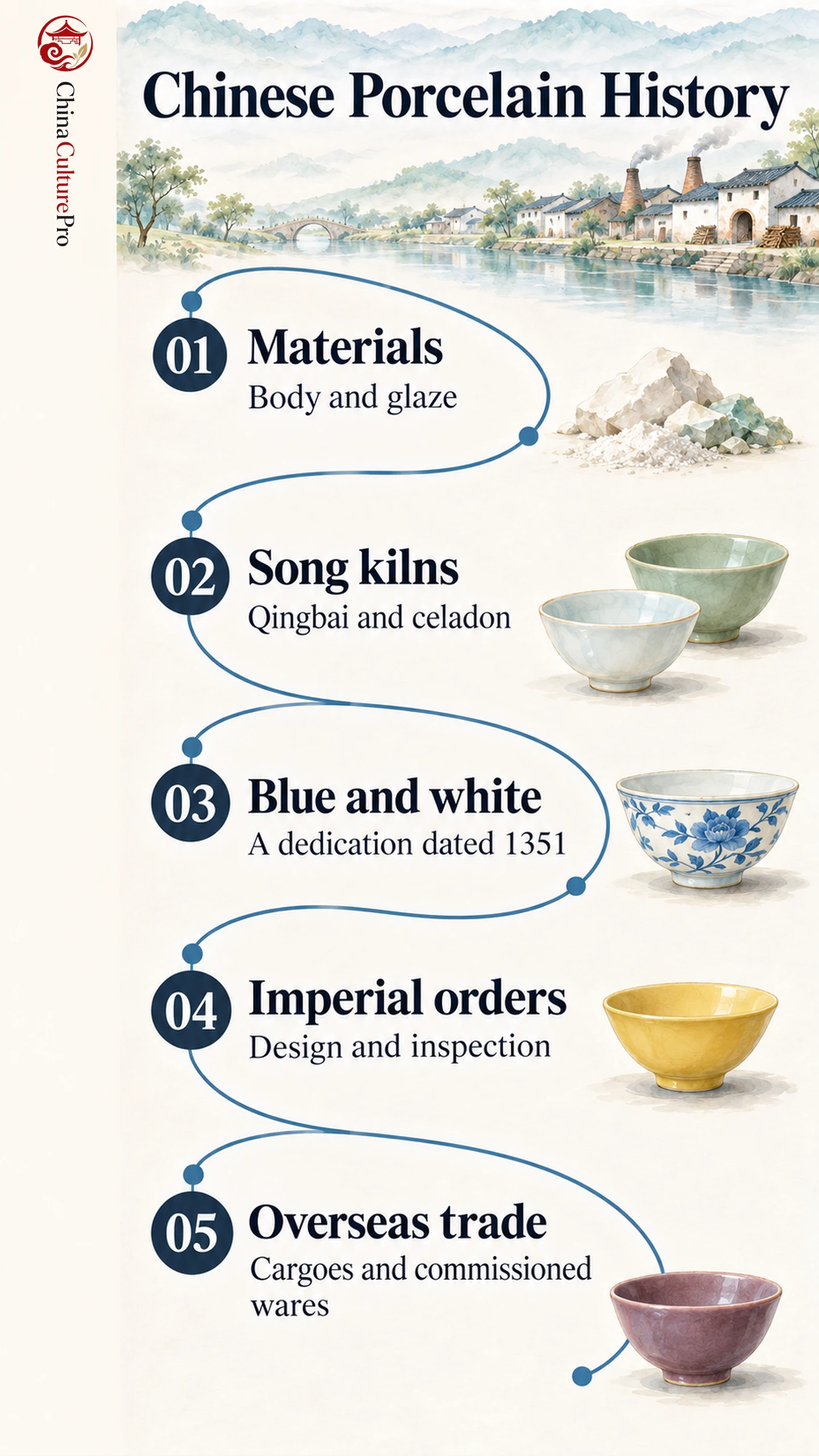
- Materials: The ceramic body and its glaze are different parts of a finished object. Both affect appearance.
- Regional kilns: Song potters made white wares, pale glazed porcelain and green-glazed ceramics in different centers.
- Blue and white: The David Vases carry a 1351 dedication, dating a pair of Yuan cobalt-decorated wares (青花, qīnghuā).
- Trade: Shipwreck cargoes and commissioned tableware show ceramics traveling into different markets.
A dated object establishes what one workshop could make by a certain time. Its inscription or findspot may tell a different part of the story.
A bowl can have a white body, a pale blue glaze and decoration cut into the clay under the glaze. Another vessel can have a similar body and a pattern painted in cobalt. Those differences are central to the history of porcelain among Chinese technologies. The look of the finished object reflects several decisions before it reached a buyer or a court. [1][2][4][6]
What Makes a Ceramic Porcelain?
Porcelain commonly refers to a dense, high-fired ceramic that can be white and translucent when thin. Classification varies. The Chinese word ci (瓷, cí) can include wares classified in English as either porcelain or stoneware. An early date may depend on which material and firing characteristics a researcher uses as the definition. [1]
The body is the material shaped into a bowl, dish or other vessel. The glaze is the coating fused to its surface during firing. In northern China, some potters worked with materials rich in kaolin. Southern producers could use porcelain stone. At Jingdezhen, a body could combine kaolin with porcelain stone. Other centers used different combinations or relied on different raw materials. [1]
Song Kilns and Different Ceramic Traditions
A Smithsonian bowl dated to the second half of the twelfth century comes from Jingdezhen. It has a thin white body and a pale transparent qingbai (青白, qīngbái) glaze. Its ornament was cut into the body and remains visible beneath the surface. The bowl shows that Jingdezhen produced a pale, incised ceramic during the Southern Song. The incised lines and translucent glaze create a visual effect distinct from painted cobalt. [2][4]
Longquan (龙泉, Lóngquán) in Zhejiang provides a different kiln tradition. UNESCO describes how makers of Longquan celadon control firing to develop the appearance of a green or blue-green glaze on a stoneware body. The qingbai bowl and Longquan wares show why color alone is a poor guide to the body or category of a piece. [1][2][3]
Jingdezhen and the Rise of Blue and White
In blue and white (青花, qīnghuā), cobalt decoration typically appears beneath a clear glaze. The Victoria and Albert Museum traces examples of blue-and-white ceramics back to the Tang, when some had a coarser, greyer body. Yuan Jingdezhen wares reflect later changes in materials and firing. The British Museum’s David Vases were made at Jingdezhen under the Yuan dynasty. Their inscriptions record a dedication in 1351 to a Daoist temple. That date shows that the technique was well established by then and identifies a particular temple offering. [4][8]
A Yuan plate with fish in the Met offers a closer look at the material. The museum notes dark areas where cobalt concentrated during firing. Those areas show how a pigment could behave in the kiln. The appearance of blue and white was shaped by how potters painted, glazed and fired a vessel. [5]
Imperial Orders and Kiln Evidence
Under the Ming and Qing, imperial kilns produced wares for the court. The Palace Museum describes official designs, inspections and the destruction of pieces that failed to meet a standard. Accepted pieces went to the palace. Archaeological finds at Jingdezhen help study the production side of a system connected to the imperial court. [6]
A completed vessel in a court collection can show what was accepted. Pieces recovered from kiln contexts can show what was made and discarded. The comparison gives a fuller picture of the steps between design and delivery. Commercial kilns and export markets had other customers and requirements. [1][6][8]
How Ceramics Moved Through Global Trade
The Sinan wreck, which sank off Korea in 1323 while en route from Ningbo to Japan, carried many Longquan wares. The National Museum of Korea uses the cargo to study trade and the forms of ceramics in circulation. A wreck provides evidence of transport through the maritime trade network. Its findspot records where the vessel sank, while study of the cargo can reveal where particular goods were made. [7]
In European trade, the V&A describes blue-and-white Kraak dishes and later Chinese pieces made in shapes that appealed to overseas buyers. A plate in the Met made for the Verplanck family of New York has European-style decoration. The museum points out that the design resembles European porcelain and could suggest a different destination. Its history in the Verplanck family connects it to a New York household. Export porcelain is therefore also evidence of commercial relationships between workshops, traders and customers. [8][9]
FAQs About Chinese Porcelain History
Was all Chinese porcelain blue and white?
Chinese porcelain includes pale glazed qingbai, white wares and many other types. Blue and white is one category based on a particular form of decoration.
When did blue-and-white porcelain appear in China?
Blue-and-white ceramics are documented as early as the Tang. The 1351 dedication on the David Vases gives a secure date by which the refined porcelain was well established at Jingdezhen.
Was all Jingdezhen porcelain made for the emperor?
Jingdezhen supplied the court and other buyers. Imperial wares were made under particular controls, while commercial production included goods for domestic and export markets.
Sources
[1] Smarthistory. Chinese Porcelain: Production and Export
[2] Smithsonian National Museum of Asian Art. Qingbai Ware Bowl With Incised Decoration
[3] UNESCO Intangible Cultural Heritage. Traditional Firing Technology of Longquan Celadon
[4] British Museum. Chinese Ceramics Gallery Guide: The David Vases
[5] Metropolitan Museum of Art. Plate With Fish
[6] The Palace Museum. Porcelain From the Ming and Qing Dynasty Imperial Kilns
[7] National Museum of Korea. Tea, Incense, and Carrying the Soul: Longquan Ware From the Sinan Wreck
[8] Victoria and Albert Museum. Chinese Blue-and-White Ceramics
[9] Metropolitan Museum of Art. Plate, Chinese, for American Market