

Quick Answer: What Was Chinese Merchant Culture?
Chinese merchant culture grew around the practical work of trading away from home. Traders formed partnerships, built associations, found ways to move money and dealt with different rules in different markets.
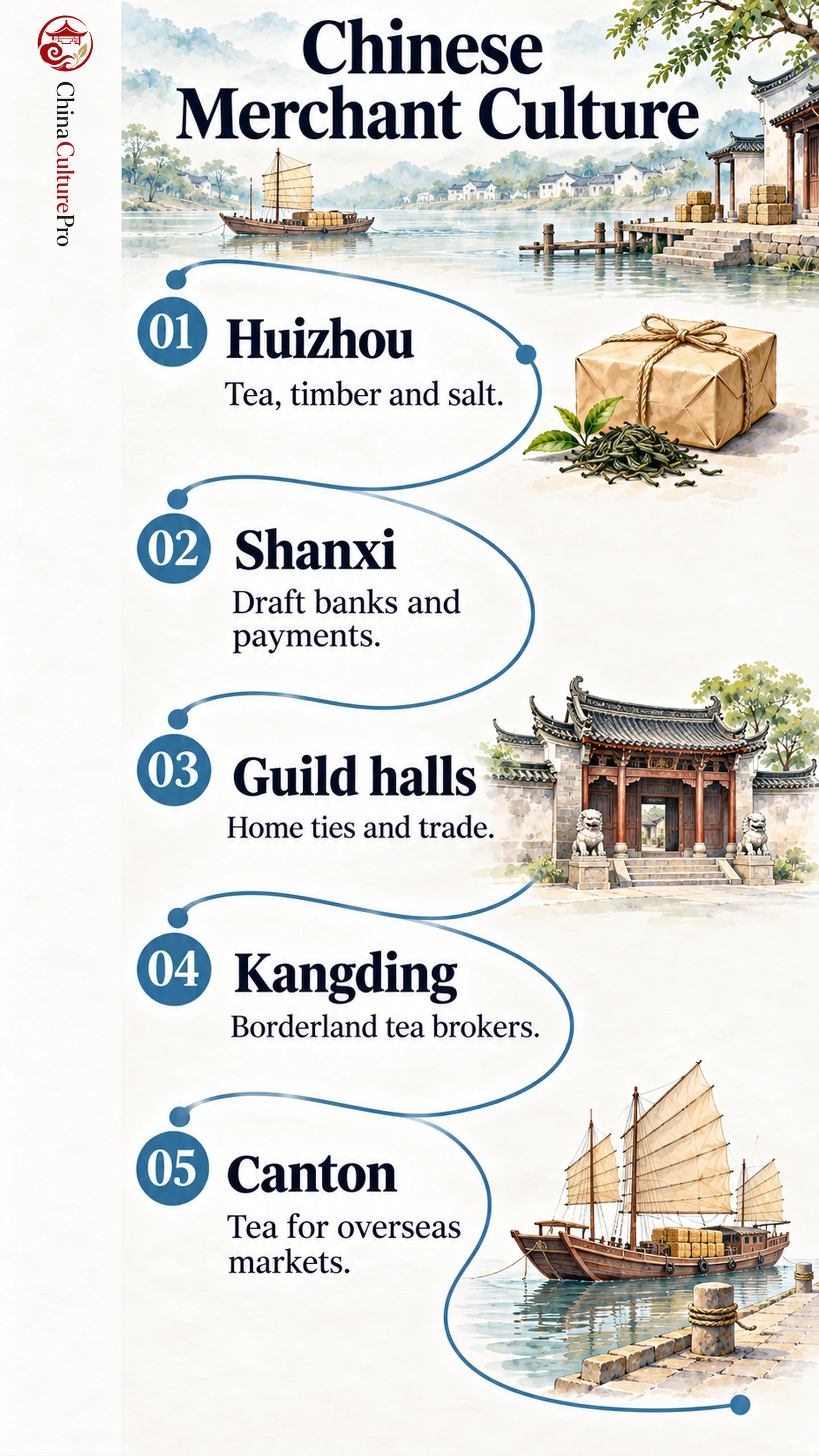
- Goods: Huizhou (徽州, Huīzhōu) traders moved from tea and timber into salt networks centered on places such as Yangzhou.
- Payments: Shanxi (山西, Shānxī) draft banks let customers settle payments between cities through branches.
- Associations: Native-place halls and trade associations brought merchants together, sometimes to arrange lodging, coordinate business or support local activities.
- Regulation: Salt privileges, border trade and access to foreign markets shaped what traders could sell and how.
The details below center on the Ming and Qing periods. Goods, customers and rules varied by route, date and place.
A salt trader in Yangzhou, a draft bank manager in Pingyao and a tea broker in Kangding solved different problems. Their businesses depended on different institutions, from family firms to bank branches and inns that brokered sales. In Chinese history, the buildings and records of those businesses show how a trade could stretch beyond one family, city or province. [1][2][3][5][6]
Huizhou Merchants: From Regional Goods to the Salt Trade
During the Ming dynasty, merchants from the mountainous Huizhou prefecture traded goods such as timber and tea. Some went into the salt business in Yangzhou and other commercial cities. Shanxi merchants had also traded salt in Yangzhou. Over the sixteenth century Huizhou firms gained a stronger position there and in other parts of the lower Yangtze region. “Huizhou merchant” identified where a person’s network began, even when the business operated in another region. [1]
Kinship could help a trader find funds and partners. Historian Joseph McDermott’s studies of Huizhou house firms show how branches of families pooled lineage and business resources. The size and structure of those firms varied. Merchants also reached beyond direct descent ties when they needed partners. A family label can therefore tell only part of the history of a particular firm. [2]
Shanxi Merchants and the Business of Moving Money
By the nineteenth century, Shanxi merchants were prominent in finance as well as trade. The Rishengchang firm at Pingyao developed from a dyed-goods business with shops in several cities. Its managers saw a way to settle accounts across those locations with fewer costly shipments of silver. Economic historians Randall Morck and Fan Yang use 1823 as the likely founding year for the draft bank. The date varies in other accounts. [3]
A draft bank, or piaohao (票号, piàohào), used a network of branches. A buyer could deposit money at one branch and arrange for the seller to receive funds elsewhere. In one procedure, one half of a draft went to the seller and the other to the branch that would pay. Bringing the halves together after delivery allowed the branch to settle the account. The bank still needed to keep accounts and deal with differences in the units or purity of silver used in different places. This is one connection between the history of merchants and Chinese currency history. [3]
What Guild Halls Did for Merchants Away From Home
A huiguan (会馆, huìguǎn) commonly gathered people from the same place. A gongsuo (公所, gōngsuǒ) was more often associated with an occupation or trade. Historians often call such bodies guilds in English. Their rules and membership varied by city, and each Chinese term points to a different basis for association. A hall could provide lodging or a meeting place, while an association using it might coordinate business. Some halls in Beijing served people who came on official business or for study and examinations. [4]
At Zigong in Sichuan, salt merchants from Shaanxi (陕西, Shǎnxī) built the Xiqin Guildhall between 1736 and 1752. Shaanxi was a different place of origin from Shanxi, home of the Pingyao draft banks. The hall later became home to Zigong’s salt industry museum. The building links a particular group of migrants to the region’s salt economy. Other halls trace different routes of Chinese migration. [4][5]
Two Tea Trades With Different Rules
On the Tea Horse Road, tea from the Sichuan area passed through centers such as Dartsedo, now Kangding. In the eighteenth century, local Khampa innkeepers there brokered exchanges between Chinese tea merchants and Tibetan wholesalers. A trader’s ability to reach customers depended on local intermediaries and relationships, as well as transport. [6]
Canton, now Guangzhou, linked tea and other exports to overseas buyers under a different system. In 1757 the Qing court made Canton the designated port for regular Western maritime trade under Qing supervision. Tea caddies in the Hong Kong Maritime Museum depict the foreign trading houses on its waterfront. Those images are evidence of how the trade was pictured for customers abroad. They complement accounts of regulations and crises, including Lin Zexu’s suppression of the opium trade at Canton in 1839. [7][8][9]
How to Read the Material Record of Merchant Life
The Xiqin Guildhall stands in Sichuan, but its founding history points back to Shaanxi. A draft can identify the branch that handled a payment and the silver unit it used. A decorated tea caddy can picture a port while reflecting what a customer overseas wanted to see. Before drawing a conclusion about an entire trade, ask who commissioned the object, who used it and which locations it actually connects. [3][4][5][7][9]
FAQs About Chinese Merchant Culture
What is the difference between a huiguan and a gongsuo?
A huiguan often connected people from the same home region. A gongsuo often represented a trade or occupation. Local membership and functions could overlap.
Were Huizhou and Shanxi merchants in the same trades?
Some competed in salt markets. Over time, merchants from both places worked in several trades, and Shanxi firms became particularly associated with draft banking in the nineteenth century.
What did a Shanxi draft bank do?
It could receive money in one city and arrange payment in another through its branches. Some banks also handled deposits, lending and exchange.
Sources
[1] Cambridge University Press. Chinese Diasporas: Early Modern Patterns
[2] Joseph P. McDermott. Huizhou House Firms: The Binds of Kinship and Commerce
[3] Randall Morck and Fan Yang. The Shanxi Banks
[4] Christine Moll-Murata. Chinese Guilds from the Seventeenth to the Twentieth Centuries
[5] Zigong UNESCO Global Geopark. Xiqin Guildhall
[6] Oxford Research Encyclopedia of Asian History. The Sino-Tibetan Borderlands
[7] Hong Kong Maritime Museum. Canton Trade
[8] Hong Kong Government. Hong Kong Yearbook: History
[9] MIT Visualizing Cultures. The Rise and Fall of the Canton Trade System