


Quick Answer: What Was the May Fourth Movement?
The May Fourth Movement (五四运动, Wǔsì Yùndòng) began with a student demonstration in Beijing on May 4, 1919. The students protested plans at the Paris Peace Conference to transfer former German rights in Shandong to Japan. The protest grew into a wider campaign involving students, merchants and workers.[1][2][4][5]
- The trigger: The settlement concerned Germany’s former lease and related rights in Shandong.[2]
- The spread: The campaign moved from student demonstrations to boycotts, strikes and shop closures.[4][5]
- Cultural change: In a broader usage, May Fourth also names an era of literary experimentation and debate over education and social life.[7][8][9][10]
The Beijing demonstration, the wider 1919 campaign and the cultural era have distinct timelines.[3][5][7]
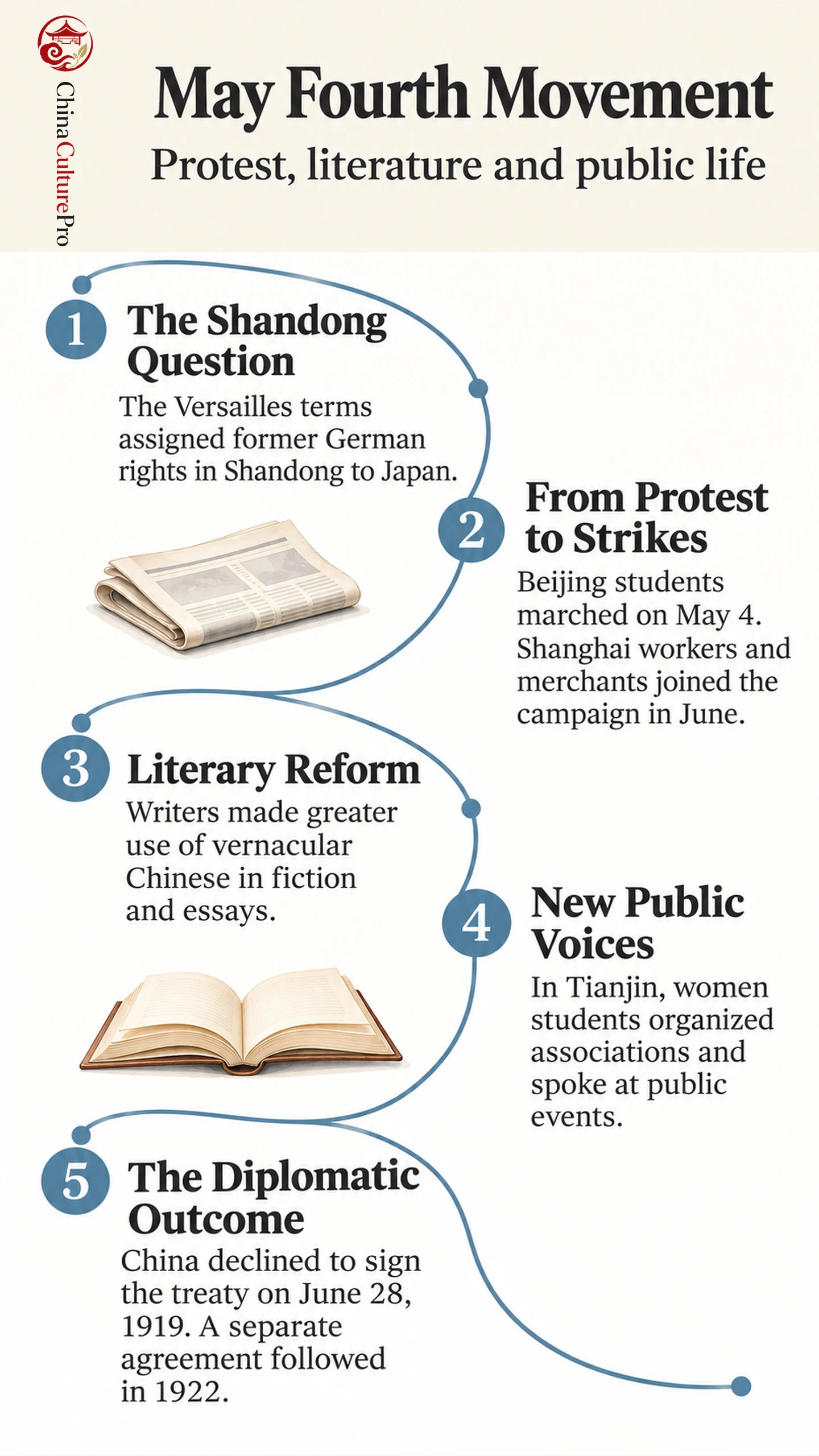
Students used public speeches and newspapers to challenge a diplomatic settlement. Writers of the same era used new literary forms to ask what should change in society.[3][7][9][10]
Why the Shandong Question Sparked Protests
The Shandong question (山东问题, Shāndōng Wèntí) concerned what would happen to rights Germany had acquired in China before World War I. In 1898, Germany acquired a lease on territory around Jiaozhou Bay (胶州湾, Jiāozhōu Wān), including the area around Qingdao, and secured related privileges. Japanese forces captured the German-held port in 1914. Chinese negotiators, including Wellington Koo (顾维钧, Gù Wéijūn), sought direct restoration of Germany’s former rights to China.[1][2][3]
Article 156 of the Treaty of Versailles called for Germany to give up its rights in favor of Japan. The terms named the leased territory and interests in railways, mines and submarine cables. A railway concession affected the movement of goods well beyond the port. That made the scope of the settlement an issue of political authority as well as territory.[2][3][6]
Chinese delegates and their allies used press coverage and public discussion to build support for their position. Reports about the talks reached readers in China, and telegrams and petitions carried reactions back toward the government and the delegation. Diplomats could point to public sentiment as a reason to resist a concession. Readers and associations could use the same channels to press those diplomats and the government.[3][6]
From May 4 to the June Strikes
On May 4, students from multiple Beijing schools gathered near Tiananmen and marched. They challenged the proposed settlement and criticized officials they held responsible. Some protesters went to the residence of Cao Rulin (曹汝霖, Cáo Rúlín), where a fire broke out. Police arrested 32 students. Student groups pressed for the release of those arrested.[1][4][5][12]
Pressure spread beyond Beijing. In early June, renewed repression of students in the capital and the spread of strike action gave the campaign a wider base. On June 5, Shanghai workers struck and merchants closed shops. The boycott of Japanese goods gave people another way to participate. School groups could call students out of class. The involvement of merchants and workers added shop closures and work stoppages to the campaign.[4][5][12]
The Beijing government eventually removed Cao and two other officials targeted by protesters. On June 28, the Chinese delegation stayed away from the signing of the Treaty of Versailles. In 1922 a separate agreement between China and Japan provided for the restoration of the former German leased territory, with detailed terms for the railway and other property.[2][4][6][11]
New Culture and Vernacular Literature
The New Culture Movement (新文化运动, Xīn Wénhuà Yùndòng) included debates about literature and education before the May 4 demonstration. In 1917, Hu Shi (胡适, Hú Shì) called for writers to put substance into their work, avoid habitual imitation and accept vernacular expressions. Written vernacular Chinese, or baihua (白话, báihuà), already had a long history. Reformers wanted to make it a regular medium for more kinds of writing.[7][8]
Lu Xun (鲁迅, Lǔ Xùn) used vernacular fiction to explore social relations. In My Old Home (故乡, Gùxiāng), the narrator returns to his home region and meets a childhood friend. The friend addresses him with the deference expected across a class boundary. That change in the relationship lets the reader feel social distance through a few words of dialogue. This is one way that modern Chinese literature made everyday encounters carry a wider argument.[7][9]
Students, Women and Public Debate
In Tianjin, Deng Yingchao (邓颖超, Dèng Yǐngchāo) was a fifteen-year-old student at a women’s teacher-training school when the movement began. She and fellow students helped organize demonstrations and the Society of Tianjin Women Patriots. They used speeches, newspapers and public performances to address people beyond their school.[10]
Women activists also linked their public work to questions about schooling, arranged marriage and access to spaces and institutions divided by gender. The associations and public events gave women a place to discuss questions that also mattered inside schools and families.[7][10]
What the Movement Changed
In the short term, the protests increased the political costs of accepting the Versailles settlement and showed how coordinated action could spread between cities. The diplomatic dispute required further negotiation. In the longer term, the campaign offered a precedent for organizing through schools, workplaces, print and consumer action.[3][5][6][11]
The broader May Fourth era is also remembered for arguments about how to write, educate and participate in public life. Its participants pursued several different reforms and political paths. The cultural history of Republican China follows those debates into a later world of film, magazines and regional education projects.[5][7][9][10][12]
FAQs About the May Fourth Movement
Why did students protest on May 4, 1919?
They opposed the decision at the Paris Peace Conference to transfer former German rights in Shandong to Japan. They also criticized Chinese officials whom they held responsible for the government’s position.[1][2][4]
Did China sign the Treaty of Versailles?
The Chinese delegation declined to sign on June 28, 1919. The Shandong issue continued through later diplomacy and was addressed in a separate treaty with Japan in 1922.[2][6][11]
How was May Fourth related to the New Culture Movement?
The New Culture Movement included literary and social debates that began before May 1919. The student protests and their aftermath brought some of the same publications, students and ideas into a wider political campaign. The name May Fourth can refer to the protest campaign or to the broader cultural era.[3][7][8][12]
Sources
[1] The National Archives. May Fourth Movement, 1919
[2] U.S. Department of State. Treaty of Versailles: Shantung
[3] Modern Asian Studies. The Making of Public Opinion at Versailles
[4] Peking University. A Brief History of the May Fourth Movement
[5] The China Quarterly. An Eventful Account of the May Fourth Movement
[6] Journal of Global History. China and the Limits of International Law, 1919–1929
[7] Columbia University. Before and After the May Fourth Movement
[8] Columbia University. Hu Shi’s Preliminary Discussion of Literary Reform
[9] Columbia University. Lu Xun’s My Old Home
[10] Wang Zheng, University of Michigan. Deng Yingchao and the Women’s Movement
[11] U.S. Department of State. 1922 Shandong Treaty Between China and Japan
[12] Modern Asian Studies. The May Fourth Movement Redefined