
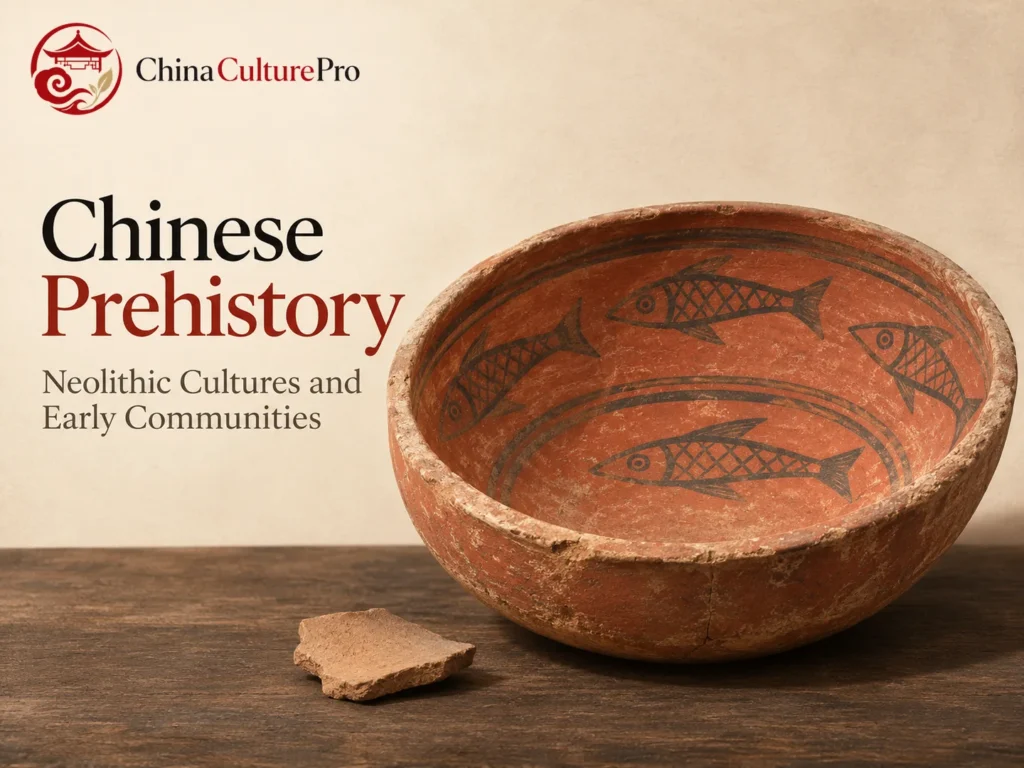

Quick Answer: What Was Chinese Prehistory?
Chinese prehistory covers the long span of human activity in what is now China before extensive surviving written records. Stone tools and fossils document early occupation. Later settlements, ceramics, burials and plant remains preserve evidence of how communities lived.[1][2][5][13]
- Early occupation: Stone tools on the Loess Plateau have been dated to about 2.1 million years ago.[1]
- Neolithic communities: People cultivated crops, built settlements and developed distinctive pottery and woodworking traditions in different regions.[5][6][9][10][11][15]
- Material evidence: The context of an object can show how it was used, deposited or associated with other objects.[4][7][10]
Prehistoric lifeways changed at different times and speeds from one region to another.[5][11]
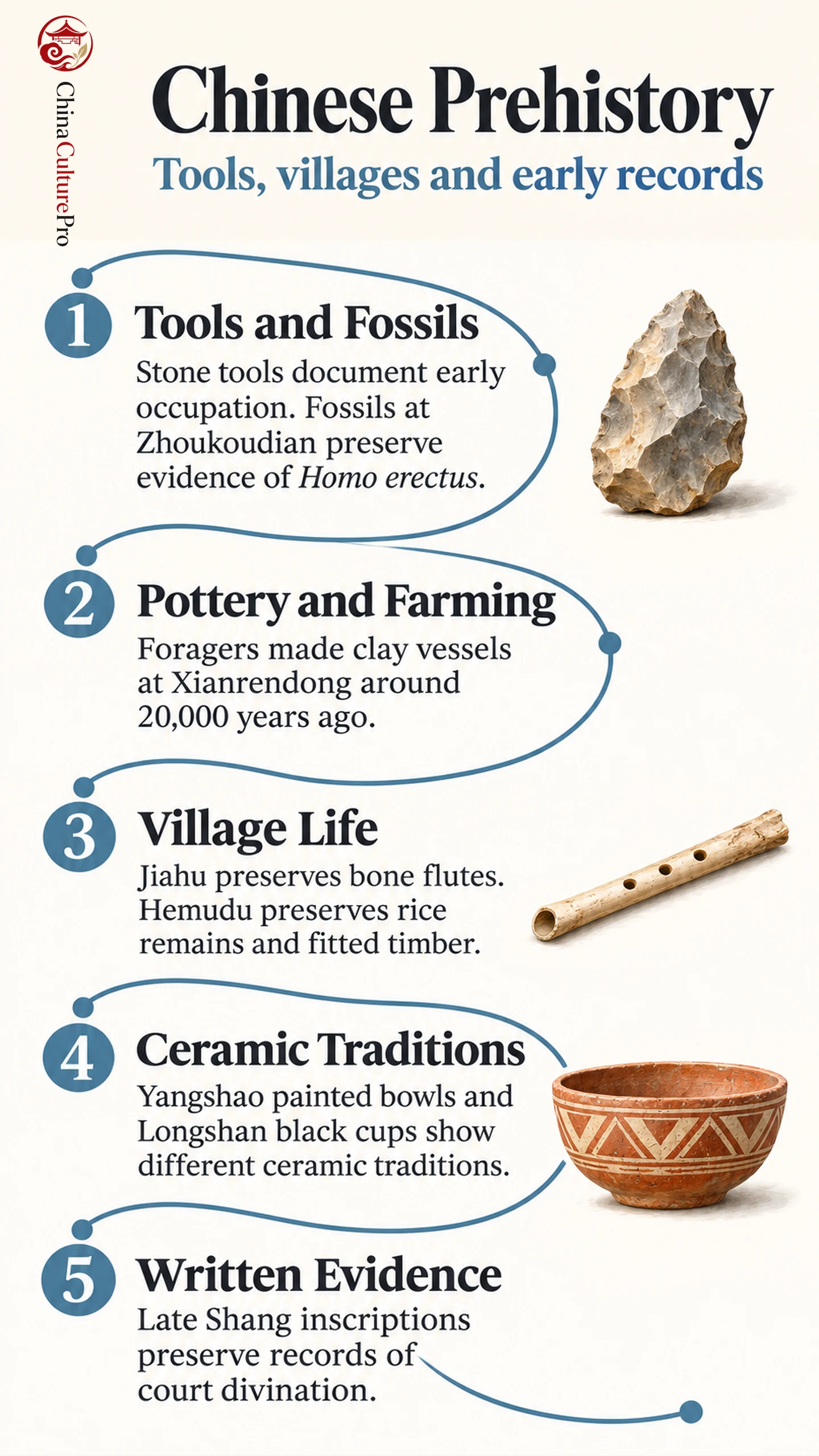
A stone tool, a bone flute and a painted basin have each survived for thousands of years. The layer, settlement or burial where each object was found gives archaeologists part of its history.[1][7][10]
Early Humans and the Evidence at Zhoukoudian
At Shangchen (上陈, Shàngchén), in present-day Shaanxi, stone artifacts were reported from layers that reach back about 2.12 million years. Researchers related the deposits to known changes in Earth’s magnetic field. The positions of stone flakes and other artifacts within that sequence helped them estimate when people were present. The worked stone is evidence of early hominins in the area. Identifying the makers to species would require a different kind of evidence.[1]
At Zhoukoudian (周口店, Zhōukǒudiàn), near Beijing, researchers found fossils assigned to Homo erectus and known as Peking Man (北京人, Běijīng Rén), as well as stone artifacts. One study dated quartz-bearing deposits and artifacts from lower levels of the main site to about 770,000 years ago. The method estimates how long minerals were buried. That date applies to particular lower levels at a site occupied over a long period.[2][3]
Pottery, Farming and Settled Life
Fragments of pottery from Xianrendong (仙人洞, Xiānrén Dòng) in Jiangxi came from layers dated to about 20,000 years ago. The context indicates that the people who made the vessels lived by foraging. The site shows that a community could make containers from fired clay thousands of years before farming became established in its region.[4]
At Shangshan (上山, Shàngshān) in Zhejiang, microscopic residues in roughly 10,000-year-old pottery show how vessels could be used to process plants. Researchers identified rice and interpreted some residues as evidence of fermentation. A sherd can preserve both a trace of what people put in the vessel and evidence of how they shaped it.[6]
In parts of northern China, millet became a major food over time. Researchers can compare plant remains with chemical evidence of what people ate to distinguish crop use from a diet that regularly depended on the crop. Food production could also coexist with hunting, fishing and gathering. A community’s diet depended on what it could grow and what it could obtain in the surrounding landscape.[5][11][15]
Jiahu and Hemudu in Daily Life
Jiahu (贾湖, Jiǎhú), in Henan, was occupied around 7000–5700 BCE. The site yielded flutes made from crane wing bones, including instruments deposited in burials. One intact instrument was still playable. Across the surviving flutes, the number of holes varies. They document how makers shaped a bird bone into an instrument capable of producing different notes.[7][8]
Hemudu (河姆渡, Hémǔdù), in present-day Zhejiang, preserves a different set of clues. Remains of rice document food production, and wooden components provide evidence of raised buildings. Pieces of timber preserve mortise-and-tenon joints, in which a shaped end fits into a matching opening. Such pieces let researchers see how builders assembled wooden structures. The survival of wood at the site makes this aspect of construction easier to study than at sites where only traces of posts remain.[5][9][17]
Yangshao and Longshan Pottery
Yangshao (仰韶, Yǎngsháo) is associated with Neolithic communities in parts of the middle Yellow River region. A painted basin associated with Banpo (半坡, Bànpō), near present-day Xi’an, has dark fish and human-face designs on its red interior. The pigment, repeated pattern and placement inside the bowl are visible evidence. Excavators found similarly painted bowls used as covers for children’s burial jars. That context is evidence of one use of these vessels. The meaning of the fish and face designs remains open to interpretation.[10][11]
Some later Longshan (龙山, Lóngshān) sites are known for finely finished black pottery. A tall-stemmed cup attributed to the Longshan tradition in Shandong illustrates a different approach to vessel shape. Some especially thin examples are described as eggshell pottery. The contrast with the painted basin is a starting point for comparing Yangshao and Longshan cultures. Both labels cover sites with varied objects, from coarse vessels to more carefully finished forms.[5][11][16]
Where Prehistory Meets Written History
Later Neolithic sites preserve evidence of larger construction projects and more differentiated burials. Liangzhu (良渚, Liángzhǔ), near the lower Yangtze, has earthen monuments, a water management system and graves with different furnishings. Other communities developed their own traditions, including the distinctive jades associated with Hongshan (红山, Hóngshān) in the northeast.[5][11][12]
Erlitou (二里头, Èrlǐtóu), in Henan, is a later Bronze Age center. Buildings and workshops tell archaeologists about the layout of the settlement and the organization of craft production. By the late Shang dynasty (商朝, Shāng Cháo), inscriptions on oracle bones (甲骨, jiǎgǔ) at the capital near Anyang preserve written records of royal divination. An inscribed bone can preserve the wording of an inquiry made during divination. The difference between a village deposit and a royal archive helps explain why the kinds of questions historians can ask change in the study of the origins of Chinese civilization.[13][14]
FAQs About Chinese Prehistory
How old is the earliest evidence of humans in what is now China?
Among the earliest reported evidence are stone artifacts from deposits at Shangchen dated to about 2.12 million years ago. These tools document the activity of hominins. The specific identity of the makers is uncertain.[1]
Did pottery appear before farming?
Yes. At Xianrendong in Jiangxi, pottery was recovered from layers about 20,000 years old and associated with foragers. The first dates for pottery and farming differ from region to region.[4][5]
What is the difference between Yangshao and Longshan pottery?
Painted designs on reddish earthenware are characteristic of many Yangshao objects. Longshan sites include fine black wares, among them thin-walled cups. Both archaeological labels include a broader range of vessels than those examples.[5][10][11][16]
Sources
[1] Nature. Early Hominin Occupation of the Chinese Loess Plateau
[2] UNESCO World Heritage Centre. Peking Man Site at Zhoukoudian
[3] Nature. Burial Dating of Zhoukoudian Homo erectus
[4] Science. Early Pottery at Xianrendong Cave
[5] Smithsonian National Museum of Asian Art. Neolithic Period
[6] Proceedings of the National Academy of Sciences. Rice Processing and Fermentation at Shangshan
[7] Nature. Playable Bone Flutes from Jiahu
[8] The Metropolitan Museum of Art. Jiahu, about 7000 to 5700 BCE
[9] Zhejiang Provincial Government. Hemudu Cultural Site Museum
[10] National Museum of China. Painted Pottery Basin with Fish and Human Face Design
[11] The Metropolitan Museum of Art. Neolithic Period in China
[12] UNESCO World Heritage Centre. Archaeological Ruins of Liangzhu City
[13] UNESCO World Heritage Centre. Yin Xu
[14] Cambridge University Press. Erlitou and Erligang
[15] American Journal of Physical Anthropology. The Earliest Evidence of Millet as a Staple Crop
[16] Smithsonian National Museum of Asian Art. Longshan Stem Cup
[17] Beijing Municipal Government. National Museum Exhibition on Hemudu Culture