


Quick Answer: What Was Liangzhu Culture?
Liangzhu culture (良渚文化, Liángzhǔ Wénhuà) was a late Neolithic archaeological culture of the lower Yangtze region. Its best-known site, near present-day Hangzhou, preserves the remains of a walled settlement, waterworks and cemeteries dating to about 3300–2300 BCE.[1][2]
- City and dates: Earthen walls and a large central platform mark a major center in the Lake Tai region.[1][2]
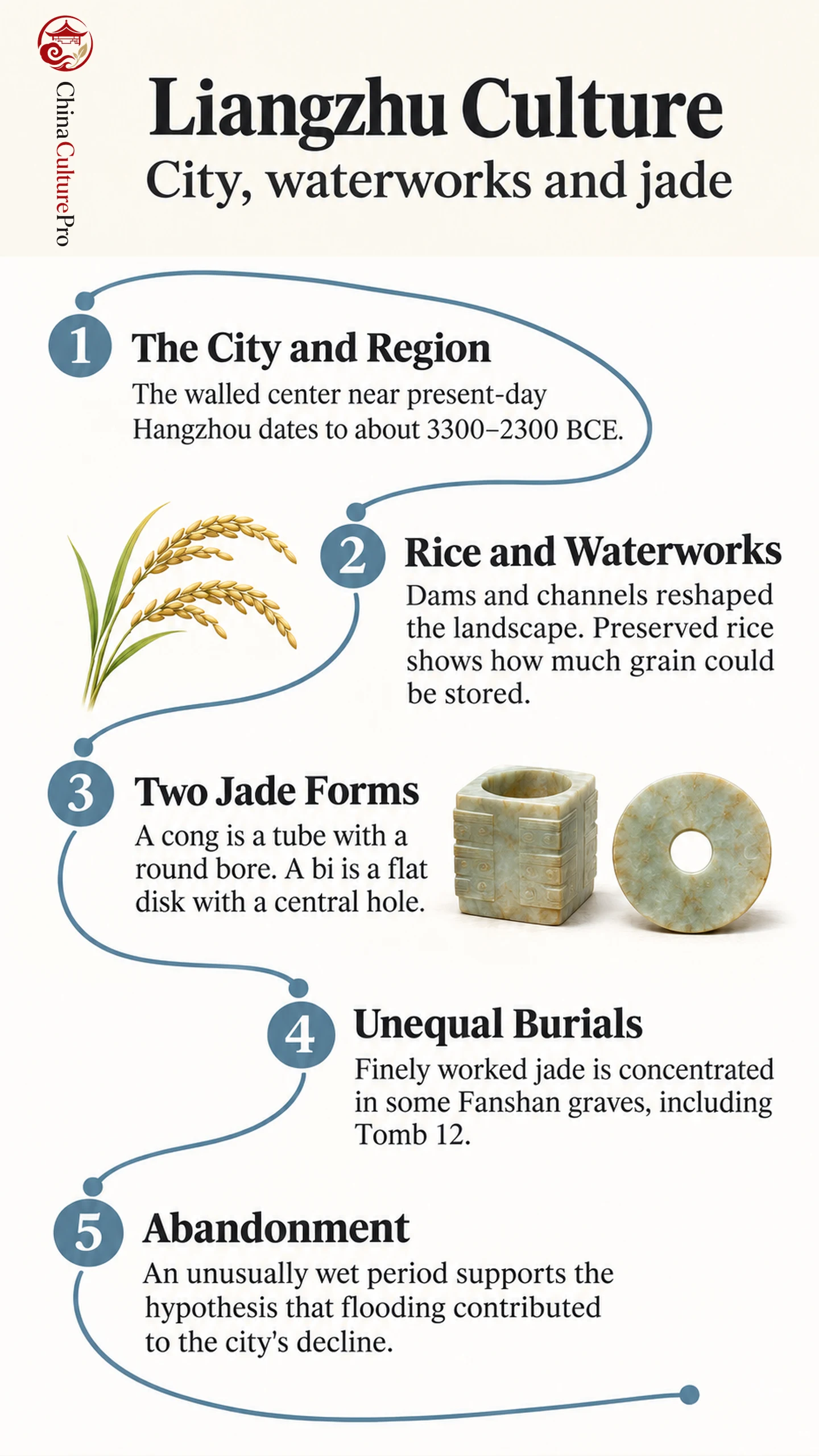
- Water and rice: Dams and channels altered the landscape, and preserved rice documents the scale of food production and storage.[3][9]
- Jade and burials: Carefully worked jades were concentrated in some graves, giving archaeologists evidence of differences in wealth, rank and ceremony.[2][4][5][8]
Liangzhu is often described as an early regional state on the basis of its built landscape and social organization.[1][2][3]
A polished jade tube and a bundle of grass used to build a dam preserve different parts of Liangzhu’s history. Both help explain the kinds of skilled work that took place around the city.[3][4][6]
Where and When Liangzhu Flourished
Liangzhu City (良渚古城, Liángzhǔ Gǔchéng) lay in the lower Yangtze basin near present-day Hangzhou in Zhejiang. The site sits on a plain crossed by rivers, near the foothills west of Hangzhou. Archaeologists use Liangzhu as the name of both the city site and a wider material culture identified across the region. The dates of about 3300–2300 BCE give the broad span of the archaeological property.[1][2]
The central site includes a raised earthen platform at Mojiaoshan (莫角山, Mòjiǎoshān). Its position and size have led researchers to interpret it as the likely setting for high-status buildings. Archaeologists can trace where the central buildings stood and how they related to the rest of the settlement. Details of the buildings above the platform are harder to reconstruct.[1][2][8]
In 2019, UNESCO inscribed the Archaeological Ruins of Liangzhu City on the World Heritage List. The protected property includes four areas: the city site, Yaoshan (瑶山, Yáoshān), the high-dam area at the mouth of a valley and the low-dam area on the plain. Their separation helps explain how far organized construction extended beyond the city walls.[1]
Rice, Dams and Waterways
Builders constructed dams in valleys and across lower ground and used channels to connect parts of the landscape. Evidence of early construction in the system dates to roughly 5,100 years ago. Excavations preserve practical details, including knotted bundles made from grass plants. The tied grass held sediment together in units that builders could lay in an embankment. The surviving knots preserve evidence of a technique that an outline of the dam alone would miss. The plant material could also be radiocarbon-dated. Most dates for the high dams fall earlier than or overlap those for the low dams and levees, which helps establish a sequence of construction.[3]
The layout suggests several uses for the network, including water storage, flood control, access to fields and transport. Archaeologists infer those roles from the position of the dams, channels and other features in relation to farmland and the city. The system could help support intensive rice farming and the movement of supplies. It also required people to coordinate labor across several construction sites. Stone in the bases of the city walls has been traced to mountains north of the settlement. The rock source and the downstream route illustrate how waterways could move heavy building material into the city.[1][2][3]
At eastern Mojiaoshan, researchers estimated that roughly 10 to 15 metric tons of preserved rice were recovered from a storage pit. Samples of charred grains from the site have also been examined for differences among rice types. These finds document the scale at which grain could accumulate at a center, although they leave open who controlled it or how farmers brought it there.[3][9]
Jade Cong and Bi
A cong (琮, cóng) is a jade tube with a circular bore and a usually square outer cross-section. Some examples have stylized faces carved across their corners. One tall nephrite example dated to around 2400 BCE has rows of small faces with round eyes and bar-shaped mouths. A shorter one-tier example preserves the same broad relationship between the opening, outer faces and corner motifs.[4][6]
A bi (璧, bì) is a flat disk with a circular opening. Nephrite was used for both forms, and their surfaces show extensive shaping and polishing. The shape makes the two objects easy to distinguish in a collection. Their excavation contexts add evidence of how people deposited them with the dead.[2][4][5][6]
Burials and Social Organization
The cemetery at Fanshan (反山, Fǎnshān), near the central platform, contained graves with finely worked jades and other objects. Some were furnished much more richly than others. Tomb 12, for example, contained a particularly large group of objects, most of them jade. The concentration of skilled work in one grave is evidence of differences in status and access to valuable material.[2][8]
The cemetery and waterworks give different grounds for describing Liangzhu as an early regional state. Differences in burials indicate an unequal distribution of prestige goods. The dams record the coordinated labor needed to alter waterways on a much larger scale. With the central platform and walled settlement, they show institutions capable of bringing resources and work together across a wide area. They leave the names and exact titles of its leaders unknown.[1][2][3]
Why the City Was Abandoned
The city was abandoned around 2300 BCE, near the end of the Liangzhu period. Sediments in the area and regional climate evidence support a role for serious flooding. A study using mineral deposits from caves found an exceptionally wet interval around the time of abandonment. Those deposits record regional conditions, while the sediments at the site help researchers investigate what happened locally.[1][3][7]
Large floods could have inundated fields and settlements despite earlier efforts to manage water. The timing makes floods a plausible contributor. Researchers continue to investigate how the local deposits relate to the wider wet interval. Liangzhu’s trajectory belongs within the wider history of Chinese prehistory and the regional origins of Chinese civilization. Its jades also offer a comparison with the distinct Hongshan tradition in the northeast.[1][2][3][7]
FAQs About Liangzhu Culture
Where was Liangzhu culture located?
It developed in the lower Yangtze region around Lake Tai. The walled archaeological site lies near present-day Hangzhou in Zhejiang. Liangzhu is the name of both the site and a wider archaeological culture.[1][2]
What is a Liangzhu jade cong?
It is a jade tube with a round bore and a generally square exterior. Some examples have carved faces at the corners. Excavated examples from graves help researchers study burial practices and differences in social rank.[2][4][6]
Why was Liangzhu City abandoned?
Evidence of flooding and an unusually wet period supports the hypothesis that inundation helped bring about the city’s abandonment around 2300 BCE. The available evidence leaves room for different local responses and other contributing factors.[1][3][7]
Sources
[1] UNESCO World Heritage Centre. Archaeological Ruins of Liangzhu City
[2] Antiquity. The Emergence of Complex Society in China: Liangzhu
[3] Proceedings of the National Academy of Sciences. Hydraulic Engineering at Liangzhu
[4] The Metropolitan Museum of Art. Liangzhu Jade Cong
[5] The Metropolitan Museum of Art. Liangzhu Annular Jade Disk
[6] Smithsonian National Museum of Asian Art. One-Tier Tube with Masks
[7] Science Advances. Climate and the Decline of Liangzhu
[8] Zhejiang Focus. The Ancient City Archaeological Park
[9] Food Production, Processing and Nutrition. Classification of Rice Grains from Mojiaoshan