
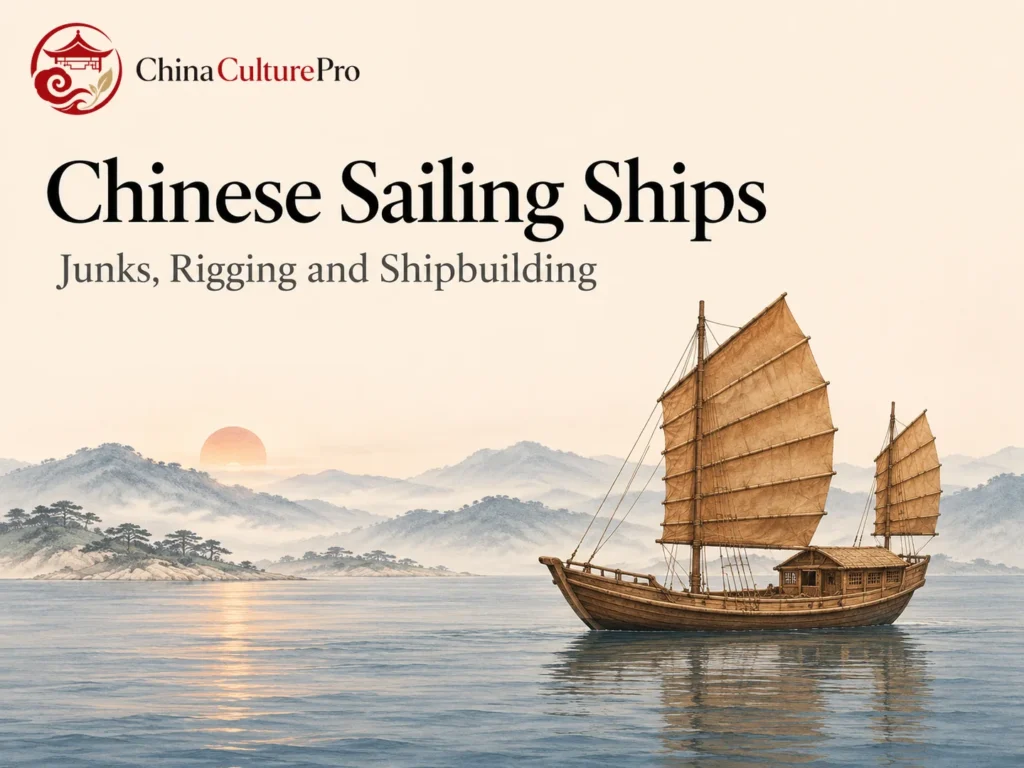

Quick Answer: What Was a Chinese Junk?
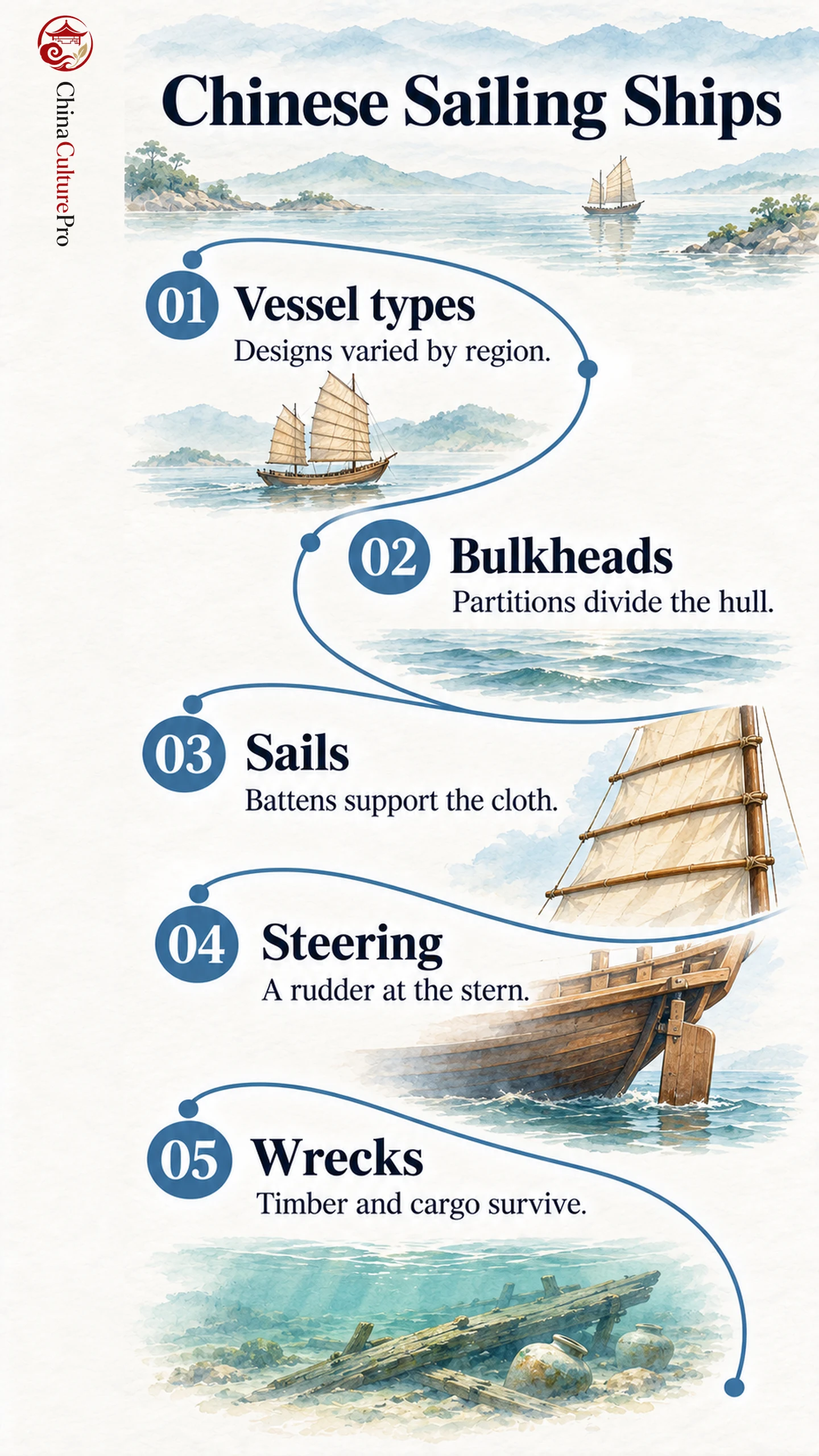
A Chinese junk was one of several kinds of wooden vessel described by that name in English. Regional shipbuilders made different hulls and rigs for different waters and cargoes.
- Hull: Fujian shipbuilders used watertight bulkheads to divide some wooden vessels into compartments.
- Rig: Many examples show sails with horizontal battens that helped support and handle the sail.
- Steering: A rudder at the stern appears on many vessels and models.
- Evidence: A preserved wreck reveals parts of the hull. A model or written description may show details of sails and steering that the wreck no longer preserves.
A single model can illustrate a particular rig. It cannot stand for all boats built along China’s coasts and rivers.
A shipwreck can preserve timber and cargo even when its sails are gone. A museum model can show a sail set above a hull whose original never survived. Read together, those kinds of evidence help tell the history of sailing ships alongside other Chinese technologies. They also show why the English term “junk” covers vessels with different designs. [1][2][3][4][6]
A Name for a Range of Vessels
Museum collections use “junk” for more than one kind of Chinese sailing vessel. Some were built for coastal trade or long sea passages. Others served rivers, harbors or local transport. Hull depth, cargo space and sail arrangements could vary with the setting. The boats share several recurring features, but a label in an English catalogue does not specify one uniform plan. [1][2][6]
Royal Museums Greenwich, for example, catalogues a rigged model as a pole junk and cargo vessel. It shows three masts, hatch openings and two small boats. Its keel, rig and arrangement belong to that particular model. A vessel built for a river or harbor could present a different silhouette and arrangement of working space. [2]
How Bulkheads Divided the Hull
A bulkhead is a partition across the inside of the hull. UNESCO documents a traditional Fujian practice of building vessels with watertight compartments. If water entered one compartment through damage, the sealed partitions could help keep it from spreading into the others. This was a technique for managing the consequences of damage, and its effectiveness depended on how the vessel was built and maintained. [3]
The Song ship excavated near Quanzhou (泉州, Quánzhōu) preserves a large part of a hull. The local museum description reports remains about 24.2 meters long and 9.15 meters wide, with thirteen compartments. These are dimensions of what survives. Lost bow or stern material can change an estimate of the vessel’s full length. A surviving lower hull can show the spaces below deck even when upper sections are missing. The preserved material shows how compartments fit within the hull itself. [4][5]
What Battens, Masts and Rudders Did
Battens are supports that run across a sail. They help maintain its shape and make it possible to handle sections of the sail as it is raised or lowered. The Burke Museum uses historic models to explain this feature. A rig also includes the masts and lines that support and control the sails. The size and number of sails varied with the boat. Stephen Davies also describes changes over time in sail materials, from forms of woven matting to canvas on some vessels. [1][6]
A stern rudder helped steer the vessel. The Greenwich pole junk model has a rectangular rudder and a sail set on each of its three masts. A rudder worked in the water at the stern, while the sail was held and adjusted above the deck. The model shows their relation to the hatches, cabins and working deck of one cargo vessel. [2][6]
How Wrecks Connect Ships to Trade
Quanzhou’s port connected ceramic and iron production sites, docks and inland transport routes during the Song and Yuan. In that setting a ship was one element in a larger trade system. The wreck complements evidence from the city and its surroundings, which show how producers could move goods toward the shore and maritime routes. [4][5][7]
Research on another Song wreck, Nanhai I (南海一号, Nánhǎi Yī Hào), provides a cargo example. Archaeologists in Guangdong compared some ceramics from the wreck with excavated material from two kiln sites in the Foshan area. The results linked part of the cargo to those production sites. Such finds help place a ship within production and distribution networks, a connection also visible in the history of Chinese porcelain and ceramic exports. Cargo origin alone cannot identify where the vessel was built. [8]
What Models and Written Accounts Add
The early twelfth-century writer Zhu Yu (朱彧, Zhū Yù) discusses how sailors worked with winds and sails. He also describes pilots observing the sun and stars and consulting a compass in overcast conditions. The text records knowledge used at sea. His account describes practices at sea. It gives a different kind of evidence from the fitted wood and joints recovered in an excavation. [9]
A medal struck in 1848 shows the Chinese vessel Keying with its mainsail set and commemorates its voyage. The side view is evidence of how the voyage was presented to a British audience. Its inscription celebrates the achievement, so its claims need to be checked against a different kind of record before being used as measurements or historical priorities. A medal, a rigged model and a surviving hull can illuminate different aspects of Chinese shipbuilding, depending on what the reader wants to know. [2][4][6][10]
FAQs About Chinese Sailing Ships
Were all Chinese junks built the same way?
Hulls, rigs and uses varied by region, period and the kind of water the vessels traveled. The English term groups several related designs.
What did watertight bulkheads do?
They separated parts of the hull so that water entering a damaged compartment was less likely to spread to adjacent compartments.
What can a shipwreck tell us about the sails?
A wreck can sometimes preserve rigging parts or their attachment points. Where those are missing, historians can compare models and written descriptions, with attention to their date and origin.
Sources
[1] Burke Museum. Model Chinese Junks Sail On
[2] Royal Museums Greenwich. Cargo Vessel, Junk, Pole Junk
[3] UNESCO Intangible Cultural Heritage. Watertight-Bulkhead Technology of Chinese Junks
[4] ChinaCulture.org. Museum of Ocean Transportation History in Quanzhou
[5] Jeremy Green, Nick Burningham and Museum of Overseas Communication History. The Ship From Quanzhou, Fujian Province
[6] Stephen Davies. East Sails West: The Voyage of the Keying
[7] UNESCO World Heritage Centre. Quanzhou: Emporium of the World in Song-Yuan China
[8] Guangdong Culture and History. Tracing Ceramics From the Nanhai I Wreck to Kilns in Guangdong
[9] Zhu Yu. Pingzhou Table Talks: Volume Two
[10] Royal Museums Greenwich. Medal Commemorating the Chinese Junk Keying