

Quick Answer: How Did Chinese Medicine Change Over Time?
Medicine in China developed through varied practices, texts and institutions. Manuscripts record some early approaches. Later editors compiled influential works, governments organized pharmacies, and twentieth-century institutions standardized parts of the inherited tradition.
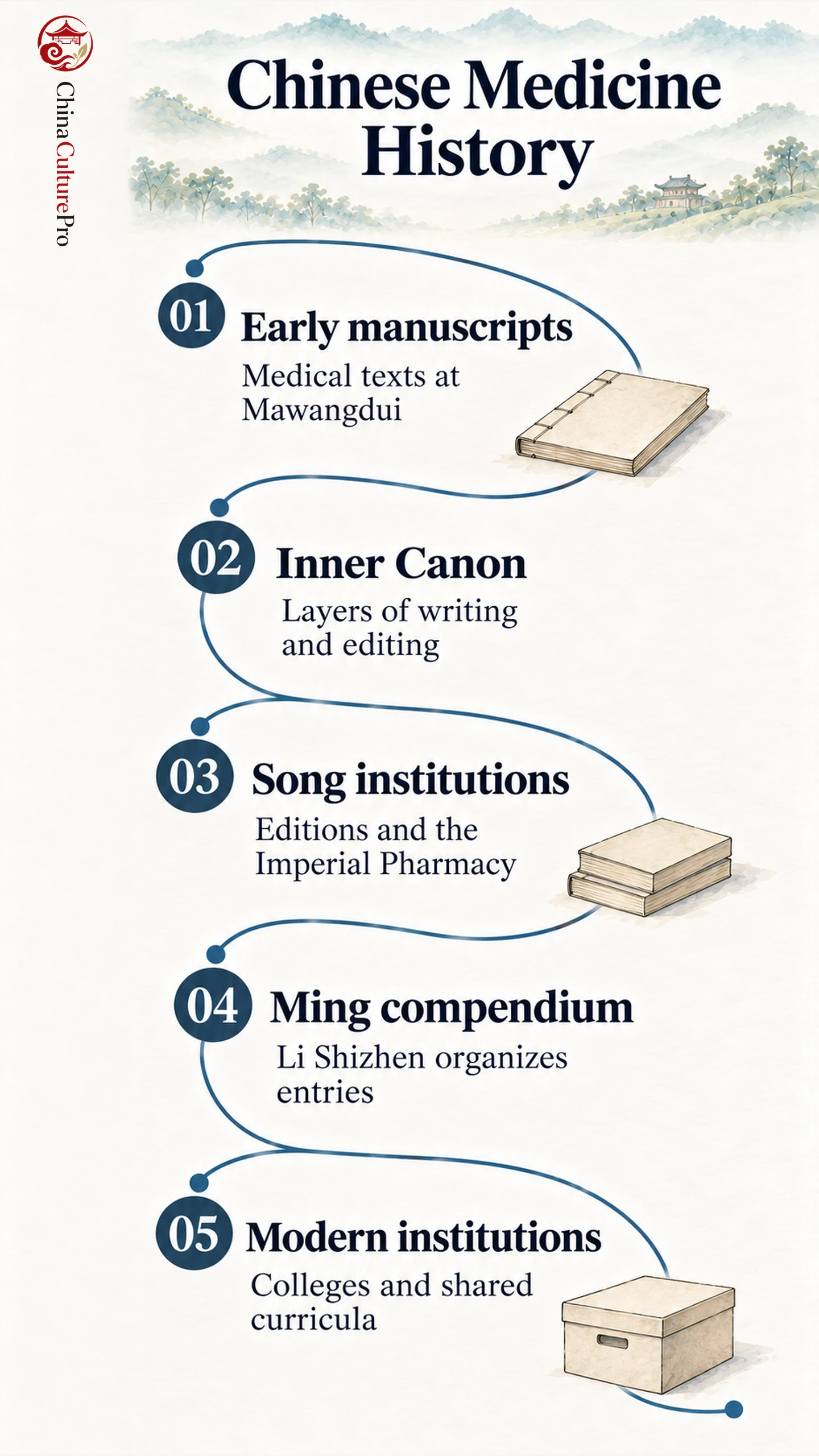
- Early manuscripts: The Mawangdui (马王堆, Mǎwángduī) finds preserve several kinds of medical writing.
- Classical texts: The Yellow Emperor’s Inner Canon (黄帝内经, Huángdì Nèijīng) took shape through layers of writing and editing.
- Imperial institutions: Song scholars edited works, while the Imperial Pharmacy developed a separate public role.
- Modern change: Colleges, research institutes and publishing programs helped give traditional Chinese medicine a new institutional form after 1949.
A text’s date, the date of a printed copy and the founding date of an institution measure different kinds of change.
A medical scroll packed inside a lacquer box, a printed edition of a classic and the records of a pharmacy offer different ways to study medicine in China. They show which ideas people recorded, which texts editors preserved and how institutions organized access to medical knowledge and materials. Those questions place medicine within the broader history of Chinese science and knowledge. [1][2][4][5][7]
Early Medical Manuscripts and What Survives
Paul Unschuld traces early written evidence about illness to inquiries recorded on oracle bones and shells. Some records place concerns about illness alongside questions about ancestors and ritual. Centuries later, a different kind of evidence survived inside a lacquer box in Tomb 3 at Mawangdui, near Changsha. Its manuscripts come from an early Han burial context. [1][2][3]
Donald Harper describes scrolls that had fused together in the box. Separating them revealed several medical treatises and illustrations of therapeutic exercises. The physical discovery matters. A collection stored together can show which kinds of writing came to be grouped at that site. Its survival depends partly on where it was placed and how its materials endured. [2][3]
The Yellow Emperor’s Inner Canon as a Textual Tradition
The Yellow Emperor’s Inner Canon is an influential textual tradition. The title invokes the Yellow Emperor, who appears in dialogues about the body and illness. An annotated translation of the Basic Questions (素问, Sùwèn), one major part of the tradition, describes a work built up over centuries and drawing on more than one school of thought. The figure in the dialogue belongs to the way the text presents authority. Its compilation history is a separate question. [4][6]
Ideas about yin and yang and the Five Agents helped some writers organize explanations of health and disease. Those frameworks also appear in broader Chinese cosmology. A woodblock edition dated 1339, registered by UNESCO, gives a concrete point in the history of how the text was transmitted. Its date belongs to that surviving printed edition, centuries after earlier layers of the text were composed. [4][5]
Song Editing, Printing and the Imperial Pharmacy
Elisabeth Hsu traces official editing of the Basic Questions under both Tang and Song governments. Editing and printing could make a particular version available to later readers. That work belongs partly to the history of Chinese printing, where selecting and correcting a text were distinct from producing copies. [5][6]
The Imperial Pharmacy was another kind of institution. Historian Asaf Goldschmidt dates its foundation to 1076 under the Song dynasty. He argues that it initially aimed to intervene in the market for medicinal materials. Its work later included making prepared prescriptions available for sale and establishing branches. Maps and local gazetteers help trace that expansion. These sources trace branches and administration. They give a different view of medical history from a classical text read by scholars. [7]
Li Shizhen and the Ming Compendium
Li Shizhen (李时珍, Lǐ Shízhēn) compiled the Compendium of Materia Medica (本草纲目, Běncǎo Gāngmù). He organized descriptions of substances discussed in medical literature. The work includes materials from plants, animals and minerals and draws together accounts inherited from earlier writers. The Library of Congress catalog describes 1,892 entries and identifies two sections of illustrations. The arrangement gave readers different ways to consult the work. A surviving illustration also offers evidence of what a particular edition reproduced visually. [8]
Li completed a draft in 1578. The catalog describes a later Ming printing in Jinling, now Nanjing, and a reprint in Jiangxi dated 1603. The dates separate a manuscript draft, an early woodblock edition and a later edition that helped the work circulate more widely. They are useful when identifying which version a digitized page belongs to. [8]
From Plural Practices to Modern Institutions
Bridie Andrews describes nineteenth-century China as a setting where herbal practitioners, midwives, bone-setters, religious specialists and Western medical missionaries could all offer care. The mix varied by place. Reformers in the late Qing and Republican periods also debated what practitioners should learn and how to organize medical work. That institutional history began before the People’s Republic was established in 1949. [9]
In the 1950s, state-sponsored programs worked to standardize selected teachings through colleges, research institutes and publications. Teachers and editors drew on earlier knowledge while deciding what to put into shared courses and texts. The new institutions changed how that material could be taught and published. That history helps explain why the modern term “traditional Chinese medicine” can describe an institutional system as well as point back to older bodies of writing and practice. [6][9][10]
FAQs About Chinese Medicine History
Was the Yellow Emperor the historical author of the Inner Canon?
The Yellow Emperor is a figure in the text’s dialogues. Scholars study the work as a compilation that grew through multiple stages of writing and editing.
Were all historical Chinese medical practices the same?
China had many kinds of healers, texts and local practices. A classical text or government institution preserves one part of that larger history.
When did traditional Chinese medicine take its modern institutional form?
Many features took shape after 1949, particularly through 1950s standardization and the growth of colleges, institutes and professional publishing.
Sources
[1] Paul U. Unschuld. History of Chinese Medicine
[2] Donald J. Harper. Mawangdui Tomb Three: The Medical Documents
[3] Donald J. Harper. Early Chinese Medical Literature: The Mawangdui Medical Manuscripts
[4] Paul U. Unschuld and Hermann Tessenow. Huang Di Nei Jing Su Wen: An Annotated Translation
[5] UNESCO Memory of the World. Yellow Emperor’s Inner Canon
[6] Elisabeth Hsu. The Standardised Transmission of Knowledge
[7] Asaf Goldschmidt. Commercializing Medicine or Benefiting the People: The First Public Pharmacy in China
[8] Library of Congress. Ben Cao Gang Mu: Compendium of Materia Medica
[9] Bridie Andrews. The Making of Modern Chinese Medicine
[10] Judith Farquhar. Re-writing Traditional Medicine in Post-Maoist China