

Quick Answer: Who Was Cao Cao?
Cao Cao (曹操, Cáo Cāo) was a commander, administrator and poet in the final decades of the Han dynasty. He controlled much of northern China and laid the groundwork for Wei. His son formally founded that dynasty after Cao Cao’s death.[1][2][3][5]
- Power: Cao Cao brought the Han emperor under his protection and control while building authority of his own.
- Battles: A major victory strengthened him in the north. A later defeat checked his advance south.
- Government: He organized grain supplies, recruited officials and became King of Wei.
- Image: Later fiction and opera gave his reputation a distinctive dramatic form.[1][2][3][4][6][7]
His lifetime titles and his later portrayal as a character belong to different kinds of history.

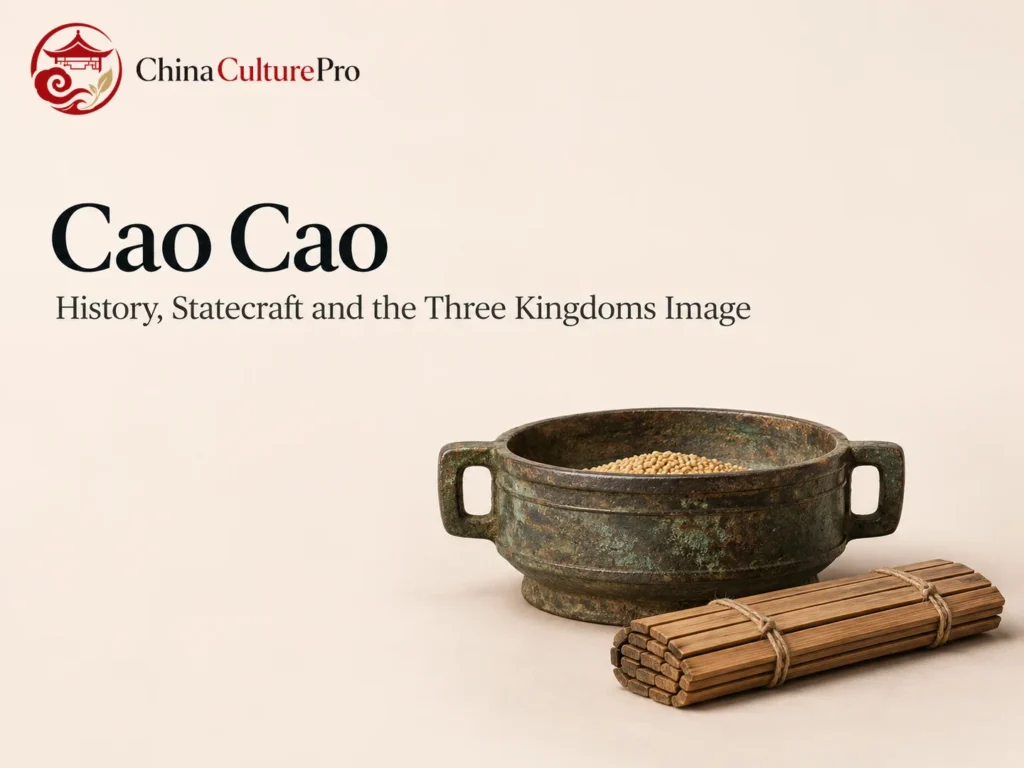
Cao Cao’s career is often introduced through a battle or a novel. An agricultural settlement offers another starting point. An army could win and still fail to hold territory if supplies ran short. Cao Cao’s arrangements for producing grain help explain the authority that grew behind his victories.[1][4]
How Cao Cao Rose at the End of Han
Born in 155 CE, Cao Cao entered public service under the Han dynasty. When imperial authority weakened, he raised forces and became one of several commanders competing for territory. In 196 he took Emperor Xian (汉献帝, Hàn Xiàndì) under his protection and established the court at Xu, near present-day Xuchang.[1][2][3]
The emperor continued to occupy the Han throne. Cao Cao’s position gave him a way to issue orders and secure appointments through imperial institutions. The continued presence of the emperor mattered to commanders and officials who still acted in the name of the Han. His formal position and his practical power changed as his territorial base grew.[1][2][4]
Guandu, Red Cliffs and the Limits of Conquest
In 200 Cao Cao defeated the forces of his northern rival Yuan Shao at Guandu (官渡, Guāndù). His army struck at the rival’s supplies, and the victory made it easier for him to consolidate the north. Operations continued after the battle, so its importance lies in how it changed the balance of power rather than in an immediate end to fighting.[1][2][3]
In 208 Cao Cao moved south. An alliance involving Sun Quan and Liu Bei defeated his forces at Red Cliffs (赤壁, Chìbì). Cao Cao retained his northern base, while rivals remained in a position to build competing governments. The two battles help explain why his successor inherited a powerful northern state while rival governments remained in the south.[1][2][3]
Grain, Officials and the Foundations of Wei
Cao Cao expanded agricultural colonies known as tuntian (屯田, túntián). Settlers cultivated land under official supervision, and part of the crop went to support the government and army. In regions disrupted by war, the policy tied the recovery of production to the state’s ability to feed soldiers.[3][4]
He also recruited administrators and officers to operate a government that extended well beyond the battlefield. He became King of Wei in 216, while Emperor Xian retained the Han imperial title. After Cao Cao died in 220, Cao Pi (曹丕, Cáo Pī) took the throne and established Wei. That succession marks a formal change in the history of the Three Kingdoms.[1][2][3][4]
Cao Cao as a Poet and Patron
Cao Cao also wrote poetry and gathered writers around his court. Jian’an (建安, Jiàn’ān) was the late Han reign era that gives its name to this literary setting. War, displacement, friendship and the shortness of life appear in works associated with his circle.[3][5]
His poetry helps a reader see kinds of activity that political accounts are less likely to foreground. A poem about the brevity of life can preserve concerns shared by members of a literary circle living through war and disease. It gives access to experiences that are easy to miss in a chronology of campaigns. Political deeds still require evidence about the decisions and circumstances of a particular crisis.[5]
From Historical Figure to Stage Character
The Romance of the Three Kingdoms (三国演义, Sānguó Yǎnyì) organizes events around questions of loyalty and rightful government. Cao Cao’s control of a Han court gave later storytellers material for a powerful and often suspect character. Comparing him with the treatment of Zhuge Liang helps show how the novel assigns different narrative roles to real people.[2][6]
In a conventional Peking opera portrayal, Cao Cao’s face is painted mainly white, with dark accents around the eyes and brows. This is a cue for the audience within a theatrical vocabulary. It belongs to the history of Peking opera facial patterns, while his statecraft belongs to the historical record. Both help explain why he remains one of the most discussed Chinese historical figures.[2][6][7]
FAQs About Cao Cao
Was Cao Cao an emperor?
During his life Cao Cao held powerful offices and became King of Wei. The Han emperor remained on the throne until Cao Pi established Wei after Cao Cao’s death. Cao Cao was honored as an emperor posthumously.[1][2][3]
Did Cao Cao found the Wei dynasty?
He built the military and administrative base of Wei. His son Cao Pi formally founded the dynasty in 220.[1][2][3]
Why is Cao Cao often portrayed as a villain?
Later fiction often reads his power over the Han court through questions of loyalty and legitimacy. The novel and opera give that interpretation dramatic forms, while historical sources also record his achievements as a commander and administrator.[2][4][6][7]
Sources
[1] Wiley Encyclopedia of War. Cao Cao
[2] Australian National University. The Three Kingdoms and Western Jin
[3] Chen Shou. Records of the Three Kingdoms: Annals of Cao Cao
[4] East Asian History. The Three Kingdoms and Western Jin: A History of China in the Third Century
[5] Cambridge University Press. Aging with Fellow Mortals
[6] University of Washington Press. Romance of the Three Kingdoms and Political Sovereignty
[7] Selected Peking Opera Facial Patterns. Cao Cao Peking Opera Facial Pattern