


Quick Answer: Who Was Yue Fei?
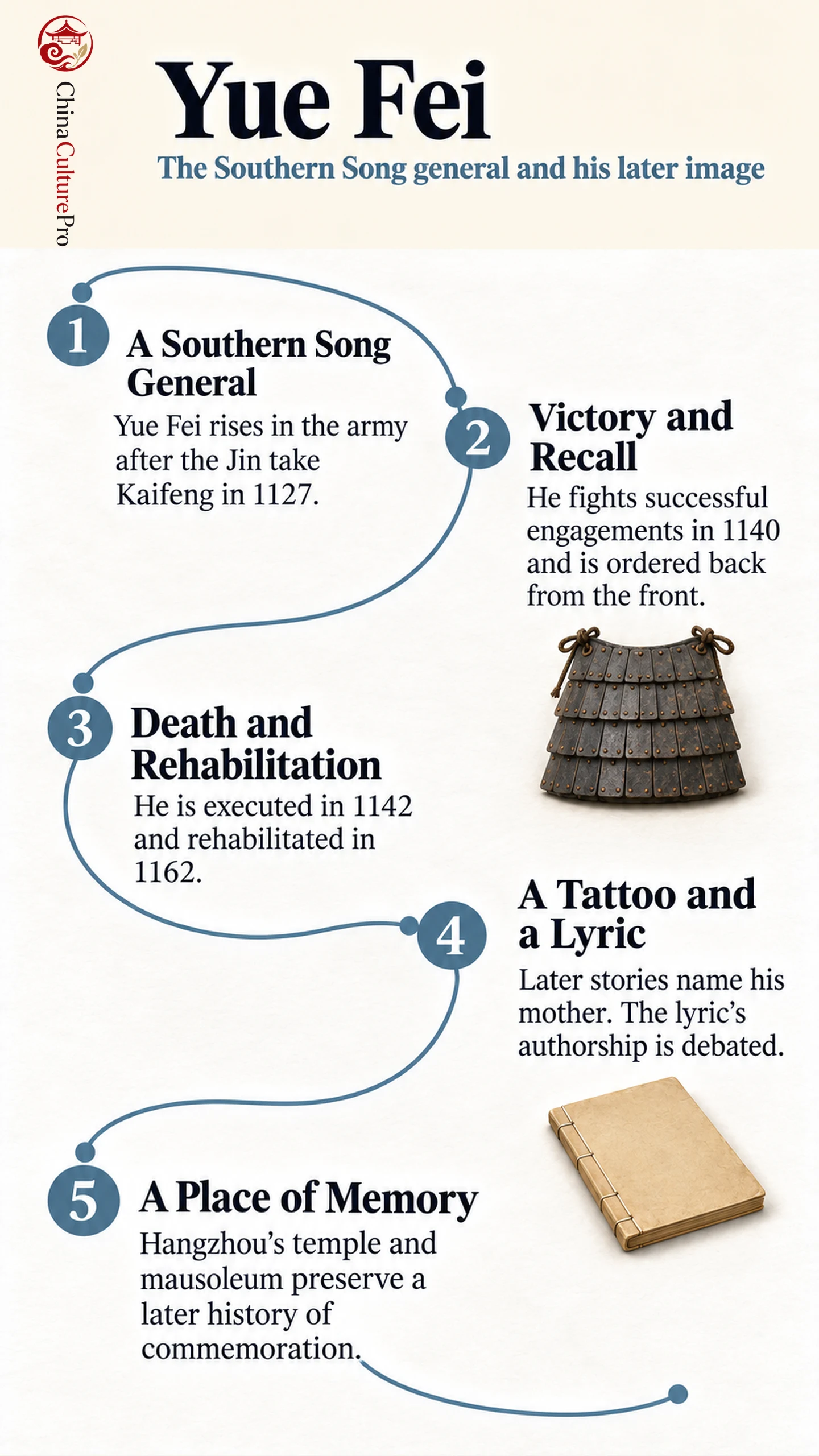
Yue Fei (岳飞, Yuè Fēi) was a Southern Song general who fought the Jurchen Jin and was executed in 1142. Later writers and communities made him a symbol of loyalty. His military career, the story of a tattoo and the poem attributed to him rest on different kinds of evidence.[1][2][3][4][5]
- War: He became a leading commander after the Jin took the Northern Song capital.
- Court: He was recalled from the front and executed during a period of negotiation with the Jin.
- Loyalty: A historical account records a tattoo. The story that his mother made it became famous later.
- Memory: His rehabilitation, temple and literary reputation gave later generations ways to reinterpret his life.[1][2][3][4][5][6]
The surviving accounts help explain both what happened to him and how the meaning of his loyalty changed.
The Hangzhou memorial presents Yue Fei as a loyal general. That reputation grew out of a political conflict in the early Southern Song and developed long after his execution. The military record, the official biography and the memorial each preserve a different part of the story.[2][3][6]
A General in the Early Southern Song
Yue Fei was born in 1103. In 1127 the Jin captured the Northern Song capital at Kaifeng and took two Song emperors captive. The court re-established itself in the south under Emperor Gaozong (宋高宗, Sòng Gāozōng). The loss of the old capital forced the re-established Song dynasty to defend a new political center in the south.[1][2][3]
Yue rose through military service in the decades after the crisis. His forces grew through campaigns against internal armed groups and through recruiting some of the men who had fought in them. By the time he led major operations against the Jin, he commanded an army whose organization mattered as much as his personal reputation.[1][2][3]
The Campaigns and the Recall
Yue’s forces fought successful engagements against Jin armies in 1140. One took place at Yancheng. The fighting formed part of a larger effort to recover territory and secure the Southern Song position. The next move depended on political decisions at court as well as on conditions in the field.[1][2][3]
The Song government recalled Yue while negotiating an end to the war. Later narratives emphasize the speed or number of messages ordering his return. The court ordered him to abandon the advance and return. Decisions on whether to hold recently won territory or accept a settlement lay with the emperor and senior officials. A commander’s success in battle and a government’s decision about whether to continue a war answer different questions.[2][3][7]
Execution and Rehabilitation
Yue lost his command and was imprisoned. The chief minister Qin Hui (秦桧, Qín Huì) played a central role in the proceedings. Yue and his son were put to death. The execution is generally dated to early 1142 in modern calendars. The proceedings accused Yue of disloyalty. The case unfolded as the Song court sought a settlement with the Jin. A later reversal of his status made the accusation itself part of the dispute over his reputation.[2][3][7]
The Song court rehabilitated Yue posthumously in 1162. Later honors changed his official standing and made it possible to commemorate him openly as an example of loyal service. His reputation was therefore shaped by a reversal within the dynasty as well as by writers in later centuries.[3][6]
The Tattoo Story and the Attributed Poem
The official biography says Yue’s back bore the words jin zhong bao guo (尽忠报国, jìn zhōng bào guó), an injunction to serve the country with the fullest loyalty. In the account of his imprisonment, Yue exposes the writing on his back during questioning. It does not identify his mother as the person who made it. Later stories gave her that role, turning the tattoo into a scene about family duty and public service. The difference shows how history and legend can share an image while making different claims.[2][3][4]
Man Jiang Hong (满江红, Mǎn Jiāng Hóng) is the tune title associated with a famous lyric traditionally attributed to Yue. The authorship of that lyric has been debated. Its status as a text associated with Yue grew through later copying, interpretation and performance. Its later circulation and use as a statement of loyalty are better documented than the circumstances in which it was written. The distinction matters when reading it alongside other works of Song ci poetry.[3][5]
How Yue Fei’s Memory Changed
The temple and mausoleum near Hangzhou’s West Lake give Yue’s story a physical setting. They commemorate a general who was condemned by his own court and later honored by it. The complex brings together worship and the grave. Later authors sometimes placed the emphasis on service to the Song dynasty and sometimes on loyalty to a country understood in broader terms.[3][6][7]
Among Chinese historical figures, Yue Fei offers a way to see why the memory of a person can have a chronology of its own. His battles, rehabilitation and the later circulation of a Chinese lyric are separate events in that chronology.[1][3][5]
FAQs About Yue Fei
Why was Yue Fei executed?
He was recalled and imprisoned while the Southern Song court pursued a settlement with the Jin. Qin Hui helped direct proceedings that led to Yue’s death in 1142. The court later rehabilitated him.[2][3][7]
Did Yue Fei’s mother tattoo his back?
The official biography describes a tattoo, but does not identify his mother as the tattooer. Her role belongs to the later popular story.[2][3][4]
Did Yue Fei write Man Jiang Hong?
The famous lyric is traditionally attributed to him. Its authorship is debated, and its later transmission provides a clearer record of how it became associated with his memory.[3][5]
Sources
[1] Academy of Chinese Studies. Yue Fei
[2] History of the Song. Biography of Yue Fei
[3] Journal of Chinese History. Tattooed Loyalty and the Evolution of Yue Fei’s Image
[4] Frontiers of History in China. Loyalist Tattoos and Tattooed Generals in the Song Dynasty
[5] Hong Kong Polytechnic University. Loyalism and Canonization of Yue Fei’s Manjianghong
[6] Zhejiang Provincial Government. Yue Fei Temple
[7] The Journal of Asian Studies. Yüeh Fei and China’s Heritage of Loyalty