


Quick Answer: How Do You Tell Chinese History From Legend?
Start with one claim, then check what the oldest identifiable source actually says. An account may preserve a person, place or event while later versions add details, characters and motives.
- Check the genre: A travel record, a ballad and a historical novel answer different questions.
- Check the date: Distinguish when a work was composed or compiled from when its events supposedly happened.
- Check independence: Several retellings can all come from one earlier work.
- Check the match: Archaeology can establish that a city or object existed. Identifying it with a named ruler or event requires further evidence.
A story can remain valuable for what it tells us about the people who wrote, performed or retold it.
Two versions of a story can agree that a traveler went west and differ on who accompanied him or what happened along the way. A traveler’s existence and the details of an episode are separate claims. In Chinese history, that distinction lets us take court records, traditional narratives and material remains seriously on their own terms. [1][2][3]
Ask What Kind of Source You Are Reading
Identify who produced the evidence, when and for whom. A record of a journey can describe a place the traveler saw. A dynastic history can compile earlier accounts after a regime falls. A novel can use both to build a convincing scene, and a play can emphasize a character the earlier text treats briefly. The date of the version matters even when all these works use a familiar name. [1][3][5][6]
A source can be primary evidence for one question and distant evidence for another. A twentieth-century film is primary evidence for a portrayal made in its own time. It may stand many centuries away from the events it depicts. The same distinction applies to a painting or another object associated with a historical figure. [5][7]
Xuanzang: A Historical Journey and a Later Novel
The seventh-century monk Xuanzang traveled through Central Asia to India in search of Buddhist texts. The Great Tang Dynasty Record of the Western Regions preserves an account of places along the way. Later storytellers reworked the pilgrimage. The Ming novel Journey to the West (西游记, Xīyóujì) made the Monkey King a central part of a literary adventure. [1][2][3]
For example, a question about where the monk studied points to his stay at Nalanda and the evidence for Buddhist learning there. A question about why the Monkey King accompanies the pilgrim points to a later cycle of stories and the novel. The historical journey connects the works. The companion belongs to the later telling. [1][2][3]
Mulan: What a Ballad Can Establish
The Ballad of Mulan (木兰, Mùlán), commonly placed in the fifth or sixth century, describes a daughter taking her father’s place in military service. Its use of the title “Khan” helps situate the setting in a world shaped by northern courts. The poem dramatizes a decision about military service and family duty. Independent evidence would be needed to identify a specific person who served under that name. [4][5]
Comparing versions reveals what later audiences took from the story. The collection edited by Shiamin Kwa and Wilt L. Idema includes early verse and the screenplay for the 1939 film Mulan Joins the Army. The two forms can be read as evidence of changing uses of the story, even while the question of a historical Mulan remains open. [4][5]
Red Cliffs: A Battle and Its Literary Afterlife
Chen Shou compiled the Records of the Three Kingdoms (三国志, Sānguózhì) in the late third century, after the end of the rival states. His history and the fifth-century annotations of Pei Songzhi are major sources for the Three Kingdoms era. They preserve accounts of the campaign at Red Cliffs, where forces allied with Sun Quan opposed Cao Cao. The compiler and the later annotator preserved different layers of evidence. Identifying which layer a passage belongs to matters if you want to know when that detail entered the record. [6][7]
The later Romance of the Three Kingdoms turned Red Cliffs into a dramatic sequence. Historian Rafe de Crespigny compares early accounts with that literary tradition and cautions that the scale of Cao Cao’s defeat could have been exaggerated. The battle, the number of people involved and what individual commanders said each require evidence of their own. [6][7]
Erlitou: When an Archaeological Site Has a Debated Name
Erlitou (二里头, Èrlǐtóu) in present-day Henan preserves evidence of a major early Bronze Age settlement. Archaeologists have studied its planned buildings, bronze production and ritual vessels. The sequence of remains helps archaeologists track changes in settlement organization and the production of ritual bronzes. A bronze vessel’s context can help place it within that sequence. [8][9][10]
The question of whether the site should be identified with the Xia dynasty requires a separate argument. The Erlitou museum presents the site within a Xia framework. Researchers Li Liu and Xu Hong argue for analyzing the site’s archaeological sequence separately from traditional dynastic histories. Other scholars ask how early ritual forms and elite culture spread across regions. These are different questions about the same site. [8][9][10]
A Reading Test for Traditional Stories
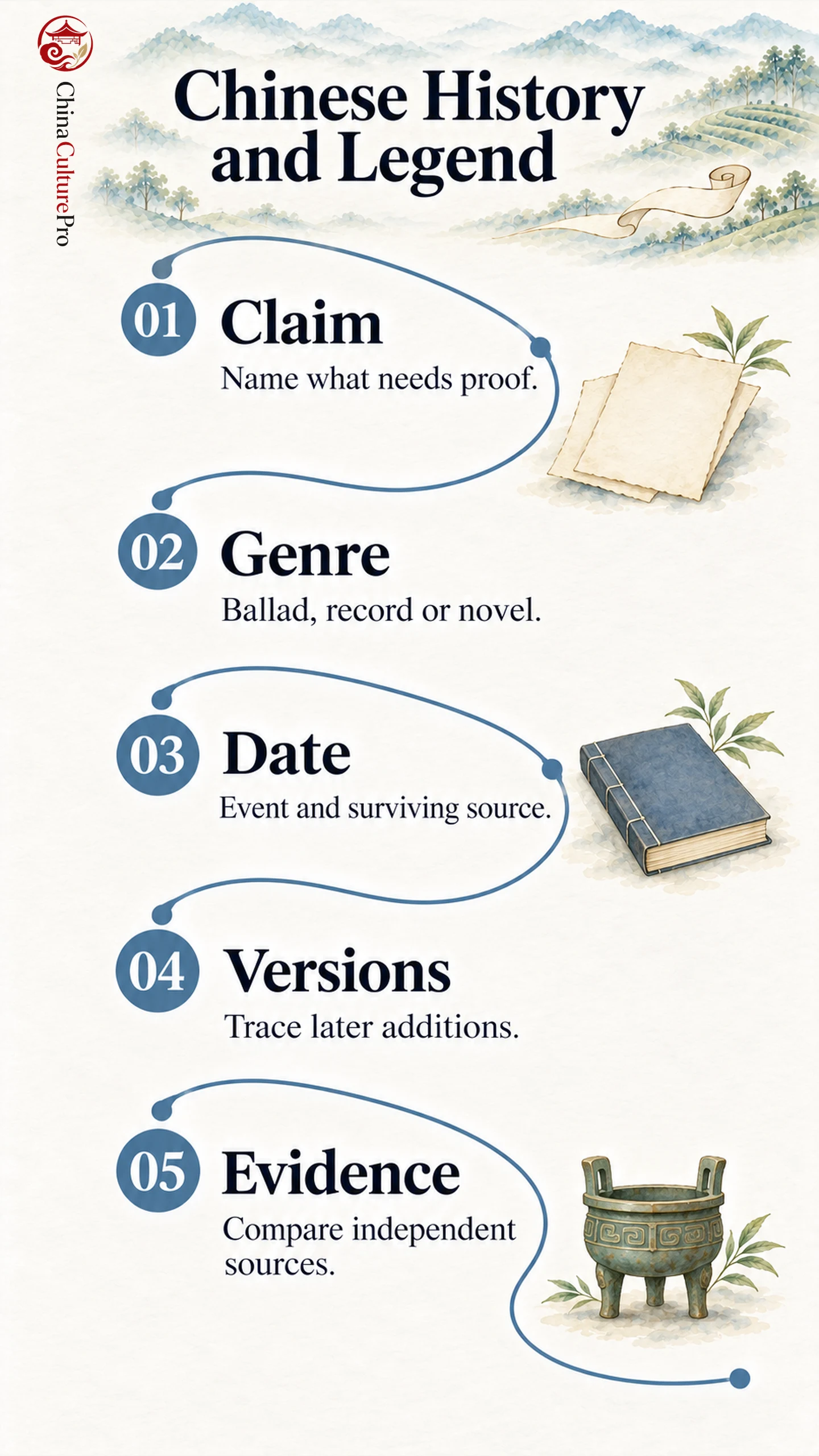
- Identify the claim: Is it about a person’s existence, a date, an event or an exact speech?
- Identify the witness: Find the earliest available text or object and ask what it can show.
- Trace later versions: See which details appear only in a novel, play or film.
- Compare another kind of evidence: Check whether an independent text, inscription or excavated context actually supports the same claim.
Suppose a story names a city as an ancient capital. An excavated workshop can establish production at that site. An administrative inscription naming the city could support a different claim about its political identity. Those conclusions depend on different finds. [6][7][8]
FAQs About Chinese History and Legend
Can a legend be based on real events?
Yes. Xuanzang’s travels helped inspire later pilgrimage stories and a novel. Details that appear in later works need their own evidence before they can be treated as events from his life.
Are official histories always eyewitness accounts?
Official histories often compile earlier documents and testimony. Check when the compiler wrote and whether the passage identifies an earlier witness.
Can archaeology settle every question about a traditional story?
Material remains can establish that a settlement or object existed and help date it. Matching it to a person or event described in a later text may require independent evidence.
Sources
[1] Xuanzang, translated by Li Rongxi. The Great Tang Dynasty Record of the Western Regions
[2] British Library International Dunhuang Programme. Buddhist Travellers and Pilgrims
[3] Columbia University Asia for Educators. The Origins of the Story
[4] Columbia University Asia for Educators. The Ballad of Mulan
[5] Shiamin Kwa and Wilt L. Idema. Mulan: Five Versions of a Classic Chinese Legend, with Related Texts
[6] Presses de l’Inalco. The Records of the Three Kingdoms
[7] Rafe de Crespigny, Cambridge University Press. The Cambridge History of China: The Three Kingdoms
[8] Li Liu and Xu Hong. Rethinking Erlitou: Legend, History and Chinese Archaeology
[9] Sarah Allan. Erlitou and the Formation of Chinese Civilization
[10] Xinhua. Erlitou Relic Museum Opens in Central China