

Quick Answer: Who Was Sun Quan?
Sun Quan (孙权, Sūn Quán, 182–252 CE) led the southern power that became Eastern Wu (东吴, Dōng Wú), one of the Three Kingdoms (三国, Sānguó). He succeeded his brother Sun Ce in 200 and took the imperial title in 229.[1][2]
- Power base: He built on the Sun family’s holdings around the lower Yangzi.[2]
- Red Cliffs: His commanders joined Liu Bei’s forces against Cao Cao at Red Cliffs (赤壁, Chìbì) in 208.[1][2]
- Statehood: A title granted in 221, an era proclaimed in 222 and an imperial accession in 229 marked different stages of Wu’s emergence.[1][2]
Sun Quan’s career began under the late Han and outlasted the first alignments that formed at Red Cliffs. The eastern state changed as its alliances, titles and institutions changed.
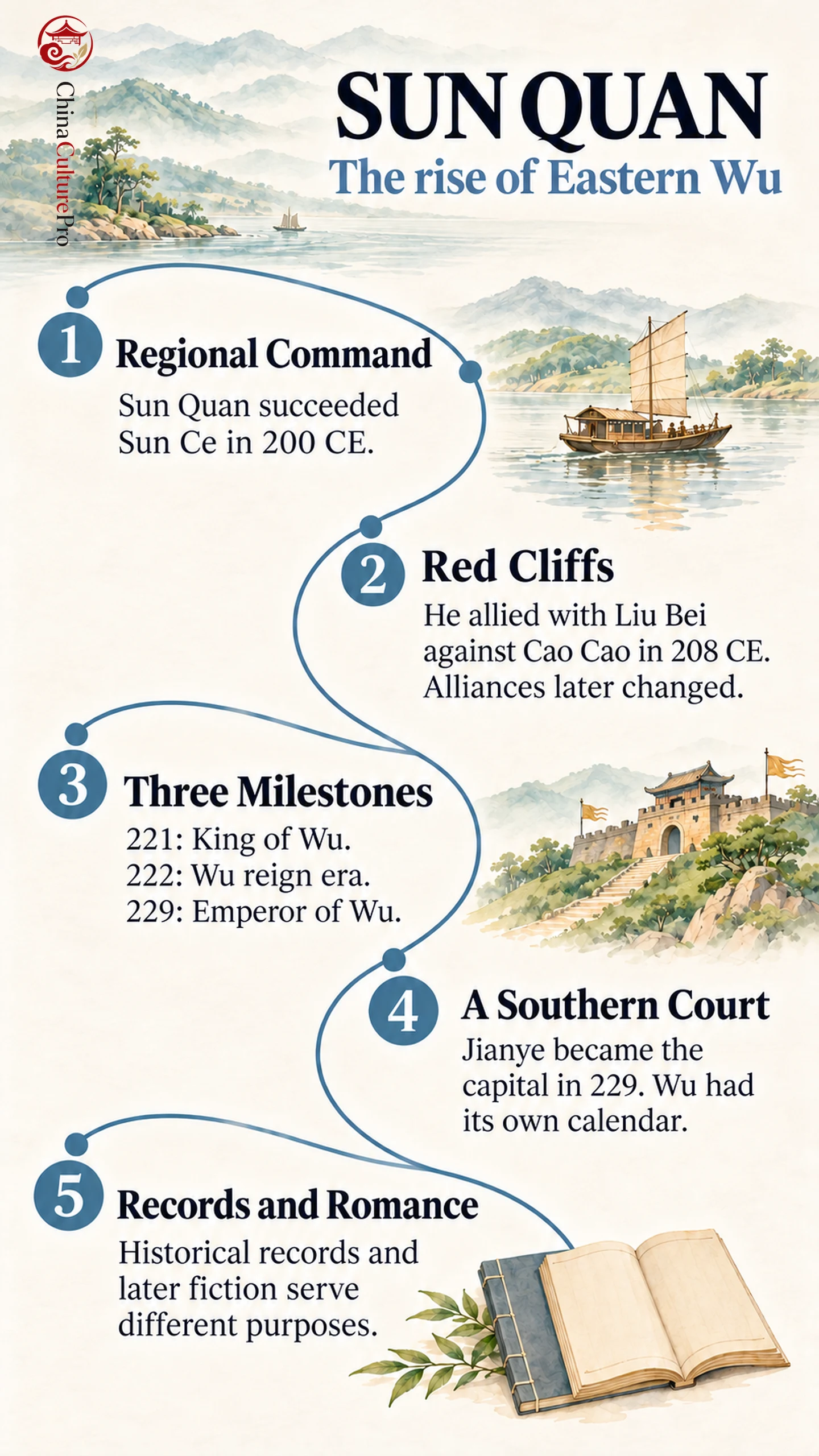
Sun Quan inherited a regional military command and left an imperial court. The decisions between those two stages make sense when read against the river corridors linking his bases to rival powers. That longer process gives him a distinctive place among Chinese historical figures of the era.
The Lower Yangzi Base Sun Quan Inherited
Sun Ce had secured a group of commanderies in Jiangdong (江东, Jiāngdōng), a regional name associated with the lower Yangzi lands. After his death in 200, the eighteen-year-old Sun Quan took over. The territory was substantial but unevenly controlled. The continued support of administrators such as Zhang Zhao and commanders such as Zhou Yu helped the young successor maintain a coalition across it.[1][2]
The Sun family operated while the Han dynasty still existed formally. Sun Quan could hold Han offices even as his command depended on his own regional followers. Rivers linked his bases and helped move troops and supplies, but they also led directly toward rival powers in the middle Yangzi. A defensible position required control of men, supplies and access points across the region.[1][2]
Red Cliffs and the Changing Alliance with Liu Bei
In 208, Cao Cao pushed south after gaining dominance in northern China. The collapse of resistance in much of Jing province threatened Sun Quan’s western approaches. Sun chose to support a coalition with Liu Bei and sent Zhou Yu and Cheng Pu to lead his forces. The alliance defeated Cao Cao’s expedition at Red Cliffs, checking the immediate threat from the north.[1][2]
After the battle, the allies still had competing interests along the river. In 219 Sun Quan’s forces seized territory held by Liu Bei’s general Guan Yu in Jing province. Liu Bei’s response ended in defeat by Lu Xun at Yiling in 222. This sequence explains why the alliance at Red Cliffs and later fighting between Wu and Shu both belong to the same Three Kingdoms history. The allies had shared an opponent without settling who would control the middle Yangzi. After Liu Bei’s death, Wu and Shu renewed cooperation against Wei, another sign that their alignment changed with circumstances.[1][2]
From King of Wu to Emperor
Three dates are used in discussions of the founding of Wu because a recognized title, an independent reign era and an imperial claim represent different changes.
| Milestone | What changed |
|---|---|
| 200 CE: Succession to Sun Ce | Sun Quan inherited the Sun family’s regional command.[1][2] |
| 208 CE: Red Cliffs | His alliance with Liu Bei stopped Cao Cao’s southern expedition.[1][2] |
| 221 CE: King of Wu | Cao Pi, the emperor of Wei, conferred the title on Sun Quan.[2] |
| 222 CE: A Wu Reign Era | Sun Quan proclaimed his own reign era amid the break with Wei.[1][2] |
| 229 CE: Emperor of Wu | He claimed imperial status and moved his capital to Jianye (建业, Jiànyè), now Nanjing, later that year.[1] |
The accession account describes a sacrifice to Heaven and the presentation of auspicious signs. An imperial title also asserted a claim to legitimate rule, expressed through ideas such as the Mandate of Heaven. Placing the court at Jianye turned the lower Yangzi into the centre of a rival empire and gave the city a lasting place among China’s historical capitals.[1][2]
How Eastern Wu Governed the South
Wu’s government used familiar offices and commanderies, with its own central court. It also adopted the Qianxiang (乾象历, Qiánxiàng lì) calendar system in 223, before Sun Quan took the imperial title. An independent calendar gave Wu a way to mark official time under its own authority. That decision connects political rivalry to the practical work of Chinese astronomy and calendrics.[2]
The lower Yangzi was a core, but Wu’s reach extended through river and coastal connections farther south. A third-century object representing a cargo and passenger boat, recovered from a tomb at Guigang in present-day Guangxi, offers a different kind of evidence from the battle stories. Its funerary context shows that boats belonged to the material vocabulary of the region. It gives no direct evidence of the exact vessels used at Red Cliffs.[2][3]
Wu continued under Sun Quan’s successors. Its defeat by Western Jin in 280 ended the political division that had outlived the founder by nearly three decades.[2][3]
Sun Quan in the Records and the Romance
The Records of the Three Kingdoms (三国志, Sānguó Zhì) and its later annotations preserve dated events, biographical narratives and sometimes competing accounts. The entry for Sun Quan is useful for tracing appointments and diplomatic decisions. Even within that historical tradition, speeches and claims preserved in an annotation need to be read as reports, with attention to their source.[1][2]
The Romance of the Three Kingdoms (三国演义, Sānguó Yǎnyì) retells the political struggle through a different literary form. Later paintings, operas and prints add further interpretations. A vivid image of Red Cliffs can show how later audiences understood the event. The question of who held which title in 221 or 229 calls for the historical record.[1][4]
FAQs About Sun Quan
Did Sun Quan fight at Red Cliffs in person?
Sun Quan made the decision to join the coalition and dispatched forces. The account names Zhou Yu and Cheng Pu as commanders of his contingent at Red Cliffs.
Why are there different dates for the founding of Wu?
The title King of Wu was granted in 221. Wu’s own reign era began in 222, and Sun Quan’s imperial accession followed in 229.
Did Eastern Wu end when Sun Quan died?
Wu continued after his death in 252. It fell to the Western Jin in 280, ending the Three Kingdoms division.
Sources
[1] Chen Shou, with annotations by Pei Songzhi. Records of the Three Kingdoms, Volume 47: Biography of the Ruler of Wu
[2] Rafe de Crespigny. Generals of the South: The Foundation and Early History of the Three Kingdoms State of Wu
[3] Tokyo National Museum. Three Kingdoms: Unveiling the Story
[4] National Palace Museum. Timeless Legend: The Red Cliff and Historic Figures of the Three Kingdoms