

Quick Answer: What Roles Did Women Have in Chinese History?
Women in Chinese history raised families, managed resources, produced goods, wrote for readers and took part in public organizations. Their opportunities varied across periods, regions and social groups. Marriage and household rules could constrain a woman’s choices while still giving her responsibilities and ways to exercise authority.[1][2][4][7][9]
- Family: Song records show women bringing assets into marriage and sometimes exercising rights over property.[1][2]
- Work: Textile production, brewing and selling goods connected women’s work with household and market economies.[4][5]
- Public roles: Surviving anthologies, reform journals and relief records document different ways women reached people beyond their households.[6][7][8][9]
These examples span selected periods. A rule, an object and a published text each make different experiences visible.[2][5][7]
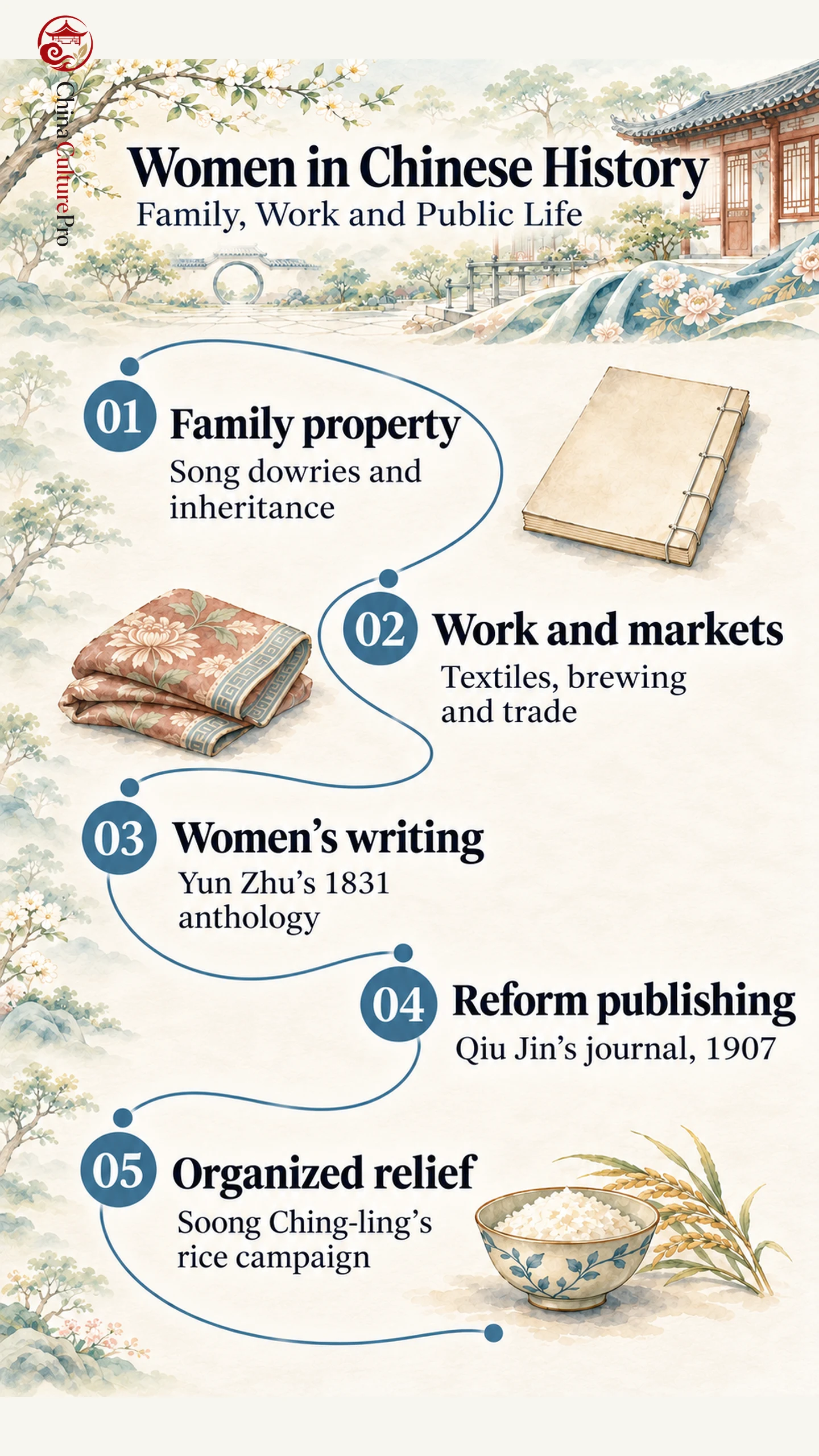
A record of a Song dowry, a Han image of brewing and a Qing anthology preserve three kinds of activity. One points to property within marriage. Another depicts work. The third records women as authors and editors. Reading them together makes it possible to follow women’s lives through the institutions and objects that shaped Chinese history.[2][5][6]
Family, Marriage and Property
Marriage involved negotiations between families and could change a woman’s household, work and access to property. In the Song dynasty, daughters could bring property into marriage through a dowry. Bettine Birge describes how substantial dowries could give some elite wives assets of their own within households otherwise organized around the male line. A family’s means affected the property available to a daughter. Records of large dowries are especially useful for studying elite marriages, where assets could matter to both households.[1][2]
Widows’ rights and the prospect of remarriage were also contested. Some Song writers opposed widows’ remarriage, yet property rights could help a widow support herself or remarry. The disagreement is visible when advice about conduct is read alongside records of property. Birge traces changes in marriage and property law under the Yuan that restricted women’s autonomy. These changes are part of the longer history of Chinese marriage institutions and of dowry and marriage transfers.[1][2][3]
Work in Households and Markets
The household could be a place of production. Textile work involved knowledge of materials and techniques, and it contributed to family resources. Francesca Bray’s research follows changes from household to more commercial forms of production between the Song and Qing. The expansion of commercial production changed how work was divided and how finished cloth reached buyers. Bray also describes financial management and ritual responsibilities within households, work that would be missed in a count of people employed in a workshop. This is one part of the history of Chinese silk and textile production.[4]
A different source comes from Eastern Han Sichuan. Tomb tiles and carved images depict women brewing alcohol. Hajni Elias compares these images with texts describing women who sold alcohol in shops or markets. The images establish that women were represented performing the work. The written references provide separate evidence for commercial activity. They add an economic dimension to the study of daily life in early imperial China.[5]
Writing, Education and Print
Some women’s writing reached readers through manuscript and print. An 1831 edition of the Guochao Guixiu Zhengshi Ji (国朝闺秀正始集, Guócháo Guīxiù Zhèngshǐ Jí), edited by Yun Zhu (恽珠, Yùn Zhū), preserves works by Qing women and introductory texts by the editor and others. The project records a woman organizing and presenting other women’s work. The printed book shows how literary participation could extend beyond composing a text privately.[6]
The archive is selective. The Harvard-Yenching Library notes that women’s writings often survive in rare book collections because many other works were lost or neglected. A printed anthology reveals a network that had the means to circulate its work. It offers a starting point for studying the place of women’s writing in Chinese print culture.[6][7]
Public Life from Publishing to Organized Relief
Near the end of the Qing, Qiu Jin (秋瑾, Qiū Jǐn) used a journal to address women directly. Her Chinese Women’s Journal began publication in 1907. It gave her a medium for arguing about women’s choices and opportunities in public. The journal published only two issues. Financing a periodical was itself part of the work of reaching readers.[8]
Public work could take a different form in the twentieth century. In 1938, Soong Ching-ling (宋庆龄, Sòng Qìnglíng) founded the China Defence League in Hong Kong. In its 1941 One Bowl of Rice campaign, merchants donated rice and the public bought coupons that could be exchanged for it. The operation illustrates organizing work that depended on businesses, donors and a relief institution. The surviving records document the mechanics of raising money as well as Soong’s leadership.[9]
What the Sources Leave Visible
Property studies illuminate women’s rights and disputes where records survive. Images can show a task that artists considered recognizable. Printed works and relief archives preserve the efforts of people whose work reached a public audience. A woman whose writing reached a printer is easier to identify by name than someone whose work appears in an anonymous image. Comparing these records makes both kinds of activity visible while preserving the limits of each.[1][2][5][7][9]
FAQs About Women in Chinese History
Could women own property in imperial China?
Some women did. Song records show wives with assets brought into marriage as dowry and widows with property rights. Legal rules, practice and the amount of property involved varied.
Did women work outside the home?
Women worked in and around households and also took part in market activity. Eastern Han evidence, for example, includes accounts of women selling alcohol.
Could women publish their writing before the twentieth century?
Yes. The 1831 printed anthology edited by Yun Zhu is one example of Qing women’s writing appearing in print.
Sources
[1] Patricia Buckley Ebrey. The Inner Quarters
[2] Bettine Birge. Women’s Property and Confucian Reaction in the Sung
[3] Bettine Birge. Women, Property, and Confucian Reaction in Sung and Yüan China
[4] Francesca Bray. Technology and Gender
[5] Hajni Elias. Women’s Role in the Production and Sale of Alcohol in Han China
[6] Ming Qing Women’s Writings Digitization Project. Guochao Guixiu Zhengshi Ji, Edited by Yun Zhu
[7] Harvard-Yenching Library. Ming-Qing Women’s Writings
[8] Women in World History. Qiu Jin
[9] Hong Kong Memory. The China Defence League and the One Bowl of Rice Movement