

Quick Answer: What Was Daily Life Like in Ancient China?
Daily life in ancient China varied by place, period and resources. In the early imperial centuries of the Qin dynasty (秦朝, Qín cháo) and Han dynasty (汉朝, Hàn cháo), homes and households were centers of cooking, storage, work and family organization. Pottery models, food remains and local registers preserve different parts of those routines.[1][2][4][8][9]
- Homes: Han tomb models depict houses with courtyards and facilities such as stoves, wells and mills.[1][2][3]
- Food: The balance of millet, wheat and rice varied by region and shifted over time.[4][5]
- Work: Farming and processing grain were important, alongside household craft and work that reached markets.[2][4][7]
- Family: Qin local records show officials classifying members of households by age, sex and their recorded relationships.[8][9]
The examples below concentrate on Qin and Han evidence. They show a range of early practices, and each source gives a view of particular people or activities.[1][4][6][8]
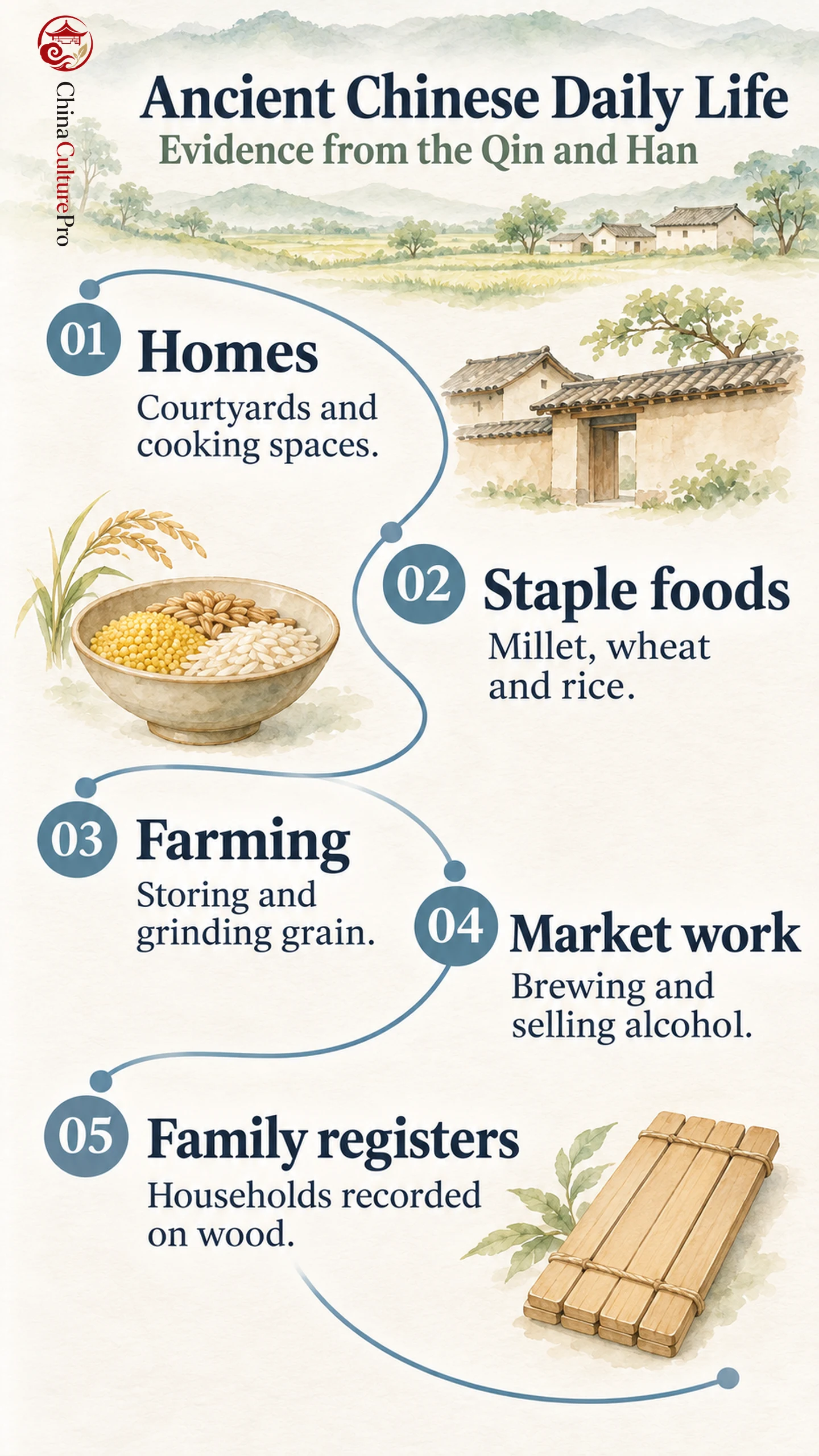
A clay courtyard, the chemical traces in human remains and a wooden tablet all preserve something that would be hard to learn from a story about emperors. Each survived for a different reason. They give Chinese history a view from inside households and the institutions that recorded them.[1][4][8]
Homes, Courtyards and Domestic Space
An Eastern Han earthenware model at the Metropolitan Museum of Art depicts a house enclosing a courtyard. Open space and rooms appear as parts of the same domestic arrangement. Models of houses and farm buildings were included in some burials of the Han dynasty as burial objects (明器, míngqì), made to accompany the dead. The choice to represent ordinary facilities in a tomb is part of a wider history of how furnishings served the dead in early Chinese burials.[1][2]
A courtyard model gives one arrangement of rooms and open space. Other pottery models depict wells, granaries, pens and cooking equipment. The museum interprets these forms as facilities that might be found in a village or on a large estate. A burial set could assemble several structures together, so its size and contents cannot establish what the average household owned.[1][2][3]
Food, Cooking and Regional Differences
In studies of ancient food, northern sites often show a strong role for millet. At many southern sites, rice was part of a wider range of staple plants. A study of human remains from three Central Plains sites found increasing wheat consumption from the Eastern Zhou into the Han. The study used differences in the chemical signatures of human remains to infer shifts in staple consumption. The result belongs to a specific region and period in the history of Chinese agriculture.[4][5]
Cooking equipment and burial food offer another view. The Met’s Han stove model represents a domestic cooking installation. At the Mawangdui (马王堆, Mǎwángduī) tombs in Changsha, the food finds and their inventories include rice, millet, meat preparations and other provisions. The burials belonged to an elite family. Their contents show what could be prepared, stored or selected for a burial, while the dietary study reflects foods consumed over time.[3][4][6]
Farming, Craft and Market Work
The Met’s models of a mill and a granary show two tasks that came after cultivation. Grain needed storage, and some grain needed grinding before it could be eaten. A well and animal pens appear in the same museum group, making it possible to consider how access to water, food processing and animal care could be arranged around a settlement or estate.[2]
Work also connected households to markets. Eastern Han tomb reliefs and tiles from Sichuan depict women brewing alcohol. Hajni Elias compares these scenes with written accounts of women selling alcohol in shops and markets. Brewing and textile production were both identified as women’s work in some records, although the activities and opportunities differed by place and circumstance. The example belongs to a larger history of women’s work in China.[7]
Households, Families and the State
At Liye (里耶, Lǐyē) in present-day Hunan, documents recovered from a well preserve part of the archive of Qianling County in the Qin dynasty. Household registration could use one wooden tablet for a household. The records distinguish men and women, adults and minors, and household servants. Wives and children could be recorded in relation to the husband or father.[8][9]
These descriptions show what officials needed to identify, such as who belonged to a registered group. One registered household could include more than one immediate family unit. Studying a register alongside the history of marriage and family institutions helps separate recorded kinship from the circumstances of living and working together.[8]
How Historians Reconstruct Daily Life
Each source has a different reach. A pottery house preserves a design selected for the afterlife. An elite tomb inventory documents one setting for the preparation and provisioning of food. The household tablet preserves names and categories used by officials. A courtyard model can establish that a particular arrangement was depicted, while a register can show who counted as a member of a household. Establishing that a specific family used that kind of house would require evidence connecting the two.[1][6][8]
FAQs About Ancient Chinese Daily Life
Did everyone in ancient China eat rice?
Rice was important in many southern areas. In parts of the north, millet was a major staple, and wheat consumption increased in the Central Plains during the transition into the Han.
What did homes in ancient China look like?
Homes varied. Some Eastern Han tomb models show houses organized around a courtyard. Those models preserve particular building forms and were made for burial.
What work did women do in Han China?
Evidence includes textile work and brewing. In Sichuan, tomb images depict women producing alcohol, and written sources also describe women selling it.
Sources
[1] Metropolitan Museum of Art. House with Courtyard
[2] Metropolitan Museum of Art. Mill and Architectural Models
[3] Metropolitan Museum of Art. Model of a Cooking Stove
[4] Ligang Zhou and colleagues. Human Diets During the Social Transition from Territorial States to Empire
[5] Xinyi Liu and Rachel E. B. Reid. The Prehistoric Roots of Chinese Cuisines
[6] Chen Jianming, Hunan Provincial Museum. On Chinese Delicacies 2,100 Years Ago
[7] Hajni Elias. Women’s Role in the Production and Sale of Alcohol in Han China
[8] Toyo Bunko. Household Composition Records of the Qin Dynasty as Seen in the Liye Qin Slips
[9] Robin D. S. Yates. The Qin Slips and Boards from Well No. 1, Liye, Hunan