

Quick Answer: What Were Imperial Concubines?
Imperial concubines were ranked partners of the emperor within the palace household. Under the mature Qing system, the empress (皇后, huánghòu) was the principal wife. Seven consort ranks stood below her. Formal status could affect a woman’s accommodation, attendants, allowances and ceremonial position.[1][2]
- Rank: The Qing hierarchy ranged from empress and Imperial Noble Consort (皇贵妃, huángguìfēi) to lower titles such as Changzai (常在, chángzài) and Daying (答应, dāyìng).[1][2]
- Entry: Qing consort selection was tied to the Eight Banners (八旗, Bāqí), a hereditary system of military and social organization.[3][4]
- Palace life: Registers, investiture documents, clothing and portraits show different aspects of an imperial woman’s position.[1][2][5]
The rank ladder here describes the mature Qing system. Earlier courts organized their households differently and sometimes used the same titles at different levels.[2][8]
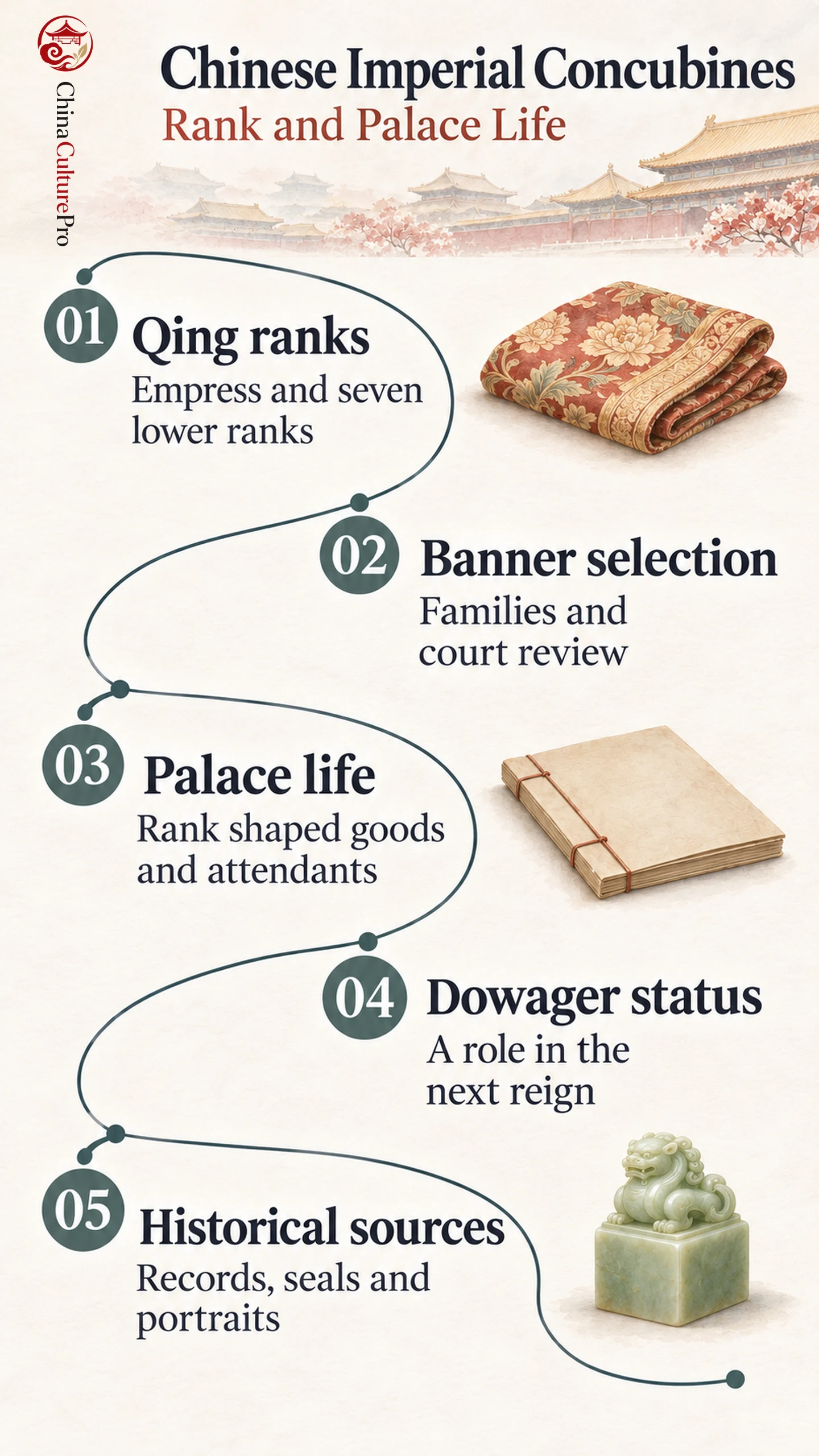
An investiture document could establish a woman’s official title, while a portrait could present the image she or the court wanted others to see. Reading both kinds of evidence adds a household perspective to Chinese history. The Qing court is especially useful because its surviving rules and objects can be compared with individual careers.[1][2][5][6]
The Qing Court’s Eight Ranks
The order below follows the system of the mature Qing dynasty. English translations vary, particularly at the lower levels. The Chinese title and its place in the hierarchy are the most reliable way to compare accounts.[1][2]
| Rank | Number of places in the rules |
|---|---|
| Empress (皇后, huánghòu) | One |
| Imperial Noble Consort (皇贵妃, huángguìfēi) | One |
| Noble Consort (贵妃, guìfēi) | Two |
| Consort (妃, fēi) | Four |
| Concubine (嫔, pín) | Six |
| Guiren (贵人, guìrén) | No set number |
| Changzai (常在, chángzài) | No set number |
| Daying (答应, dāyìng) | No set number |
These are prescribed places. A list of titles held in a particular reign depends on appointments, vacancies and promotions. The same word could also mean a different position in another dynasty. The Palace Museum notes that the Eastern Han used Guiren for a rank below the empress, while in the Qing it sat below the Consort and Concubine ranks.[2][8]
How Women Entered the Imperial Household
The Qing court recruited consorts from banner families. Selection, known as xiunü (秀女, xiùnǚ) selection, was part of a wider system governing marriage within the banner population. Mao Liping’s study of archives from the Qianlong reign describes the triennial review and the role of the Ministry of Revenue. Under the rules Mao describes, eligible banner girls had to undergo selection before arranging a marriage of their own. The system therefore affected families whose daughters never became imperial consorts.[3][4]
Women present at court had distinct positions. Some became members of the imperial household through marriage. Imperial daughters belonged to the ruling lineage by birth. Palace staff also included women appointed to serve the household. Their presence in a palace does not establish that they held consort rank. These distinctions matter when using court records to trace marriage and family institutions.[1][3][4]
What Rank Meant in Palace Life
Rank could govern what a woman was entitled to receive from the court. Household regulations and inventories record goods and attendants. Some consorts lived in the eastern or western residential palaces of the Forbidden City. Eunuchs and other staff served those residential households. Their positions belonged to a different set of palace roles from the ranks in the table.[1][2][5]
Material goods are one way to see those arrangements. Robes, furnishings and other objects marked status. The Smithsonian notes that many things used by empresses belonged to the imperial household and could return to storage after an empress’s death. An object’s recorded use at court can indicate the rank it served. Storage and reassignment records matter when attributing it to one woman.[1]
Motherhood, Promotion and Political Influence
Giving birth to a son could improve a consort’s position, although the court still conferred rank through its own decisions and rituals. When a new emperor succeeded, a senior woman could receive the status of empress dowager (皇太后, huángtàihòu) through her relationship to the new sovereign. The dowager title belonged to the new reign. A consort’s earlier rank recorded her position in the preceding emperor’s household.[1][6]
Cixi (慈禧, Cíxǐ) entered the court as a lower-ranking consort of the Xianfeng Emperor. She became an empress dowager in 1861 after her son succeeded as the Tongzhi Emperor. The Palace Museum identifies a room in the Hall of Mental Cultivation where Cixi and Empress Dowager Ci’an conducted state affairs behind a screen. Their case belongs to the history of imperial government and shows the significance a dowager’s position could acquire during a minority.[6][7]
What Records and Objects Can Tell Us
Investiture records and seals could document an official title. Court registers can illuminate scheduling and household administration. A portrait, such as Katharine Carl’s 1903 painting of Cixi, has a different purpose. Cixi commissioned the American artist to paint it for display at the 1904 world’s fair in St. Louis. The portrait is evidence of a diplomatic presentation as well as of the clothing and objects the artist depicted. Those sources reveal different aspects of women’s lives and public roles in Chinese history.[2][5][6]
FAQs About Chinese Imperial Concubines
Were all women in the palace imperial concubines?
Palace residents included imperial daughters, consorts and women appointed to household service. A formal consort rank identified a particular position within the emperor’s household.
Did the same ranks apply in every Chinese dynasty?
The eight-rank table describes the mature Qing court. Other dynasties used different systems, and some titles changed their relative position over time.
How did an imperial consort become an empress dowager?
A woman’s relationship to the succeeding emperor could entitle her to the status. Cixi, who became dowager when her son took the throne, is one documented example.
Sources
[1] Smithsonian National Museum of Asian Art. Empresses of China’s Forbidden City: Overview
[2] The Palace Museum. The Seals of Empress Dowager Cixi
[3] Mao Liping. The Significance and Influence of the Xiunü Selection System on Banner Women
[4] University of California Press. Qing Imperial Women: Empresses, Concubines, and Aisin Gioro Daughters
[5] The Palace Museum. The Daily Life of Qing Dynasty Concubines
[6] Smithsonian Institution. Cixi, the Last Empress Dowager of China
[7] The Palace Museum. Hall of Mental Cultivation
[8] The Palace Museum. Guiren and Changzai