

Quick Answer: What Were the Chinese Imperial Examinations?
The Chinese imperial examinations (科举, kējǔ) were competitive tests used by dynastic governments to assess candidates for civil office. The system developed over centuries and took a particularly elaborate form under the Ming and Qing. Its classical curriculum influenced education and elite life as well as government recruitment.[1][2][3]
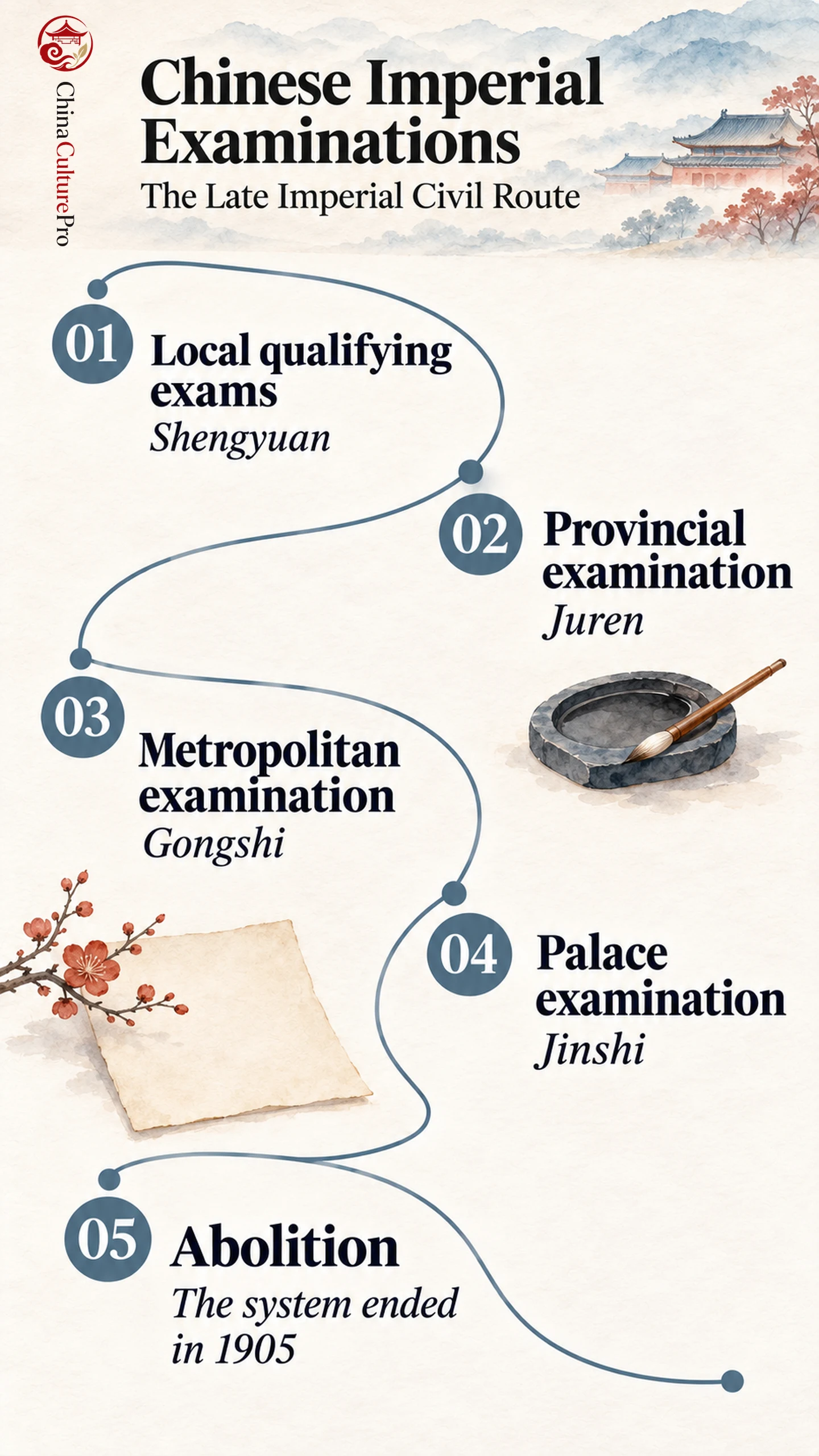
- Levels: In the late imperial system, candidates advanced through local qualifying tests and then through provincial, metropolitan and palace stages.[2]
- Subjects: Candidates wrote on classical texts, literary forms and policy. The balance changed over time.[1][2][4]
- Opportunity: Exam success could open a path to office. Preparation required time and resources, and appointment was a separate outcome.[3][5][6]
The Qing court abolished the system in 1905, a year after the last examinations were held.[2][4]
The Qing archive of the Grand Secretariat preserves copied answers, rosters and placards announcing the court’s final rankings. Each record captures a different part of the process. The exams matter in Chinese history because they connected schooling and state service through tests whose results could shape an entire career.[1][2]
How the Examination System Developed
Early forms of competitive examination took shape around the Sui and Tang dynasties. The tests grew in importance over later centuries. Benjamin Elman distinguishes the earlier Tang and Song literary examinations from the late imperial system, in which Neo-Confucian learning gained particular importance. The best-known ladder of local, provincial, metropolitan and palace examinations belongs to the late imperial form of the institution.[1][3]
By the Ming and Qing, the civil examinations linked schools, regional testing centers and the imperial court. This structure allowed the government to define the learning expected of officials. A candidate who had completed one stage gained a status that could matter even before taking the next test.[1][2][3]
The Main Examination Levels in Ming and Qing China
The table follows the late imperial civil route. The local stage involved more than one qualifying test. The final stage ranked successful candidates at the court.[2]
| Stage | Place and result |
|---|---|
| Local qualifying exams | County and prefectural tests led to student status, shengyuan (生员, shēngyuán), also known as xiucai. |
| Provincial examination (乡试, xiāngshì) | Usually held every three years in a provincial capital. Successful candidates became juren (举人, jǔrén). |
| Metropolitan examination (会试, huìshì) | In the regular sequence, the Ministry of Rites administered the exam at the capital. Successful candidates became gongshi (贡士, gòngshì). |
| Palace examination (殿试, diànshì) | Held at court to rank the candidates who advanced from the metropolitan stage. The resulting ranks belonged to the jinshi (进士, jìnshì) degree. |
The palace stage took place under imperial authority. The emperor could be represented by officials during the examination, while the court’s rank list recorded its outcome. The court divided the final results into three classes. The highest-ranked candidate in the first class was called zhuangyuan (状元, zhuàngyuán). The steps that follow, including obtaining a particular post, belong to the separate history of scholar-official careers.[2][3][5]
What Candidates Had to Write
Classical education gave candidates a common set of texts. The Four Books (四书, Sìshū) and Five Classics (五经, Wǔjīng) were central to the late imperial curriculum. Recognized commentaries also mattered, including the interpretive tradition associated with Zhu Xi. Candidates were expected to turn that learning into answers that conformed to the exam’s form.[1][2][3]
The eight-legged essay (八股文, bāgǔwén) prescribed a formal structure for some classical responses. Qing exam records also describe regulated verse and questions about past or current policy. Administration shaped what the examiners saw. In the process described by Academia Sinica, names were concealed and clerks copied answers in vermilion ink to reduce the chance that a marker could identify the candidate.[2]
How Far Exams Opened a Path to Office
The examinations gave eligible candidates a way to demonstrate learning. They also demanded years of preparation. Families had to provide or find support for study before a candidate could enter the system, and the time away from other work was itself a cost. Some occupations faced restrictions, and women were excluded from the regular civil examination route.[3][5][6]
A degree could confer standing without leading straight to an appointment. For example, a juren could be considered for government service without winning a jinshi degree, and successful provincial candidates could also gain influence in their own communities. Classical learning could also support work in teaching, medicine or other professions outside the bureaucracy. Elman describes the late imperial system as enabling some movement within and between elite groups while offering fewer opportunities for families without the time and resources to educate candidates.[3][5][6]
The Final Examination and the End of the System
The surviving yellow silk-bound list for the final 1904 metropolitan examination records 276 successful candidates, as well as officials’ roles and exam questions. The questions recorded in the list included Japanese reforms under the Meiji government, reform in Egypt and the United States’ Chinese Exclusion Act. The special metropolitan session took place at the Henan Examination Hall, and the palace stage followed in the Hall of Preserving Harmony at the Forbidden City.[4]
The same record contains older kinds of historical essay. Its range shows how some topics had broadened by the final examination. In 1905, amid calls for institutional reform, the Qing government abolished the examinations.[2][4]
FAQs About the Chinese Imperial Examinations
What was the difference between juren and jinshi?
Juren was the status earned by passing the provincial examination. Jinshi was the degree ranked through the palace stage, after candidates had passed the metropolitan examination.
Did passing an exam guarantee a government post?
A qualification could let a candidate continue to another examination or become eligible for appointment. Receiving a particular post still required a separate decision.
When did the imperial examinations end?
The last examinations took place in 1904. The Qing court officially abolished the system in 1905.
Sources
[1] Benjamin A. Elman. A Cultural History of Civil Examinations in Late Imperial China
[2] Academia Sinica, Institute of History and Philology Museum. Archives of the Grand Secretariat
[3] Columbia University, Asia for Educators. The Confucian Classics and the Civil Service Examinations
[4] National Palace Museum. 1904 Metropolitan Examination Candidate List
[5] Benjamin A. Elman. The Civil Examination System in Late Imperial China, 1400–1900
[6] Benjamin A. Elman. Late Traditional Chinese Civilization in Motion, 1400–1900