

Quick Answer: What Were the Northern and Southern Dynasties?
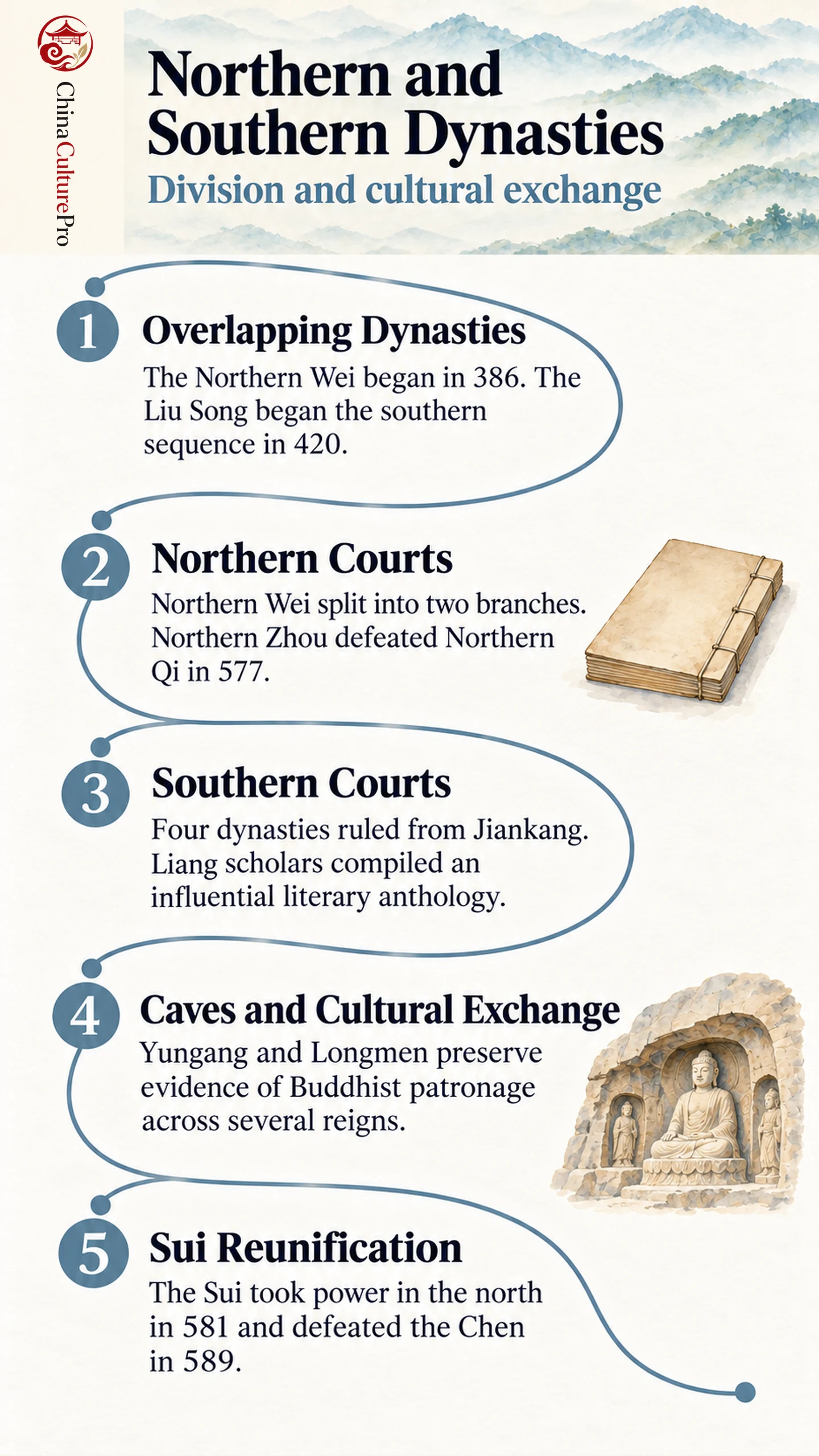
The Northern and Southern Dynasties (南北朝, Nánběicháo) were overlapping regimes in China, commonly dated as a period from 420 to 589 CE. The Liu Song (刘宋, Liú Sòng) began the southern sequence in 420. The Northern Wei (北魏, Běi Wèi) had already been founded in 386. The Sui dynasty (隋朝, Suí Cháo) ended the division in 589.[1][2][3][4][16]
- North: The Northern Wei became a major power, then divided into eastern and western regimes that had separate successors.[4][6][7]
- South: Four dynasties ruled successively from the lower Yangtze region.[1][8]
- Reunification: The Sui took power in the north in 581 and conquered the southern court eight years later.[7][16]
The northern and southern timelines overlap. Each has its own turning points.
A carved royal procession and a court anthology show two ways patrons used resources in a divided era. A northern ruler commissioned a Buddhist cave. A southern prince supported the work of selecting and preserving literature.[9][13]
Two Timelines for a Divided Era
The most common starting date, 420 CE, marks the establishment of the Liu Song after the Eastern Jin. A chronology beginning in 386 starts with the foundation of the Northern Wei. The two dates mark different events. Both bring the reader to an era in which several courts ruled at once.[1][2][3][4][8]
The northern sequence includes two branches after the Northern Wei split. The Eastern Wei (东魏, Dōng Wèi) was followed by the Northern Qi (北齐, Běi Qí). The Western Wei (西魏, Xī Wèi) was followed by the Northern Zhou (北周, Běi Zhōu). In the south, the Liu Song was followed by the Southern Qi (南齐, Nán Qí), Liang (梁, Liáng) and Chen (陈, Chén).[1][6][7][8]
| Region or branch | Dynasty | Approximate span, CE |
|---|---|---|
| North | Northern Wei | 386–534 |
| Eastern branch | Eastern Wei | 534–550 |
| Western branch | Western Wei | 535–557 |
| Eastern branch | Northern Qi | 550–577 |
| Western branch | Northern Zhou | 557–581 |
| South | Liu Song | 420–479 |
| South | Southern Qi | 479–502 |
| South | Liang | 502–557 |
| South | Chen | 557–589 |
The dates track ruling houses rather than borders. Some chronologies assign a disputed or overlapping transition to the preceding or following year.[1][2][3]
The Northern Wei and Its Successor States
The Northern Wei was founded by the Tuoba (拓跋, Tuòbá), a branch of the Xianbei (鲜卑, Xiānbēi). In 439 it united much of the north, ending the era usually called the Sixteen Kingdoms (十六国, Shíliù Guó). This consolidation occurred after the Liu Song had already been founded. Northern Wei rulers governed communities with different languages, traditions and political histories.[4][19]
The court then faced the problem of governing the territories it had brought together. By the later fifth century it had developed policies to allocate land, record obligations and collect taxes in goods and labor. The government used those arrangements to support both civilian administration and military power.[4][5]
Emperor Xiaowen (孝文帝, Xiàowén Dì) moved the capital from Pingcheng (平城, Píngchéng), near present-day Datong, to Luoyang around 494. The move placed the court in an older imperial center. The ruler encouraged new practices at court, and the ruling family adopted the surname Yuan. Reforms to names and ceremony altered official life, but a royal order tells us more about the court’s aims than about how quickly everyone’s habits changed.[4][11][12][18]
When the Northern Wei fractured, its eastern and western successors competed in their own right. The eastern court had substantial resources and military strength. The western branch eventually produced the Northern Zhou, which conquered the Northern Qi in 577. That conquest put the principal northern territories under one court. The Chen remained in power south of that court’s main territories.[1][6][7]
The Southern Courts at Jiankang
The four southern dynasties governed from Jiankang (建康, Jiànkāng), present-day Nanjing. The succession began with Liu Yu’s takeover in 420. His military supporters and links with established southern families helped him build authority. Later dynastic changes brought different ruling families to the same capital. Officials and patrons continued to work in a city with established institutions and links across the lower Yangtze.[8][16]
The south had its own court politics, but events across the frontier could change them. Hou Jing (侯景, Hóu Jǐng), a commander who broke with the Eastern Wei, obtained backing from the Liang court. He later turned against his southern patrons. His rebellion and the fighting for Jiankang weakened the Liang. The sequence shows how the decision to support a rival commander could carry a northern conflict into the politics of a southern capital.[8][20]
A southern court could also shape which texts were copied and studied. Around 520, the Liang crown prince Xiao Tong (萧统, Xiāo Tǒng) and a group of scholars compiled the Wen Xuan (文选, Wén Xuǎn), an anthology of selected literature. The collection brought poetry and prose from earlier writers together in one work. The work later circulated in different annotated editions, which gave readers new ways to approach the same selection of texts.[9]
The edition preserved in a library today has its own history. The anthology was reissued with different sets of notes, including annotations attributed to five Tang officials. That edition added a new layer of interpretation centuries after the compilation. A later commentary can tell us what later readers emphasized, while the selection of works provides evidence for earlier interests at the Liang court.[9]
Buddhist Art, Writing and Cultural Exchange
Work at the Yungang Grottoes (云冈石窟, Yúngāng Shíkū), near the Northern Wei capital of Pingcheng, began around 460. An early group of five caves is associated with the monk Tan Yao (昙曜, Tán Yào). Their closely coordinated plans and sculptures show how a large commission could develop a recognizable visual program across several spaces.[10][11]
The Longmen Grottoes (龙门石窟, Lóngmén Shíkū) developed near Luoyang after it became the capital. Carving continued there across several dynasties. A relief dated around 522–523 from the Central Binyang Cave (宾阳中洞, Bīnyáng Zhōngdòng) shows an emperor and attendants approaching worship. Emperor Xuanwu (宣武帝, Xuānwǔ Dì) commissioned the cave in honor of his parents. The emperor shown is understood to represent Xiaowen, whose reign had already ended when the relief was made.[12][13]
The procession includes people in formal dress and an attendant holding an incense burner. These details connect the image of an imperial court to Buddhist worship. A larger history of Chinese Buddhism places the commission alongside other practices and institutions. In the south, the Liang court also supported Buddhist institutions. Religious practices and images could spread between courts and communities even while the states remained politically separate.[8][10][12][13][14]
Objects outside cave temples show another kind of exchange. A Northern Qi jar with olive-green glaze has four beaded roundels with repeated human faces, a design the collection catalogue links to Central Asian imagery. The potters used the motif on a ceramic body made in China. The combination shows how a workshop could adapt a circulating motif without giving the vessel the same origin as its decoration.[17]
How the Sui Reunified North and South
After the Northern Zhou defeated the Northern Qi, it controlled the principal northern territories. Yang Jian (杨坚, Yáng Jiān) replaced the Northern Zhou ruling house and established the Sui dynasty in 581. In 589 Sui forces defeated the Chen. Those dates mark the creation of a new northern dynasty and its conquest of the south, respectively.[1][6][7][16]
The Sui inherited institutions from the northern governments it replaced. It also gained control of southern territories that had developed under several different courts. Reunification put those regions under one government after a long era in which policies and institutions had been worked out in several centers. The Chinese dynasties timeline places this change before the rise of the Tang.[5][7][16]
FAQs About the Northern and Southern Dynasties
Why do some timelines start the period in 386 instead of 420?
The date 386 marks the founding of the Northern Wei. The date 420 marks the beginning of the Liu Song, the first of the four dynasties usually grouped as the Southern Dynasties. Different timelines choose different starting events.[1][2][3][4]
Were the Northern and Southern Dynasties the same as the Six Dynasties?
The label Six Dynasties (六朝, Liùcháo) often groups Wu, the Eastern Jin and the four southern dynasties associated with the lower Yangtze capital region. It begins earlier than 420 and describes a different grouping from the parallel northern and southern sequences.[1][15]
Which dynasty reunited China after this period?
The Sui reunified the principal northern and southern territories in 589 by conquering the Chen. The Sui court itself had been founded in the north in 581.[7][16]
Sources
[1] University of Washington Press. Chronology of Dynasties
[2] Cambridge University Press. Chronology of Dynasties
[3] The Metropolitan Museum of Art. China, 1–500 CE
[4] Cambridge University Press. The Cambridge History of China: Northern Wei
[5] Cambridge University Press. The Chinese-Nomad Synthesis and the Reunification of the Empire
[6] Cambridge University Press. The Cambridge History of China: Eastern Wei–Northern Qi
[7] Cambridge University Press. The Cambridge History of China: Western Wei–Northern Zhou
[8] Cambridge University Press. The Cambridge History of China: The Southern Dynasties
[9] Library of Congress. Wen Xuan: Selected Literature
[10] UNESCO World Heritage Centre. Yungang Grottoes
[11] Getty Conservation Institute. Conservation of Ancient Sites on the Silk Road: Yungang
[12] UNESCO World Heritage Centre. Longmen Grottoes
[13] The Metropolitan Museum of Art. Emperor Xiaowen and His Entourage Worshipping the Buddha
[14] University of California Press. Buddhism in China: The Southern Dynasties
[15] University of Washington Press. Chronology of Chinese Dynasties: The Six Dynasties
[16] Columbia University. Chinese Civilization: Historical Overview of the Sui and Tang
[17] The Metropolitan Museum of Art. Northern Qi Earthenware Jar with Relief Decoration
[18] China Culture. Northern Wei: Court Reforms
[19] Cambridge University Press. The Cambridge History of China: The Sixteen Kingdoms
[20] University of British Columbia. Xiao Gang: His Life and Literature