


Quick Answer: What Was the Liao Dynasty?
The Liao dynasty (辽朝, Liáo Cháo) was a Khitan (契丹, Qìdān) empire founded by Yelü Abaoji (耶律阿保机, Yēlǜ Ābǎojī) in the early tenth century. Histories often date its beginning to 907 or 916. It ruled across parts of the eastern steppe, northeastern Asia and northern China until 1125.[1][2][3][4][16]
- Government: The court used different administrative arrangements for territories with different institutions and ways of life.[1][4]
- Diplomacy: The Chanyuan Treaty (澶渊之盟, Chányuān Zhī Méng) of 1005 established a long peace with the Song.[7][8]
- Cultural evidence: Writing, ceramics, royal burials and Buddhist buildings show how people adapted forms and practices from several regions.[9][10][12][13]
The Liao and Song were neighboring states that existed at the same time.
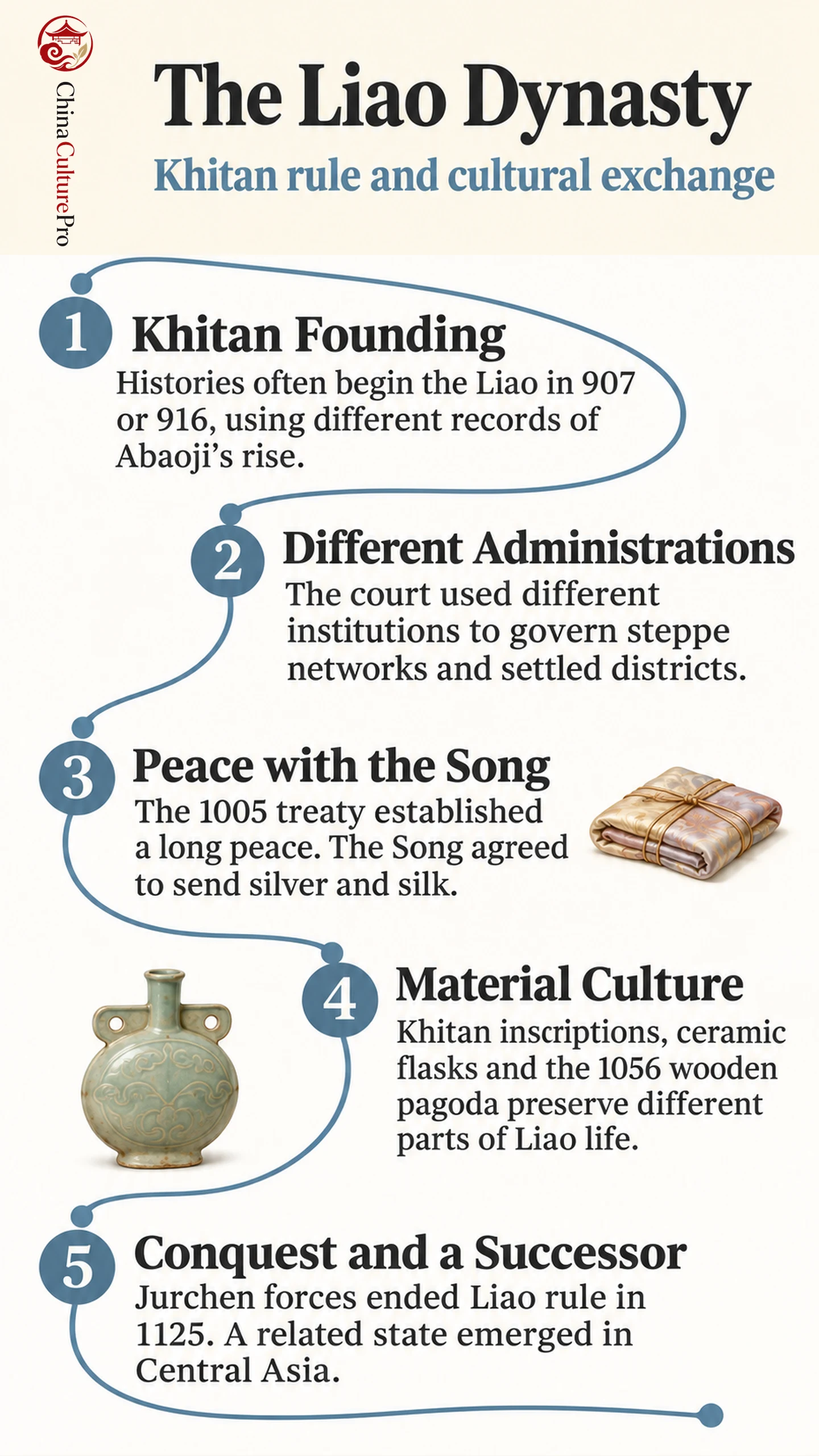
A ceramic flask preserves the shape of a leather bag. A surviving wooden pagoda documents a different scale of Liao craftsmanship.[12][13]
The Khitan Founders and the Liao Dates
Abaoji built his power among the Khitan near the end of the Tang and at the beginning of the Five Dynasties and Ten Kingdoms period. His dynasty drew on steppe political relationships and expanded its authority over communities with different forms of settlement and government. The court’s early history is preserved in several written traditions.[1][2][4]
One dynastic tradition places Abaoji’s founding accession in 907. Other records and interpretations give greater weight to 916, the start of a reign era associated with the creation of an imperial court. The choice depends partly on how historians read conflicting accounts of Abaoji’s rise and partly on which developments they count as the foundation.[1][2][3]
A written account that celebrates an early accession and a record that dates the beginning of a reign era address different events. For this reason, an object dated to a particular Liao reign can have a more specific date than the broad starting year printed in a dynasty chart.[1][2][3]
How the Liao Governed Different Regions
The court combined political practices from the steppe with bureaucratic institutions familiar in northern China. The northern administration drew on Khitan forms of leadership. The southern administration used institutions suited to settled districts and agricultural revenues. These institutions helped one court draw on both steppe networks and settled districts. Their names describe styles of administration and responsibilities, while the people living under them had varied backgrounds.[1][4]
The court maintained several capitals. Shangjing (上京, Shàngjīng), the Supreme Capital, lay in present-day Inner Mongolia. The Southern Capital (南京, Nánjīng) lay in the area of present-day Beijing. The name describes its position in the Liao network of capitals. By the late eleventh century, five cities had capital status. The emperor and his court still moved among different locations, often on a seasonal pattern. Administrative work in cities could therefore continue while the court met officials and allies elsewhere. A list of capitals helps locate fixed centers of power, while the court’s itinerary explains where decisions could also be made.[4][5][19]
Liao control of the Sixteen Prefectures (燕云十六州, Yānyún Shíliù Zhōu) increased the importance of the southern districts. The Later Jin ruler Shi Jingtang (石敬瑭, Shí Jìngtáng) had received Khitan military support in establishing his dynasty in 936. The territories were formally ceded in 938. Control of the region brought strategically important passes and settled populations under Liao rule, and it shaped later disputes with the Song.[1][6][17]
The Song Frontier and the Chanyuan Treaty
The Song dynasty competed with the Liao over the northern frontier. After fighting reached Chanyuan in 1004, the two courts negotiated a settlement conventionally dated to 1005. The Song agreed to send 100,000 taels of silver and 200,000 bolts of silk each year under the original agreement. The two governments remained separate and agreed to a political relationship that reduced the incentive for further invasion.[6][7][8]
The payments were part of a negotiated peace. The agreement also mattered because it made the frontier a place to manage in ordinary years. States had to deal with cross-border movement, military defenses and the delivery of goods. The Song maintained stretches of dense woodland on its side of the border to make movement harder for mounted forces. The frontier was both a zone of contact and an area governments continued to defend.[6][7][8]
Trade already took place across the frontier before 1005. After the treaty, the states maintained regulated market sites in Hebei, including Xiongzhou. Such markets gave merchants a place to exchange goods through recognized channels. Ceramics found in Liao territory reflect this exchange, while objects could reach buyers through other routes as well.[20]
The settlement largely held between the two states for more than a century, despite other disputes and changes in the balance of power. In 1042 the annual payments were raised to 200,000 taels of silver and 300,000 bolts of silk. These amounts belong to a later agreement. In the early twelfth century, the Song sought an alliance with the rising Jurchens against the Liao. The choice brought the period of peace to an end and altered the Song’s own position on the frontier.[8][14][17]
Scripts, Burial Goods and Buddhist Architecture
The court used two writing systems for the Khitan language. The Khitan large script (契丹大字, Qìdān Dàzì) was introduced around 920, and the Khitan small script (契丹小字, Qìdān Xiǎozì) followed around 924 or 925. The names refer to distinct systems with different forms. Inscriptions, including epitaphs, preserve examples that allow scholars to study a written language beyond the accounts of neighboring courts.[9]
The tomb of the Princess of Chen (陈国公主, Chén Guó Gōngzhǔ), who died around 1018, was excavated in 1986. Its objects include metal funerary masks and amber ornaments. A mask documents an elite burial practice. The ornaments can help historians investigate the movement of valued materials. Researchers have proposed long-distance sources for some of the amber. The tomb establishes where it was buried, while the source of the material and its route are questions of provenance.[10][11][18]
Other objects reveal borrowing in their shape. A glazed Liao flask has a body modeled after a portable leather bag. The glazed earthenware copies a shape associated with riding and travel. Near its small spout, a flat projection has two round holes. The shape recalls a bag that could be fastened or carried. This is one example of how workshops adapted familiar forms rather than simply importing a finished object.[12]
The Yingxian Wooden Pagoda (应县木塔, Yìngxiàn Mùtǎ), completed in 1056, shows the scale of Liao building in timber. Five levels are visible on the exterior. Four additional interior levels form part of the timber structure. The builders used bracket sets between columns and roof elements. It offers evidence for a tradition of architecture associated with Chinese Buddhism that survives alongside the portable goods found in tombs.[13][21]
The Jurchen Conquest and Western Liao
The Jurchen Jin (女真金朝, Nǚzhēn Jīn Cháo) was proclaimed in 1115. The Song and Jurchens planned coordinated campaigns, with the Song to take the Liao Southern Capital. In 1122 the Jurchens captured the Central and Western capitals. When their ally failed to take the Southern Capital, the Jurchens took it as well and later handed it over to the Song. Control of the cities shifted before the ruling house had lost its last emperor. In 1125 Jin forces captured him. That capture ended the Khitan dynasty’s rule in its original territory.[14][16]
A member of the Liao ruling house, Yelü Dashi (耶律大石, Yēlǜ Dàshí), went west. His followers established a new center of power in Central Asia. Their westward movement carried a dynastic tradition into a region with its own rulers and political alliances. The resulting state is called Western Liao (西辽, Xī Liáo), or Qara Khitai. It preserved a connection to Khitan rule while governing a different territory and political setting. The Mongols ended it in 1218.[15][16]
FAQs About the Liao Dynasty
Why do some dates start the Liao in 907 and others in 916?
Different written traditions and chronologies give weight to Abaoji’s founding accession or to the imperial developments associated with the beginning of his reign era in 916. Both dates appear in histories of the same court.[1][2][3]
Did the Liao and Song exist at the same time?
Yes. The Liao ruled north of much of the Song’s territory. The two governments negotiated the Chanyuan Treaty in 1005 and maintained a long peace before the rise of the Jurchen Jin changed their relationship.[4][7][8]
Was Western Liao the same state as the Liao dynasty?
Western Liao was a successor founded in Central Asia by Yelü Dashi and his followers. It retained a dynastic connection to the Liao, while its territories and political setting were different.[15][16]
Sources
[1] Cambridge University Press. The Cambridge History of China: The Liao
[2] Journal of Chinese Humanities. The Founding Year of the Khitan Dynasty: A Textual Investigation
[3] Shandong University. A Political Time Rewritten: Revisiting the Founding Year of the Khitan Empire
[4] OpenStax. Song China and the Steppe Peoples
[5] Cambridge University Press. The Cambridge History of China: Alien Regimes and Border States, Front Matter
[6] Journal of Chinese History. Frontier Fortification and Forestation on the Song–Liao Border
[7] Columbia University. The Song Dynasty’s Outside Rivals
[8] Cambridge University Press. The Song–Jurchen Conflict in Chinese Intellectual History
[9] Institute of Oriental Manuscripts, Russian Academy of Sciences. Proposal to Encode the Khitan Small Script
[10] China Culture. Tomb of the Princess of Chen
[11] Archaeology Magazine. The Princess of Chen’s Necklaces
[12] Cleveland Museum of Art. Leather Bag-Shaped Flask with Cover
[13] UNESCO World Heritage Centre. Wooden Structures of the Liao Dynasty: Tentative List Nomination
[14] Cambridge University Press. The Cambridge History of Chinese Literature: North and South, Twelfth and Thirteenth Centuries
[15] Cambridge University Press. The Empire of the Qara Khitai in Eurasian History: Introduction
[16] University of Tübingen. Historical Study of the Khitan, Jurchen and Western Liao
[17] University of Virginia. Territory, Sovereignty and Empire: The Liao–Song Treaty of Chanyuan
[18] Journal of Gems & Gemmology. Resource Acquisition and Cultural Interaction of Amber in the Liao Dynasty
[19] British Journal of Chinese Studies. Courting Capitals: Liao Cities and Imperial Itinerance
[20] Springer Nature. Imported Ceramics in the Liao Territory
[21] Changchun Institute of Technology. Yingxian Wooden Pagoda