

Quick Answer: What Does Manchu Culture Include?
Manchu(满族,Mǎnzú)culture includes community histories, a Tungusic language, distinctive writing, changing dress and food traditions, and locally transmitted arts.
- Communities: Manchu people live across China, with important concentrations in the northeast, Hebei and Beijing. [1]
- History: Imperial institutions are one part of the subject, alongside family and local life.
- Language: Speaking Chinese today does not erase Manchu identity.
- Material culture: Historic robes and familiar pastries reveal both distinctive practices and exchange.
- Living arts: Oral narratives and local paper traditions preserve different kinds of knowledge.
Manchu culture cannot be reduced to palace costume or a single lifestyle. Historical objects, regional practices and present-day identity need separate explanations.
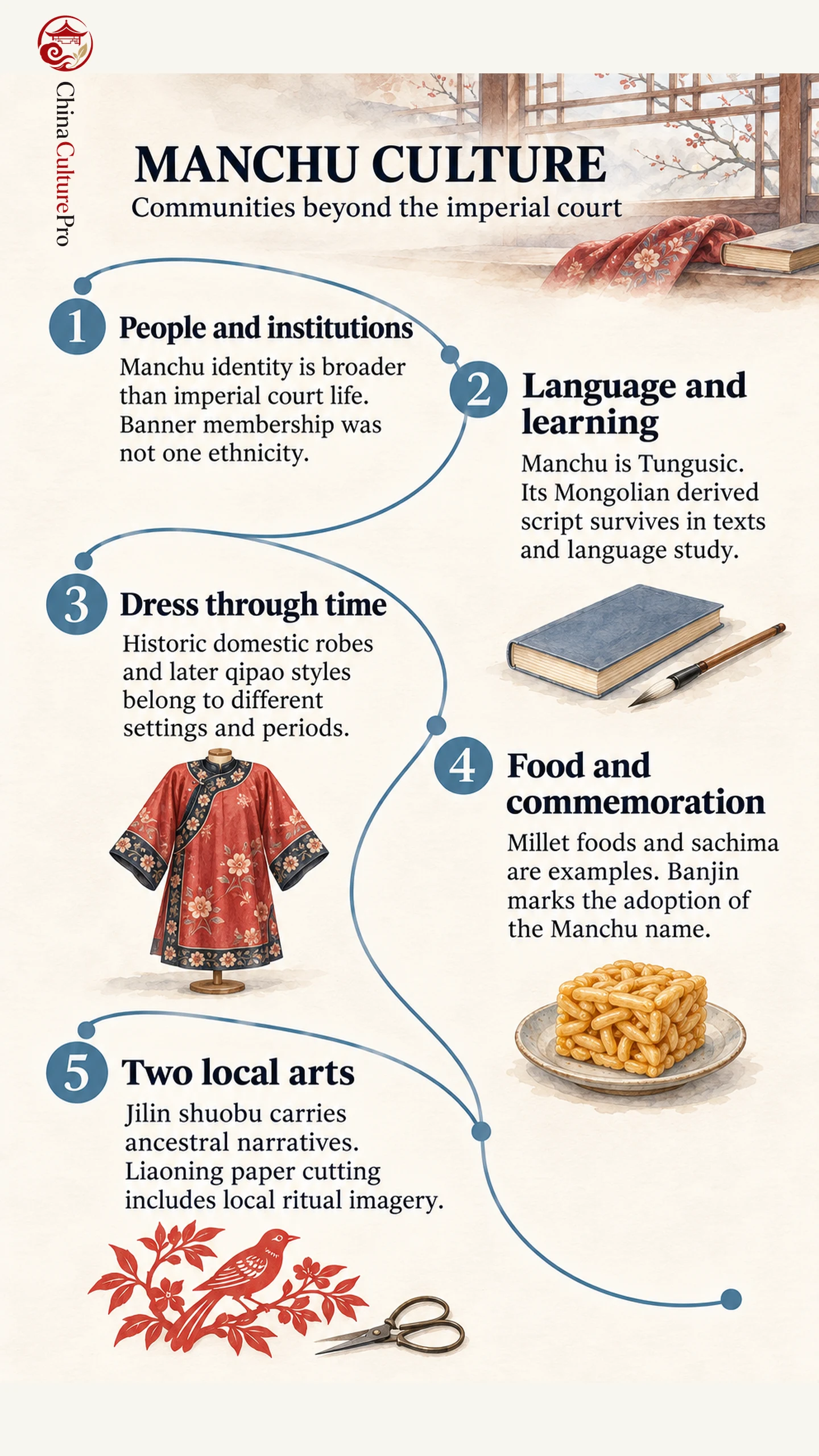
A silk robe, a family narrative and a language lesson illuminate different parts of Manchu experience. Understanding them starts with separating the people from the empire they helped establish—and recognizing that cultural transmission can continue through changed languages, settings and forms.
Manchu Communities, Qing History and the Eight Banners
The Qing dynasty(清朝,Qīngcháo)was founded by Manchu rulers, but its population encompassed many peoples. The name Manchu was formally adopted in 1635, replacing Jurchen(女真,Nǚzhēn)in the emerging state’s official naming; the dynastic name Qing followed in 1636. These dates concern political naming, rather than the sudden creation of every community practice. [3]
The Eight Banners(八旗,bāqí)combined military organization with social administration. Their divisions included Manchu, Mongol and Han banners. Banner membership therefore cannot be used as a simple synonym for Manchu ethnicity. Garrisons also connected banner communities to cities far beyond the northeast. [2]
Today, China’s ethnic categories identify Manchu as a distinct group. Northeastern regional culture provides important context, while communities in Beijing, Hebei and elsewhere have their own local histories. Neither a northeastern address nor imperial ancestry describes everyone. [1] The history of Mongolian communities in China likewise extends beyond their place within the banner system.
Manchu Language, Script and Ways to Learn
The Manchu language(满语,Mǎnyǔ)belongs to the Tungusic family. It was extensively used in imperial administration and survives in historical, literary and religious texts. Intergenerational spoken transmission is severely limited; many Manchu people use Chinese in everyday life. Avoid treating language fluency as a requirement for belonging, or describing the language simply as extinct. [1][4]
Manchu script(满文,Mǎnwén)was adapted from Mongolian writing in 1599 and revised with distinguishing dots and circles in 1632. It is written vertically, with connected letter forms organized along a vertical stem. A borrowed writing system does not make Manchu and Mongolian the same language. [5][13] Sibe culture offers a closely related linguistic context, but the two community identities should remain distinct.
Learning can involve more than recognizing decorative lettering. Harvard’s course descriptions progress from script and grammar to documents, stories and diaries. Digitized Manchu holdings at Harvard-Yenching Library include translations of Chinese classics alongside original publications and records; the catalog can be searched through romanized entries. [6][7]
Historic Robes and the Changing Qipao
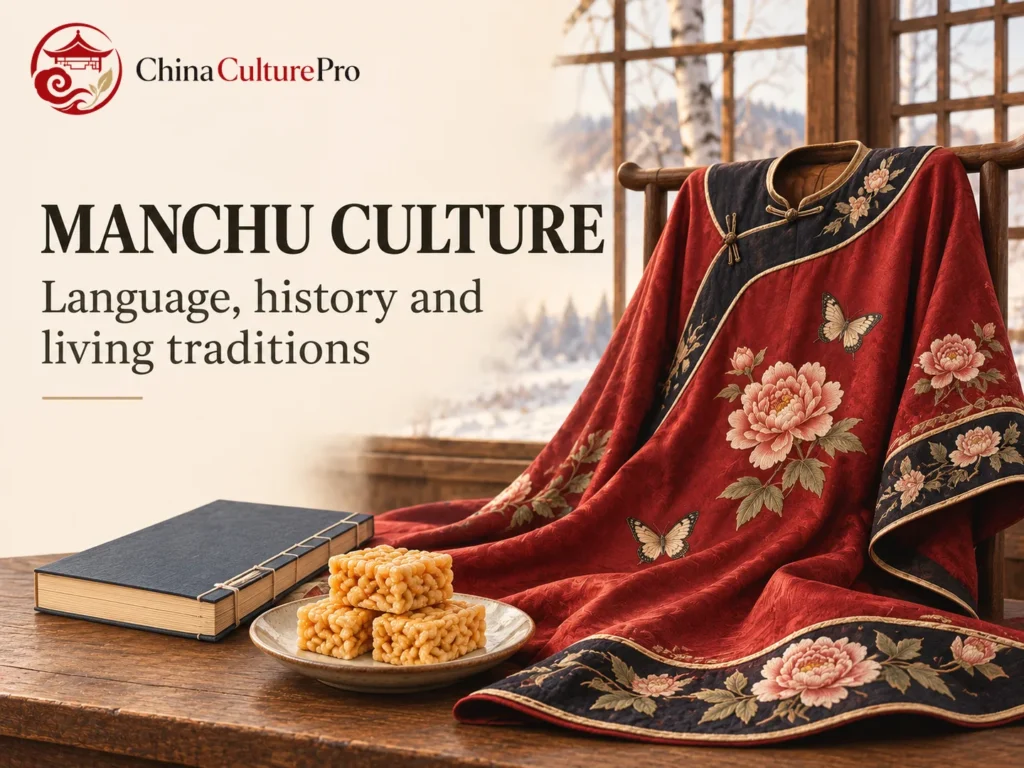
Historic dress is best understood through a garment’s date, wearer and setting. One silk robe dated approximately 1900, object 2007.67 at San Francisco’s Asian Art Museum, has peonies and butterflies on a red ground, framed by dark floral bands. It exemplifies formal domestic attire for wealthy Manchu women, rather than a uniform worn by every woman or an imperial court costume. [8]
The familiar twentieth-century qipao(旗袍,qípáo)developed from earlier robe traditions, with changed cuts and social uses. The close-fitting dresses associated with the 1920s and 1930s should not be projected unchanged into earlier centuries. [8]
This distinction also helps when reading exhibitions: embroidery, silhouette and an ethnic label cannot establish the wearer’s exact rank or daily routine by themselves. A dated domestic robe supplies a specific example; it does not summarize all Manchu clothing.
Food Traditions and the Banjin Festival
Millet meals, yellow-millet bean buns and pastries feature in descriptions of Manchu food traditions. Sachima(萨其玛,sàqímǎ)is a recognizable sweet: fried dough strips are coated with sugar and formed together. Its association with Manchu food coexists with later regional versions, including a documented tradition in Guangdong’s Pengjiang district. [9][10]
Foods circulate between communities, so eating a pastry does not identify someone’s ethnicity. Nor should an elaborate imperial banquet replace an account of everyday food. These shared and changing habits belong within the broader picture of Chinese food culture.
The Banjin Festival(颁金节,bānjīn jié)commemorates the adoption of the Manchu name. Celebrations mark the thirteenth day of the tenth lunar month, associated with the 1635 naming. Descriptions of recent celebrations support its role as a modern commemorative practice; they do not establish an unchanged festival observed continuously since that year. [9]
Storytelling, Paper Cutting and Local Beliefs
Two documented traditions show why “Manchu art” needs local and practical detail. Shuobu(说部,shuōbù)is long-form oral storytelling associated with clan histories, ancestors and heroic narratives. In the Yiwulü Shan(医巫闾山,Yīwūlǘshān)area of Liaoning, paper cutting(剪纸,jiǎnzhǐ)includes imagery linked to nature, ancestors and ritual life. [11][12]
| Tradition | Form and cultural role |
|---|---|
| Manchu shuobu in Jilin | Extended narration interwoven with singing; ancestral and heroic material transmits community memory. |
| Yiwulü Shan Manchu paper cutting in Liaoning | Bold, simplified cut-paper imagery includes local ritual themes associated with shamanic traditions. |
Both entered China’s national intangible heritage list in 2006. That designation recognizes particular practices, not an invention date or a guarantee that every Manchu person participates. [11][12]
Shuobu was transmitted in Manchu and later also in Chinese with Manchu elements, showing how narrative can continue through language change. Its stories carry cultural memory, but individual episodes still require historical evaluation. [11] The paper-cutting record also includes bearers identified as Han and Manchu: a tradition’s name need not imply exclusive participation. [12] For comparison, Chinese performing arts encompass many distinct relationships between language, occasion and audience.
FAQs About Manchu Culture
Are All Qing Dynasty Subjects Manchu?
No. Manchu rulers governed a multiethnic population. Even the banner institution included Manchu, Mongol and Han divisions, so dynasty, banner membership and ethnicity are different categories.
Do All Manchu People Speak Manchu?
No. Many use Chinese in daily life. Language study and cultural identity overlap, but fluency is not a universal feature of contemporary Manchu communities.
Is Every Qipao a Qing Court Robe?
No. Earlier domestic robes and court garments had different settings, while twentieth-century qipao styles developed new silhouettes and uses.
Does All Manchu Art Have a Religious Purpose?
No. Some local practices have ritual associations, but that does not establish a religious purpose for every artwork or a shared belief among all Manchu people.
Sources
[1] National Ethnic Affairs Commission. Manchu: overview
[2] Palace Museum. The Eight Banners system
[3] Palace Museum. Hong Taiji: the first Qing emperor
[4] Harvard University, East Asian Languages and Civilizations. Manchu
[5] National Ethnic Affairs Commission. Why was the Zizhi Tongjian translated into Manchu?
[6] Harvard University, East Asian Languages and Civilizations. Manchu courses
[7] Harvard-Yenching Library. Mongolian and Manchu Collection
[8] Asian Art Museum. Manchu woman’s robe with peonies and butterflies, 2007.67
[9] National Ethnic Affairs Commission. Manchu customs
[10] Pengjiang District Culture, Radio, Television, Tourism and Sports Bureau. Intangible heritage foods of Pengjiang
[11] China Intangible Cultural Heritage Network. Manchu shuobu
[12] China Intangible Cultural Heritage Network. Yiwulü Shan Manchu paper cutting
[13] Unicode Consortium. The Unicode Standard, Chapter 13: South and Central Asia II