

Quick Answer: What Is Mongolian Culture in China?
Mongolian(蒙古族,Měnggǔzú)culture in China includes regional languages, writing, music, gatherings, beliefs and everyday knowledge. It shares connections with communities across borders while developing within specific local histories.
- Regional identity: Communities extend beyond Inner Mongolia, and ethnicity differs from citizenship of Mongolia.
- Language and writing: Regional speech varieties coexist with traditional written forms.
- Music: Vocal traditions and bowed instruments have distinct techniques and uses.
- Gatherings and belief: Sporting festivities and sacred landscape rites have different roles, even when connected.
- Daily life: Dairy craft has important cultural associations, while livelihoods include farming, herding and urban work.
Pastoral heritage is important, but it is not a complete description of every Mongolian person’s life in China.
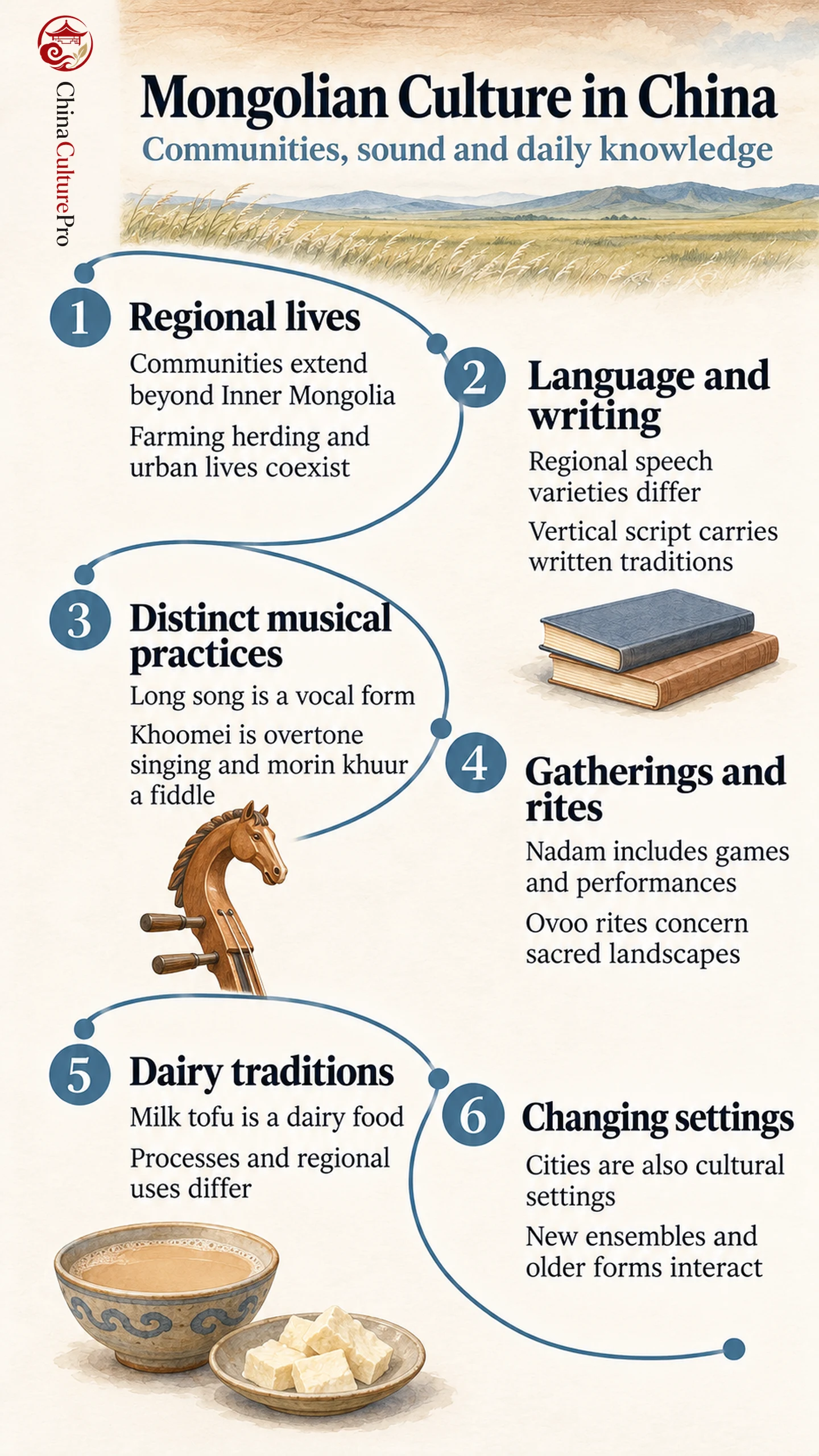
A sustained vocal phrase, a bowed fiddle and a shared bowl of tea offer different ways into Mongolian culture. Their meanings depend on performers, makers and settings. This guide focuses on communities in China, distinguishing regional practices from images drawn solely from grasslands or from the neighboring country of Mongolia.
Regional Communities and Different Ways of Life
Inner Mongolia is a major center, but Mongolian communities also live in Liaoning, Xinjiang, Qinghai and other parts of China. [1] The ethnic groups guide explains why an ethnic category should not be confused with a provincial population or a nationality understood as citizenship.
Pastoralism has a prominent place in cultural imagery. Yet agricultural communities in eastern Inner Mongolia are often overlooked in representations centered on herding. [2] A photograph of a horse and grassland can express a real association while leaving many lives outside the frame.
Seasonal movement between pastures should also be distinguished from aimless wandering. [2] Herding involves knowledge of land and timing; it is one livelihood rather than an inherited personality. The wider cultural geography guide connects such practices with changing environments and settlements.
Language and the Vertical Mongolian Script
The Mongolian language(蒙古语,Měnggǔyǔ)has regional varieties. Language-resource documentation distinguishes Inner Mongolian, Bargu–Buryat and Oirat varieties and records more localized speech forms. These distinctions matter when identifying a recording, speaker or teaching resource. [1]
Mongolian script(蒙古文,Měnggǔwén)is also part of that variation. Traditional written forms include the Clear Script(托忒文,Tuōtèwén)associated with Oirat. [1] The classical vertical script is a distinctive written tradition in Inner Mongolia. [2]
Script, language and citizenship answer different questions. A vertical written text does not tell a reader everything about its author’s spoken variety. Nor should a description of writing in China be replaced automatically with an account of Cyrillic writing in Mongolia. Comparative histories are useful when their locations and periods remain clear.
Long Song, Khoomei and Morin Khuur
These familiar names refer to different kinds of musical practice.
| Form | What distinguishes it |
|---|---|
| Long song(长调民歌,chángdiào míngē), or urtiin duu | A vocal form with extended syllables, elaborate ornamentation and a wide melodic range. |
| Khoomei(呼麦,hūmài) | Overtone singing that makes a higher tone audible alongside a sustained lower vocal sound. |
| Morin khuur(马头琴,mǎtóuqín) | A bowed, two-stringed instrument associated with a carved horse-head finial, rather than a vocal style. |
The vocal traditions differ from one another and from instrumental playing. The fiddle can accompany singing, but accompaniment does not make the voice and instrument the same art. [3][4][5]
Heritage records also have specific geographic scopes. UNESCO’s long-song inscription involves Mongolia and China. The 2009 entry titled Mongolian art of singing, Khoomei was nominated by China. Shared practice across borders should not be mistaken for identical nomination histories. [3][4]
These distinctions help a listener compare performances within the wider performing arts tradition without reducing them all to “throat singing.”
Nadam and Ovoo Rites Have Different Roles
Nadam(那达慕,nàdámù)is a gathering associated with activities such as horse racing, archery and wrestling. Heritage records from Qinghai and Xinjiang also describe music, dance, storytelling and craft displays. Programs depend on the event and locality; the name does not prescribe one schedule for every community. [6]
An ovoo(敖包,áobāo)is a mound, often of stones, associated with a sacred landscape and ritual observance. The Xilingol heritage account describes prayers for the well-being of people and animals and notes changes associated with Tibetan Buddhism(藏传佛教,Zàngchuán Fójiào). These are descriptions of religious practices and beliefs, rather than claims that offerings guarantee an outcome. [7]
A rite may be connected with subsequent festivities, but its purpose differs from that of a sporting contest. Place, organizers and participants give each occasion its particular character. Connections with Tibetan religious traditions likewise do not mean that the cultures are identical or that every individual follows one religion.
Dairy Foods and Tea: Materials, Names and Uses
Milk tofu(奶豆腐,nǎidòufu)is a dairy food, despite its English name. A Horqin Left Rear Banner food account describes curd products with differing textures and tastes, alongside milk tea(奶茶,nǎichá)as part of local food traditions. The ingredient distinction matters: this “tofu” is not made from soybeans. [8]
Chagan Idee(察干伊德,chágān yīdé), often translated as “white foods,” names a wider dairy tradition. Its national heritage record identifies Zhenglan Banner as a representative area. Transforming milk through processes including fermentation and separation produces different dairy foods. [9]
This is a craft perspective on fermented foods, rather than a recipe or a nutritional promise. A regional dairy tradition also does not establish the contents of every household’s daily menu. Food names, ingredients and social uses need to be read together.
Music Moves Between Grasslands and Cities
Urban settings are part of cultural life. A 2014 Smithsonian account describes Mongolian musicians in Beijing performing across a spectrum from inherited vocal traditions to hip-hop. [10] This dated example shows why a city performance need not be dismissed as outside the culture merely because it occurs away from a pastoral setting.
Modern versions of the horse-head fiddle also come in different sizes and registers. [5] Changes in ensemble and instrument design can be studied alongside older uses, rather than ranked automatically as more or less authentic.
A useful introduction therefore keeps several questions open: which community, which musical form, which instrument and which setting? Those details make cultural continuity and change visible without assuming that all practices remain fixed.
FAQs About Mongolian Culture in China
Does Mongolian Identity Mean Citizenship of Mongolia?
No. Ethnic identity and citizenship are separate. This guide concerns Mongolian communities in China, while recognizing cultural connections across borders.
Are All Mongolian People in China Nomadic Herders?
No. Agricultural and urban lives are also part of the picture. Pastoral heritage does not describe every person’s livelihood or home.
Is Long Song the Same as Throat Singing?
No. Long song is a vocal form associated with extended phrases and ornamentation. Khoomei uses overtone singing; the terms describe different musical practices.
Does Every Nadam Follow the Same Schedule?
No. Dates, activities and arrangements differ between events and localities. A schedule from one community should not be applied to all gatherings.
Sources
[1] Minzu University language resource center. Mongolian language use and writing (2024)
[2] Thomas White, Current History. Pastoralism and the State in China’s Inner Mongolia (2021)
[3] UNESCO. Urtiin Duu, traditional folk long song
[4] UNESCO. Mongolian art of singing, Khoomei
[5] Chan Chi chun, Hong Kong Music Office. Roving Exhibition: Music of Inner Mongolia
[6] China Intangible Cultural Heritage Network. Nadam, Hejing project record
[7] China Intangible Cultural Heritage Network. Ovoo rites, Xilingol
[8] Horqin Left Rear Banner government. Local products: dairy foods and tea
[9] China Intangible Cultural Heritage Network. Chagan Idee dairy making, Zhenglan Banner
[10] Smithsonian Institution. Reimagining Mongolian Music in China (2014)