


Quick Answer: What Does Tajik Culture in China Include?
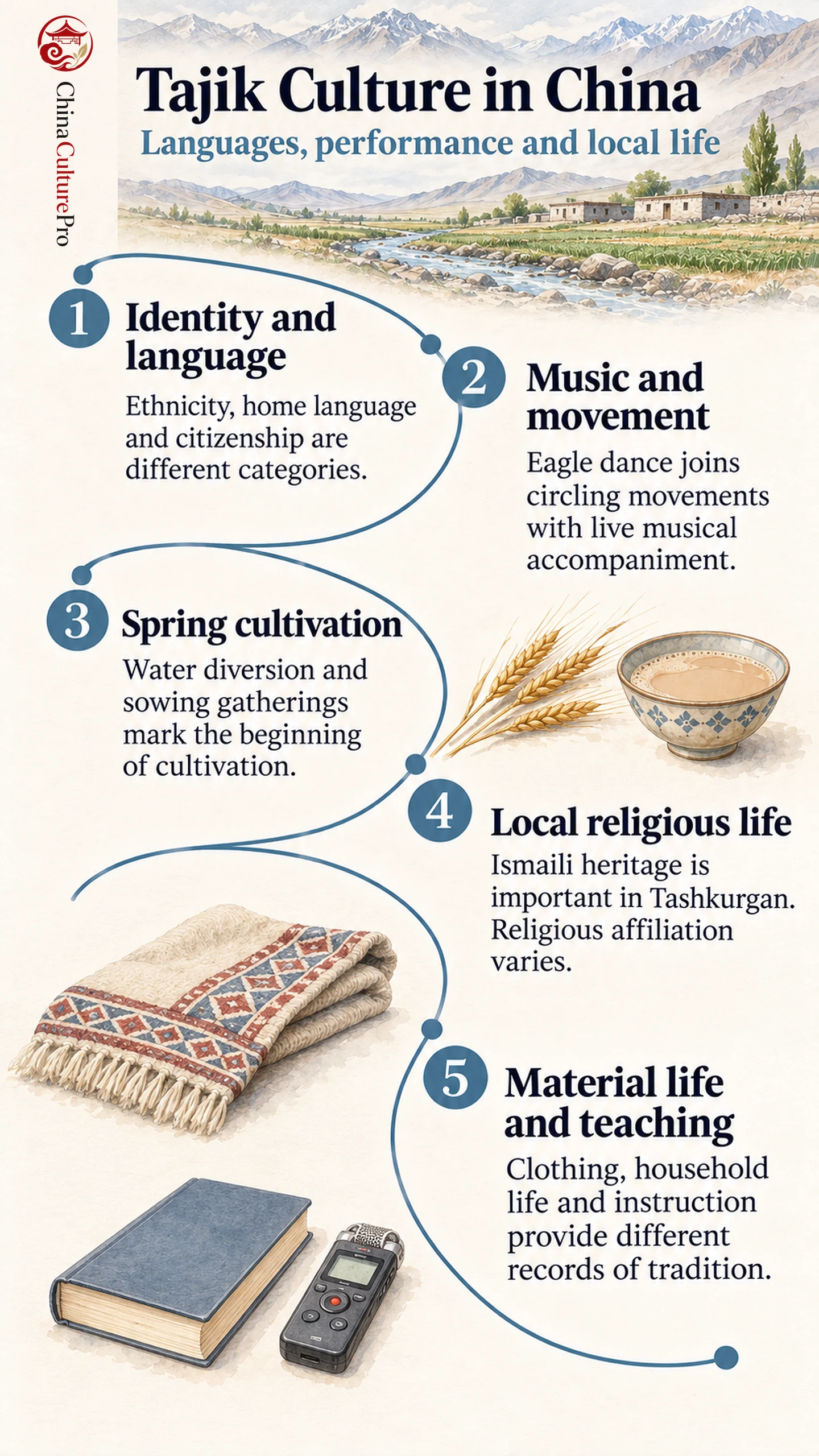
Tajik(塔吉克族,Tǎjíkèzú)culture in China includes the languages, performance traditions, religious heritage and household life of communities associated especially with the eastern Pamirs.
- Communities: Tashkurgan in Xinjiang is a major center, alongside other southern Xinjiang settlements. [1]
- Languages: Sarikoli(色勒库尔语,Sèlèkù’ěr yǔ)and Wakhi(瓦罕语,Wǎhǎn yǔ)belong to the Eastern Iranian language group; the ethnic label does not make them Persian. [2]
- Music and dance: Eagle-inspired movements interact with flute, drum and string accompaniment. [4]
- Seasonal life: Water diversion and sowing celebrations connect community gatherings with spring cultivation. [5]
Ethnicity, home language and citizenship are distinct categories.
Circling arms and turning bodies draw attention to a performance. Behind the performance are musicians, family gatherings, cultivated valleys and several language communities. This guide places those relationships within China’s ethnic diversity, with examples grounded in named places and documented practices.
Pamir Communities and the Meaning of Tajik
Tashkurgan Tajik Autonomous County lies in southwestern Xinjiang. Other Tajik communities live in places including Yarkand, Zepu, Akto, Yecheng and Pishan; their settings extend beyond the best-known highland county. [1]
The Pamirs also connect communities across several national borders. Within China, Sarikoli and Wakhi speakers share an official Tajik ethnic classification, while retaining distinct language names. That classification operates differently from a passport or the name of a country’s majority language. [2]
Chinese cultural geography provides a broader framework for understanding how mountain regions intersect with administrative boundaries.
Sarikoli and Wakhi: Languages Beyond the Label
Sarikoli and Wakhi are Eastern Iranian languages within the Indo-European family. Standard Tajik, associated with Persian, belongs to the Western Iranian group. “Tajik” therefore has different meanings in linguistic classification and Chinese ethnic administration. [2]
Neighboring languages have other affiliations: Uyghur and Kyrgyz belong to the Turkic family. Regional contact does not erase those distinctions.
Oral use also differs from scholarly documentation. A 2014 Sarikoli grammar thesis analyzes relative, complement and adverbial clauses, comparing constructions with related languages. The thesis examines how speakers join clauses to express relationships such as time, purpose and condition. This kind of grammatical documentation records how a language works, beyond a list of words or translated names. [3]
Eagle Dance and Its Musical Accompaniment
The eagle dance(鹰舞,yīngwǔ)became a national intangible cultural heritage project in 2006, with Tashkurgan as its declaring locality. Documented forms include paired dancing, improvisation, circling and turns. Some begin with extended arms and measured movement before becoming quicker and more competitive. [4]
The eagle flute(鹰笛,yīngdí)is one important instrument, alongside frame drums and plucked or bowed strings. One documented drum technique has two women playing a single drum. The flute’s phrases and changing drum patterns help organize the dancers’ timing; accompaniment is part of the performance’s structure, rather than background decoration. Eagle imagery belongs to the tradition’s aesthetic vocabulary, rather than establishing a literal account of ancestry. [4]
Watching the exchange between dancers and musicians offers a useful entry into Chinese traditional music.
Water Diversion and Sowing Festivals
The Water Diversion Festival(引水节,Yǐnshuǐjié)and Sowing Festival(播种节,Bōzhǒngjié)are agricultural observances associated with Tashkurgan. Their joint national heritage listing dates to 2006. The documented seasonal setting is the beginning of spring sowing. [5]
Families contribute wheat, gather in the fields and select a respected elder to scatter seed. These actions link cultivation with shared participation: households contribute to a collective occasion, and the first sowing has an explicitly communal form. [5]
This agricultural context matters when interpreting photographs of celebration. A dance performed during spring festivities may be part of a farming observance, while the same dance vocabulary can appear in other social or staged settings. The event’s name and location explain more than costume alone.
Ismaili Heritage and Local Religious Differences
Ismaili Shi‘i Islam is an important part of Tajik religious heritage in the Tashkurgan region. A 2016 ethnographic account documents sacred sites associated with graves, trees, springs and rock formations, together with visits, offerings and locally transmitted narratives. Stories about saints or blessings express religious understandings; they are not independently established accounts of supernatural events. [6]
Religious affiliation is not identical across the official ethnic category. The same study specifically identifies Sunni Muslim Tajiks in an Akto County ethnic village. Its observations concern particular communities and a particular research period, rather than every household’s present practice. [6]
That distinction belongs within the wider diversity of religion in China.
Traditional Dress, Homes and Food
Traditional Tajik dress entered the national heritage list in 2011, again through Tashkurgan. Its documented repertoire includes caps, headscarves, robes, trousers, skirts, belts, footwear and jewelry, using materials ranging from cotton and silk to wool and leather. [7]
Differences can express age, marital status and occasion. A ceremonial outfit is therefore one part of a clothing system, rather than a complete description of what people wear throughout the year. The heritage record also discusses the changing relationship between traditional making and commercially available clothing. [7]
A customary house description includes thick stone walls, timber roofing, a central skylight and raised sitting or sleeping areas. Seasonal pastoral shelters are another setting. Food descriptions emphasize flour-based dishes, dairy products, meat and milk tea, with differences between farming and herding households. [8]
The customary account connects seasonal herding with different dwelling types and distinguishes farmers’ diets from herders’ diets. It documents those relationships without establishing how frequently each practice occurs in present-day households. The broader context is Chinese food culture.
Teaching, Performance and Cultural Documentation
Transmission can happen through explicit teaching as well as participation. At a Beijing museum event on March 4, 2023, Tajik performers joined researchers and music specialists for demonstrations, explanations and audience instruction. Teaching addressed steps, wrist and arm movements, rhythm and instrument technique. This is a documented example of formal explanation accompanying live performance. [9]
For readers exploring Chinese performing arts, the distinction is useful: a museum demonstration makes selected elements visible to a new audience, while a community occasion has its own participants and purposes.
A research lecture programme dated September 16, 2026, focused on Xinjiang’s Ismaili Tajiks through ethnographic fieldwork, oral history, ritual and storytelling. Its stated approach treats tradition as something people continually reinterpret and transmit. It provides another way to study cultural continuity alongside performance and heritage listings. [10]
FAQs About Tajik Culture in China
Are Chinese Tajiks Necessarily Citizens of Tajikistan?
No. “Tajik” can identify an officially recognized ethnic group in China. It does not by itself state someone’s citizenship or establish that their home language is the standard language of Tajikistan. [2]
Are Sarikoli and Wakhi Forms of Persian?
They are classified as Eastern Iranian languages. Persian and standard Tajik belong to the Western Iranian group. Shared Iranian affiliation does not make the languages interchangeable. [2]
Is Eagle Dance Performed Only by Men?
No. Documented forms include men dancing together and mixed participation, as well as forms particularly associated with women. The participants and accompaniment depend on the form and setting. [4]
Do All Chinese Tajiks Follow the Same Religious Tradition?
No. Ismaili heritage is prominent in Tashkurgan, but ethnographic documentation also identifies Sunni Tajiks in Akto. Ethnicity alone does not specify every person’s affiliation or observance. [6]
Sources
[1] National Ethnic Affairs Commission. Tajik overview
[2] Leyli R. Dodykhudoeva. Nomenclature of the Minority Pamir Languages in Russia and Tajikistan: origin and evolution
[3] Deborah Kim. Subordination in Sarikoli
[4] China ICH Network. Tajik eagle dance
[5] China ICH Network. Tajik water diversion and sowing festivals
[6] Amier Saidula. Landscapes of Spirituality: The Topography of Ismaili Sacred Sites in Xinjiang, China
[7] China ICH Network. Tajik traditional dress
[8] National Ethnic Affairs Commission. Tajik customs
[9] Liu Xiao / China Arts and Crafts Museum and China National Arts and Crafts Intangible Cultural Heritage Museum. Lecture and demonstration on holistic protection of Tajik eagle dance
[10] Institute of Ismaili Studies / Amier Saidula. Ismailis of China: history, culture and tradition