


Quick Answer: What Does Daur Culture Include?
Daur(达斡尔族,Dáwò’ěrzú)culture includes a Mongolic language, narrative performance, folk songs, dance, traditional hockey and regional household traditions.
- Communities: Major centers lie in Inner Mongolia and Heilongjiang, with another community around Tacheng in Xinjiang. [1]
- Language: Daur is related to other Mongolic languages but is a distinct language. [3]
- Performance: Storytelling, lyrical songs and group dances have different structures and uses. [5][6][7]
- Everyday life: Agriculture, livestock, fishing and other work shaped food, homes and seasonal gatherings. [9]
Neither a northern hunting image nor a single stage costume captures every Daur community. Culture changes through migration, contact and individual practice.
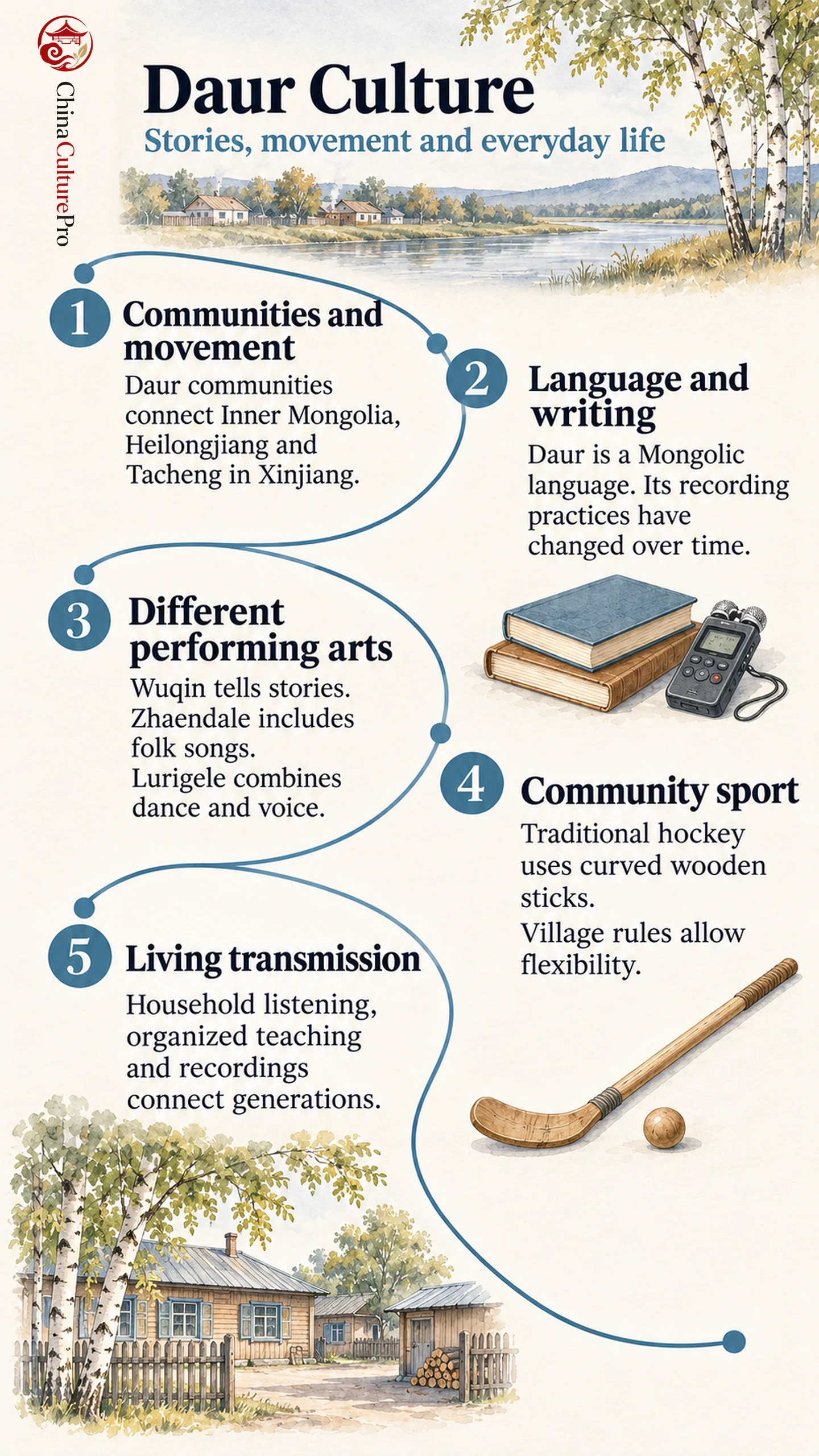
A Daur narrative singer, a dance gathering and a village hockey match communicate different kinds of knowledge. Following those differences opens a fuller picture of communities whose histories connect the rivers of northeastern China with settlements much farther west.
Daur Communities and Historical Migration
Daur communities include Morin Dawa Daur Autonomous Banner and other parts of northeastern Inner Mongolia, Qiqihar and nearby areas in Heilongjiang, and Tacheng in Xinjiang. This distribution spans several local histories rather than one compact cultural territory. [1]
Seventeenth-century conflict and Qing administration helped drive movement from areas north of the Amur toward the Nen River. Later garrison assignments brought some families to other northeastern locations and to Tacheng. Historical accounts also describe hala(哈拉,hālā)clan groupings and smaller mokun(莫昆,mòkūn)family organizations that structured cooperation and local affairs. [2]
These histories belong within northeastern regional culture, but they should not erase Xinjiang communities. A clan name, an administrative unit and an official ethnic category describe different relationships.
Language and Ways of Recording It
Daur, also written Dagur in linguistic scholarship, belongs to the Mongolic language family. This is a family relationship, not a statement that Daur speech is simply standard Mongolian spoken with an accent. Daur grammatical features also help researchers study historical relationships among Mongolic languages. [3]
Language documentation distinguishes varieties associated with Butha, Qiqihar, Hailar and Xinjiang. A 2024 language-resource profile records both speech surveys and newly created writing, illustrating why the old shorthand “a people without writing” needs qualification. It does not establish that every household uses the same orthography. [4]
Some historical Daur narrative works were also composed using Manchu writing. Such borrowing shows contact with Manchu culture while preserving a distinction between the language of a performance and the script used to record it. [12]
Three Distinct Forms of Daur Performance
These forms share a cultural setting but give listeners different things to follow.
| Form | What to listen or look for |
|---|---|
| Wuqin(乌钦,wūqīn) | Also called Wuchun, this narrative art combines verse and storytelling about work, social life, historical struggles and other subjects. Some performers sing without accompaniment; others accompany themselves on a four-stringed bowed instrument. [5] |
| Zhaendale(扎恩达勒,zhā’ēndálè) | Folk songs include lyrical and narrative pieces, sung alone or in exchanges. Question-and-answer singing, improvisation and vocables are important features; subjects include work, love, weddings and lullabies. [6] |
| Lurigele(鲁日格勒,lǔrìgélè) | Group dance combines upper-body and arm movements, side-sliding steps and vocal calls. Everyday actions such as carrying water, gathering and fishing appear in its movement vocabulary. Hakumaile(哈库麦勒,hākùmàilè)is a regional name associated with this tradition. [7] |
The national register dates Lurigele to 2006 and Zhaendale to 2008. The Morin Dawa Wuqin entry is a 2008 extension of an earlier listing. These are administrative recognition dates, rather than dates when the arts began. [5][6][7]
As with other Chinese performing arts, a short festival presentation shows one selection from a much wider repertoire. The named form matters more than a generic label such as “ethnic song and dance.”
Traditional Hockey and Community Sport
Traditional Daur hockey uses a curved wooden stick called beikuo(贝阔,bèikuò). Games have used wooden or hair-based balls, with equal teams trying to score at opposing goals. Open village spaces and grass fields provided settings for matches during gatherings and leisure time. [8]
The heritage tradition does not require one fixed field size or team number. That flexibility distinguishes local customary play from standardized international field hockey, even where players and institutions connect the two. Its 2006 national heritage listing concerns the Daur practice associated with Morin Dawa. [8]
Hockey is a learned community skill. The tradition does not imply that every Daur person plays it or that an ethnic identity determines sporting ability.
Households, Clothing and Seasonal Customs
Historical livelihoods combined cultivation and livestock with fishing, gathering and other work. Foods such as millet with milk, buckwheat preparations and oat dishes reflect these overlapping resources. Courtyard homes and connected heated sleeping platforms answered the demands of northern winters; later brick houses and apartments changed the built environment. [9]
Clothing also changed as cotton and silk became more available alongside animal skins. Hulunbuir clothing records distinguish materials and garments by season and purpose, including everyday robes and more elaborate dress. A historical garment therefore needs a place and occasion, not a claim to represent everyone’s present wardrobe. [10]
Anie(阿涅节,Ānièjié)is the Daur New Year festival associated with the lunar New Year period. Family meals, remembering ancestors and visiting relatives connect household life with the seasonal calendar. Local descriptions should not become a compulsory checklist for every family. [9]
Teaching, Recording and New Audiences
A May 2026 report describes children learning narrative songs at a primary school in E’ermenqin village near Qiqihar. It also records teaching work by performer Tao Guishui and the use of songbooks with audio or video materials. [11]
Performer He Qing described learning by listening to older singers and later used livestreaming to share stories and tunes. These examples connect household listening, organized lessons and online audiences. They show different settings in which people learn, perform and share the art. [11]
FAQs About Daur Culture
Are Daur and Mongolian the Same Identity?
No. They are distinct ethnic categories. Daur’s membership in the Mongolic language family describes a linguistic relationship, while Mongolian culture in China has its own regional histories. [3]
Are the Daur Proven to Be Khitan Descendants?
Khitan ancestry is a proposed historical connection. The evidence should not be converted into a demonstrated, exclusive genealogy for every modern Daur family. [2]
Is Traditional Daur Hockey Identical to Modern Field Hockey?
No. Village play has allowed flexible field sizes and team numbers. International field hockey uses standardized competition rules. [8]
Sources
[1] Morin Dawa government. Daur introduction
[2] National Ethnic Affairs Commission. Daur history
[3] Yohei Yamada. Dagur
[4] Minzu University language center. Daur language and writing
[5] China ICH Network. Daur Wuqin
[6] China ICH Network. Daur Zhaendale
[7] China ICH Network. Daur Lurigele
[8] China ICH Network. Traditional Daur hockey
[9] National Ethnic Affairs Commission. Daur customs
[10] China ICH Network. Daur clothing
[11] China News Service. Wuqin teaching and livestreaming
[12] China ICH Network. Daur Wuqin Heilongjiang record