
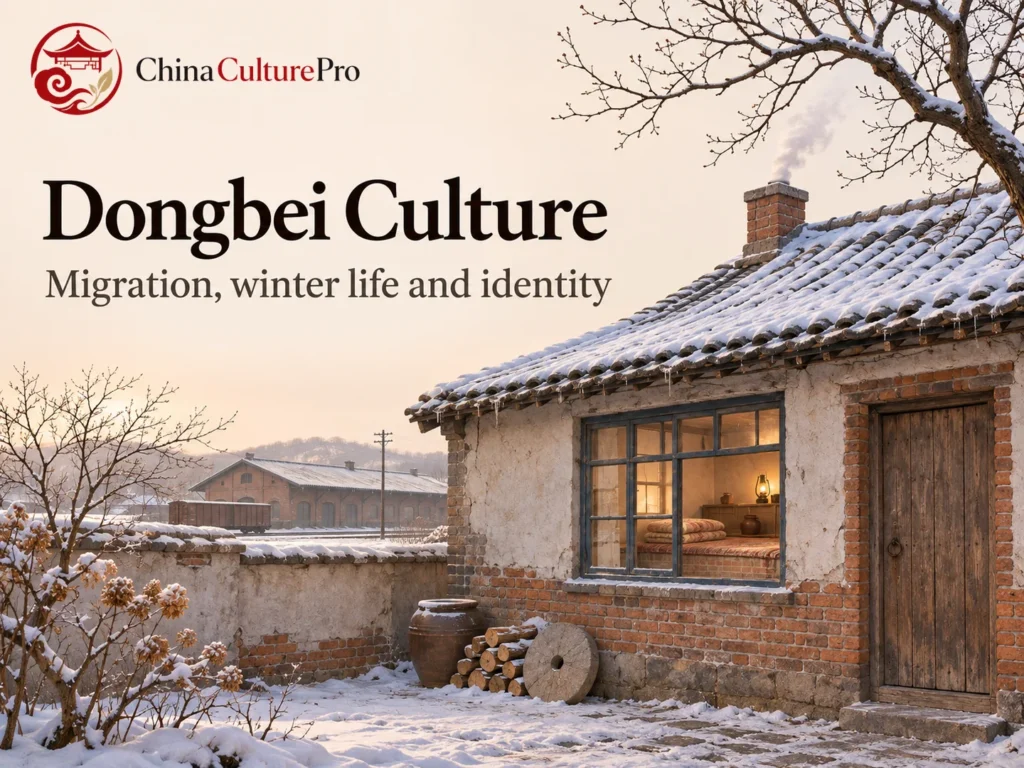

Quick Answer: What Is Dongbei Culture?
Dongbei (东北, Dōngběi) means Northeast China. It usually refers to Liaoning, Jilin and Heilongjiang, with some historical and cultural discussions also including eastern Inner Mongolia. The region’s culture has been shaped by migration, existing local communities, cold winters and industrial cities. [2][8]
- Migration: People from places such as Shandong and Hebei carried speech, skills and customs into the region.
- Winter life: Heating arrangements and preserved foods became part of domestic routines.
- Performance and cities: Local-language theater and the histories of factories and railways provide different expressions of regional experience.
These features vary between communities, generations and settings. A television character or winter scene can show one aspect of Dongbei life.
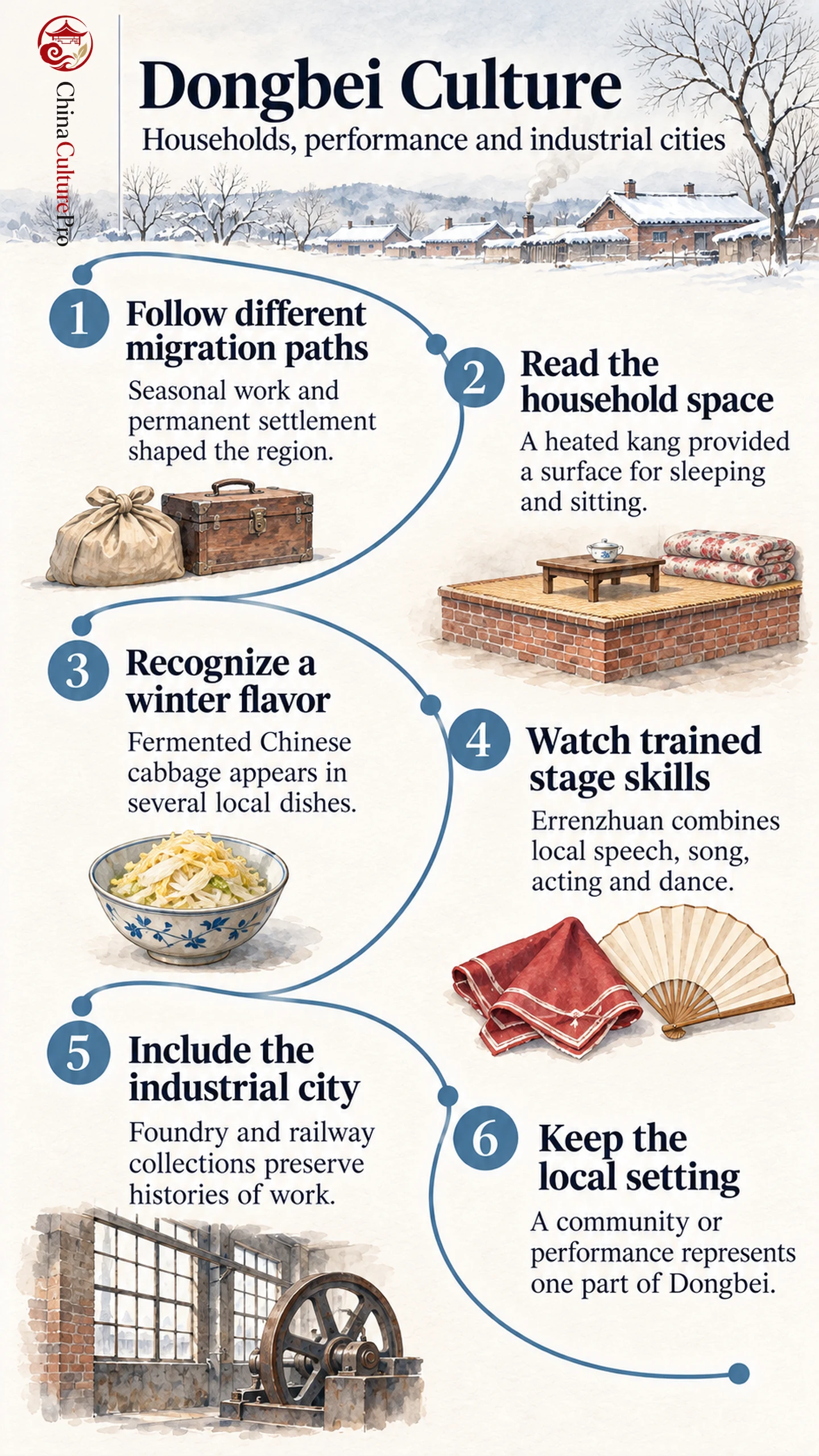
A heated platform in a rural home, a duet on a stage and an old foundry workshop tell different stories about Dongbei. One concerns household space, another performance and another urban work. Together they help explain a regional culture formed through movement and change.
Migration Into an Already Inhabited Region
Chuang Guandong (闯关东, chuǎng Guāndōng) names migrations from inside the Great Wall toward the northeast, beyond Shanhaiguan. People from Shandong and Hebei were prominent among the migrants. Their journeys occurred under changing conditions of settlement, restrictions and opportunity across the Qing period and into the twentieth century. [1]
The pattern included both seasonal travel for work and permanent settlement. Some people returned home each winter. Others stayed and built households in the northeast. That difference matters when interpreting a family story about migration. A journey remembered by descendants might describe repeated work trips, a permanent move or several stages in between. [1]
Migrants entered a region with established communities and histories. Manchu, Mongolian and other cultural traditions were already part of the region, while further movements of people added new relationships. Newcomers brought practices with them, and their lives changed through relationships with established communities. [2]
Winter Life Around the Kang and the Table
The kang (炕, kàng) is a raised platform heated through flues connected with a stove. It provides a warm surface for sleeping and sitting, bringing several household activities into one place. Its importance concerns how people arranged space as well as how they kept warm. A low table used on the platform, for example, fits a different pattern of seating from a table surrounded by chairs. [3]
The kang is associated with colder parts of northern China more broadly. Within Dongbei, its presence and design depend on the dwelling and locality. A traditional rural interior is one setting among many in a region that also contains large modern cities.
Food provides another connection between the season and domestic life. In a familiar northeastern preparation, Chinese cabbage becomes suancai (酸菜, suāncài) through fermentation. Its sour flavor appears in dishes with ingredients such as pork or noodles. The cabbage’s sour flavor makes it recognizable across several preparations. [4]
The Chinese preserved vegetables guide compares that cabbage tradition with other preserved foods. The regional name of a food is useful because different products called “sour vegetables” can have different ingredients and flavors.
Errenzhuan: Speech, Song and Stage Skill
Errenzhuan (二人转, èrrénzhuàn) is a northeastern performance tradition combining narration, song, acting and dance. Two performers taking contrasting roles are a familiar form, but the wider tradition also includes solo and group forms. Props such as fans, handkerchiefs and clappers work within a repertoire of movement and timing. [5]
The words carry stories through local speech. A performer may move between sung narrative, spoken exchanges and a physical flourish. Watch how a gesture changes the character being represented, then listen for when a sung passage turns into speech. These are trained skills within a performance, rather than evidence of a personality shared by everyone from the region. [5]
The overview of Chinese performing arts places this kind of narrative performance alongside opera, dance and other traditions. It also helps distinguish the full repertoire from a short comic excerpt circulated on a screen.
The Industrial City Is Part of Dongbei Too
Dongbei’s built culture includes workshops, factory neighborhoods and railway infrastructure. In Shenyang, a former foundry workshop became part of an industrial museum. Machinery and the preserved workshop show the setting and physical scale of foundry work. [6]
A separate railway collection in Shenyang brings together equipment and historical images. These objects connect regional experience with transport work, technical skills and generations of railway employees. They offer another way to understand a city beyond its best-known heritage monument or seasonal image. [7]
Industrial remains also broaden what counts as cultural evidence. A work tool or railway carriage can help explain regional history alongside a household object or a stage costume. Each preserves different information about how people lived, worked and moved.
Regional Identity Beyond a Single Stereotype
The three-province label is useful at a broad scale, but a Liaoning coastal city and a rural community in northern Heilongjiang have different settings. The wider northeast also includes Korean communities in China and other populations with their own languages and traditions. A regional identity can overlap with ethnic, family and hometown connections. [2]
To read a cultural example closely, identify its place and period. A migration account can explain how a family arrived. A stage recording can reveal a particular performer’s repertoire. A factory collection can record one city’s working history. None needs to represent the whole region to be informative.
The guide to Chinese cultural geography provides a broader frame for these overlapping scales of belonging.
FAQs About Dongbei Culture
Which Provinces Are Usually Called Dongbei?
Liaoning, Jilin and Heilongjiang are the common three-province definition. Eastern Inner Mongolia also appears in some historical and cultural descriptions of the northeast. [2][8]
Is the Kang Unique to Northeast China?
The heated platform is also found in other colder parts of northern China. Its form and role vary with the locality and house. [3]
Is Dongbei Culture the Same as Manchu Culture?
Dongbei is a regional category. Manchu culture is one important cultural tradition within its history, alongside the traditions of other communities and later migrants. [2]
Sources
[1] Liu Ping, Shandong University Institute of Migration Studies. Chuang Guandong: Northeast Migration Beginning with Displaced People
[2] National Ethnic Affairs Commission. Chuang Guandong and a Second Hometown
[3] University of Washington. Kang
[4] China Daily. Where Cabbage Is King
[5] China Intangible Cultural Heritage Digital Museum. Northeastern Errenzhuan
[6] Liaoning Provincial Department of Culture and Tourism. Shenyang Industrial Museum
[7] Liaoning Provincial Department of Culture and Tourism. Shenyang Railway Exhibition Hall
[8] Yu Jiang. Population Migration and Brain Drain in Northeast China