

Quick Answer: What Is Teochew Culture?
Teochew culture (潮州文化, Cháozhōu wénhuà), also described as Chiu Chow culture in English, connects a regional language, performing arts, food, tea practices and community institutions. Its roots lie in eastern Guangdong, while overseas communities have developed important local forms.[1][8]
- Language: A Southern Min speech tradition connects conversation with songs and drama.
- Shared practices: Tea, food and community occasions organize different kinds of social life.
- Living arts: Opera, instrumental music and dance remain distinct forms with trained practitioners.
The cultural label is broader than one modern city. Local settings and overseas histories explain variation within it.
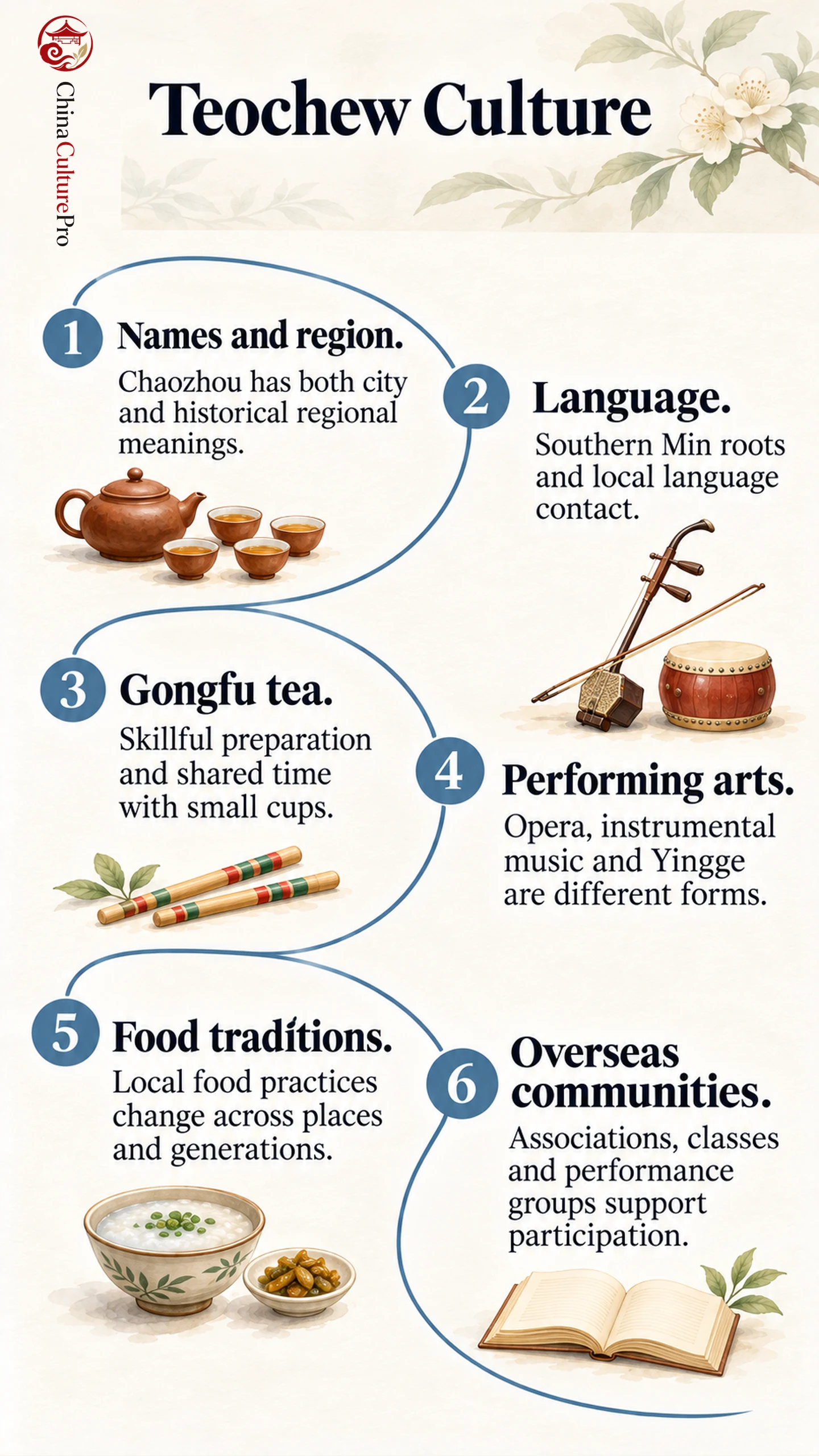
Small tea cups, an opera voice and a community association reveal different parts of Teochew culture. Their meanings become clearer when the language, place and occasion behind each are identified, connecting regional roots with lives shaped in other settings.
Teochew, Chaozhou and the Chaoshan Region
Chaozhou (潮州, Cháozhōu) names a modern city, but historically also named a larger prefecture. That older frame included areas now associated with Chaozhou, Shantou and Jieyang, with boundaries that changed over time. Cultural names carried abroad do not always follow today’s administrative map.[1]
Chaoshan (潮汕, Cháoshàn) is the broader regional term commonly associated with these eastern Guangdong settings. Teochew and Chiu Chow appear in English community names, language labels and food descriptions. Recognizing that naming history helps explain why a Teochew association overseas need not represent only people from the present-day city.[1]
These traditions belong within the wider Lingnan setting, alongside other regional cultures. Sharing a province with Cantonese communities does not make their language or performing arts identical.
Language and Local Forms of Expression
The Teochew language (潮州话, Cháozhōuhuà) belongs to the Southern Min family and has relationships with Hokkien, alongside distinctive features. It is not simply Cantonese spoken with a local accent. Literary and colloquial readings can differ, so knowing a written character does not supply one universal spoken form.[2]
Singapore Teochew includes Malay and English loanwords. Pinyin here supplies Mandarin readings, rather than Teochew pronunciation. As in other diaspora language settings, community identification and speaking ability need to be considered separately.[2]
Gongfu Tea as Skill and Shared Time
Gongfu tea (工夫茶, gōngfū chá) describes skilled, attentive tea preparation and sharing, rather than a named variety of tea leaf. A small pot and small cups concentrate attention on preparation, pouring and the time spent with other people. In a Singapore Teochew community handbook, careful distribution among cups is part of this social practice.[5]
Receiving guests, attending to the table and sharing repeated servings give tea a place within relationships. The handbook links the name with meticulous preparation.[5]
This regional example sits within wider Chinese tea hospitality. A description of one customary arrangement is not a requirement that every household use an identical set, sequence or number of cups.
Opera, Instrumental Music and Yingge
The performance setting helps distinguish three forms that may appear together in discussions of Teochew heritage.
| Form | What to listen or look for |
|---|---|
| Teochew opera (潮剧, cháojù) | Narrative theatre sung in Teochew, with actors, movement and musical accompaniment.[3] |
| Instrumental music | String and chamber ensembles differ from outdoor gong-and-drum performance; bowed and plucked instruments have different roles.[4] |
| Yingge (英歌, yīnggē) | Group dance with painted faces, hand-held batons, strong rhythm and changing formations.[7] |
Teochew opera is one of the regional theatre traditions. In Singapore it developed through temple and street performance, more fixed venues and interaction with opera films. Musical practice also extends beyond the stage to amateur societies and community gatherings.[3][4]
In instrumental ensembles, familiar melodies can be expanded through ornament and variation. The roles of different instruments help shape the ensemble sound. Yingge dance relies on collective movement and percussion; it is not an alternative name for an opera performance.[4][7]
Food Traditions and Cultural Recognition
Steamed fish, braised poultry and rice porridge with savory accompaniments illustrate different textures and serving forms in Singapore’s Teochew repertoire. Available ingredients and local tastes have shaped these foods, including the choice of poultry and the dishes served alongside porridge.[9]
Teochew cuisine gives another route into local culture, alongside the role of tea. Chaozhou joined UNESCO’s Creative Cities Network in the Gastronomy category in 2023. The designation places food knowledge, cultural activity and urban development in relation to one another.[6]
A Creative City designation differs from World Heritage inscription or recognition of a particular intangible-heritage element. It does not certify every dish served under a Teochew name. Food in a household, a restaurant and a festival can carry different meanings, even where dishes and techniques overlap.
Overseas Associations and Living Transmission
In Singapore, Teochew associations developed around both kinship and locality. Their activities included welfare, schools and cultural support. Over time they reorganized and changed their roles, showing that community institutions have histories of negotiation as well as continuity.[8]
Community organizations have offered conversational classes and parent-and-child nursery-rhyme activities. Participation provides routes to learning beyond home transmission.[2]
Performance groups provide another setting. Nam Hwa Opera received Singapore’s Chinese Cultural Contribution Award in the group category in 2023, while nurturing young performers. The group provides a particular local example of artistic transmission.[3]
FAQs About Teochew Culture
Is Teochew the same as Cantonese?
No. Teochew belongs to the Southern Min family. Cantonese is a different speech tradition, despite both having important communities in Guangdong.
Does Chaozhou always mean the modern city?
No. It can refer to the modern city, an older prefectural frame or a broader cultural connection. The context determines the meaning.
Is gongfu tea a particular tea variety?
No. It describes skills and ways of preparing and sharing tea, rather than one exclusive type of leaf.
Is Teochew opera the same as Yingge dance?
No. Opera is narrative theatre; Yingge is a group dance with its own rhythm, formations and performance conventions.
Do all overseas Teochew people speak the language fluently?
No. Identity, home language and individual ability can differ. Classes and community activities offer ways to learn and participate.
Sources
[1] Guangdong Historical and Cultural Research. Understanding Chaozhou’s Past and Present
[2] Luo Futeng, Singapore Chinese Cultural Centre. The Teochew Dialect in Singapore
[3] Su Zhangkai, Singapore Chinese Cultural Centre. Teochew Opera in Singapore
[4] Cai Bi Xia, Singapore Chinese Cultural Centre. Teochew Music in Singapore
[5] Teochew Federation Singapore. Teochew Traditions: Traditional Festivals and Customs
[6] UNESCO Creative Cities Network. Chaozhou: Creative City of Gastronomy
[7] Chao’an District Cultural Centre via Chaozhou Federation of Returned Overseas Chinese. Wenli Yingge Dance in Chao’an
[8] Lee Chee Hiang, Singapore Chinese Cultural Centre. Teochew Clan Associations in Singapore
[9] The Nutgraf Editorial Team, Singapore Chinese Cultural Centre. Teochew Food in Singapore