


Quick Answer: What Is Hainan Culture Known For?
Hainan(海南,Hǎinán)culture includes the traditions of multiple island communities and their connections across the sea.
- Community diversity: Ethnic identity, local language and place of residence describe different aspects of island life.
- Textile knowledge: Spinning, dyeing, weaving and embroidery preserve skilled work and community memory.
- Overseas connections: Migration helped shape Haikou’s arcaded streets and cultural life beyond the island.
- Performance and food: Local theatre, social singing and changing food traditions reveal different forms of participation.
Hainan culture extends beyond its resort image. Coastal towns, inland communities and overseas descendants have related but distinct histories; one costume, language or dish cannot stand for them all.
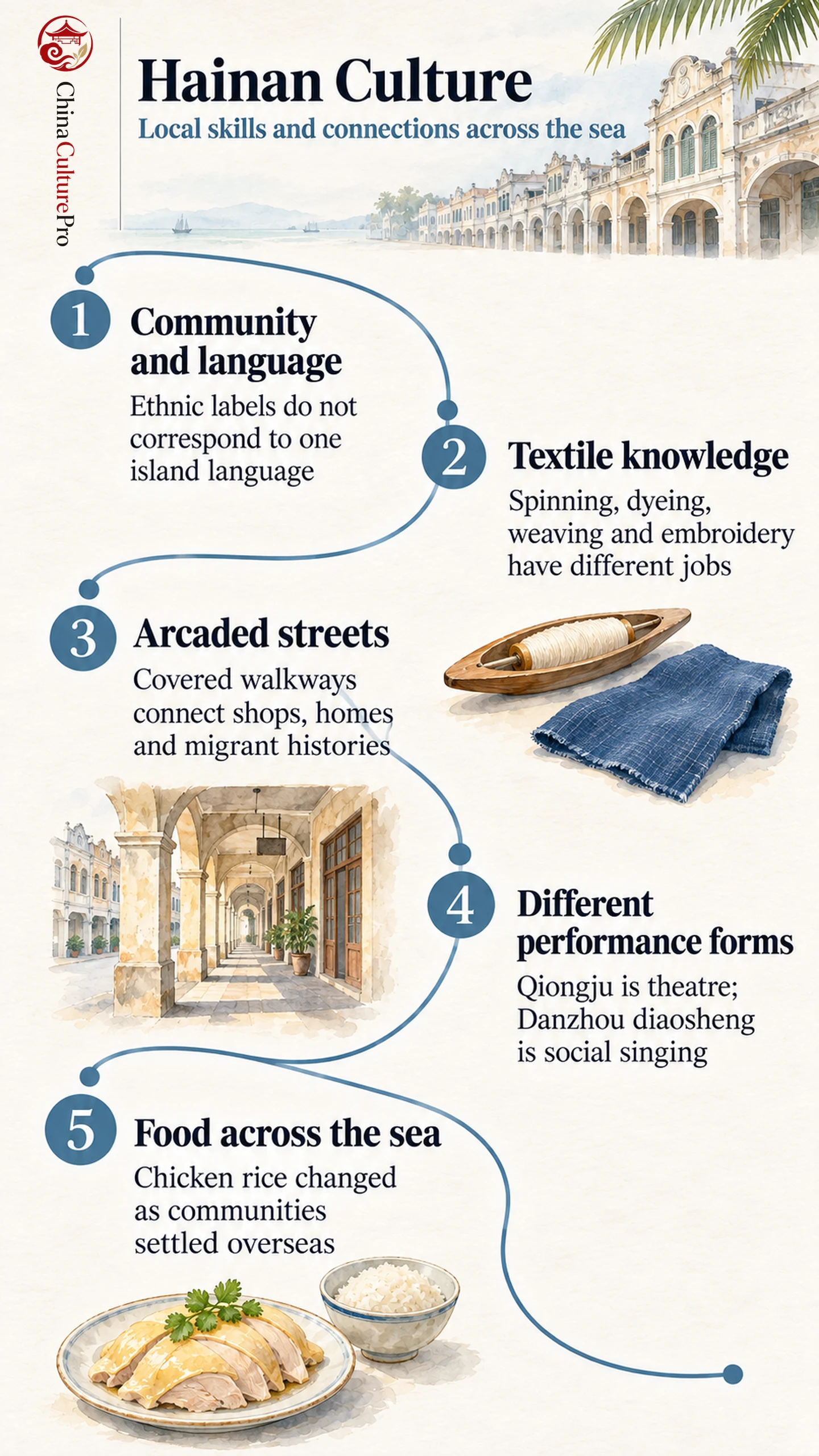
A woven cloth, an arcaded shopfront and a song gathering offer three different ways into Hainan’s cultural history. They connect materials, places and people without reducing the island to scenery. The most useful starting point is to distinguish community identities before tracing the exchanges among them.
Island Communities and Languages
The provincial museum’s cultural displays include the histories of Han(汉族,Hànzú), Li(黎族,Lízú), Miao(苗族,Miáozú)and Hui(回族,Huízú)communities. [1] These ethnic labels do not name four uniform ways of dressing, speaking or making a living. The wider guide to Chinese ethnic groups explains why official categories and cultural practices need separate attention.
Language provides another layer. Hainanese(海南话,Hǎinánhuà)is used in local theatre, but it does not cover every language spoken on the island. A national language research center documents Tsat(回辉语,Huíhuīyǔ)in Sanya within its resources on Hui language use. [2][6]
That example matters because an ethnic category does not automatically correspond to one language throughout China. The Hui culture guide explores regional differences more fully. Asking which community, place and language a source describes is more informative than treating “Hainanese” as a complete cultural classification.
Li Textiles: Skills, Memory and Continuing Transmission
Li textile traditions bring several operations together. Spinning makes fibers into thread; dyeing supplies color; weaving constructs the fabric; embroidery adds stitched decoration. UNESCO’s description identifies cotton, hemp and other fibers among the materials used for clothing and daily necessities. [3]
Patterns can also carry community memories and narratives. Their significance depends on the makers and traditions concerned, rather than a universal code that makes every motif mean the same thing.
In 2024, UNESCO transferred these textile techniques from the Urgent Safeguarding List to the Representative List. [4] That was a change in safeguarding recognition, not the moment the craft began. Nor does a listing make the work independent of teaching and practice.
The dedicated Li culture guide provides space for closer discussion of communities and traditions. Within this provincial overview, textiles demonstrate how cultural knowledge can be carried through practical work.
Haikou’s Arcades and Overseas Connections
Qilou(骑楼,qílóu)are arcaded buildings associated with Haikou’s historic commercial streets. Their upper levels extend over sheltered pedestrian space, while shops occupy the street level and residences traditionally occupy floors above. The form connects everyday commerce with protection from sun and rain. [5]
Their appearance also records movement across the sea. Hainan’s provincial account describes overseas migrants returning with architectural tastes developed in Southeast Asian cities during the nineteenth and early twentieth centuries. European-derived decorative elements, regional building practices and local workmanship came together in the streetscape. [5]
The result is more specific than a generic “Western-style” facade. A shopfront can express both practical arrangements and the history of families moving, earning money and returning.
Those connections also help explain why island culture cannot be understood only within an island boundary. Buildings, performances and foodways could change as people maintained relationships between hometowns and new places of residence.
Local Theatre and Social Singing
Qiongju(琼剧,Qióngjù), or Hainanese opera, is a theatrical tradition sung in Hainanese. Its history includes the incorporation of outside vocal styles and local development of repertoires and performance conventions. Dramatic storytelling involves trained singing and physical performance; the provincial profile distinguishes civil and martial branches. [6]
Danzhou diaosheng(儋州调声,Dānzhōu diàoshēng)belongs to another setting. It is a social singing tradition associated with gatherings and festive occasions in Danzhou. The heritage record describes participants forming facing rows or circles, linking fingers and moving with the rhythm. Familiar tunes provide a basis for variation. [7]
The difference is one of form and participation: a staged narrative and a social song gathering organize performers and listeners differently.
Overseas communities have also built their own institutions. A Singapore Chinese Cultural Centre account describes training classes and invited teachers associated with the Singapore Hainan Society, founded in 1956. [8] This shows active transmission abroad, alongside performance on Hainan itself. The wider Chinese performing arts guide explains related distinctions among theatrical and musical forms.
Food Travels and Changes with Communities
Wenchang chicken rice(文昌鸡饭,Wénchāng jīfàn)provides a useful example of food moving with migrants. Singapore’s government heritage account connects the dish with Hainanese immigrants and describes changes that developed after migration. [9]
Its discussion of the Singapore version includes Cantonese cooking influences, a chili accompaniment adjusted with lime and the use of pandan in rice. These details show adaptation through contact with other foodways. They are not evidence that every Hainan household or overseas restaurant follows one fixed preparation.
The name “Hainanese chicken rice” therefore carries a connection to place while allowing a history of change. Treating the overseas dish simply as an untouched island recipe would miss the work of cooks and communities in their new settings. The Chinese food guide offers a wider framework for regional food traditions.
FAQs About Hainan Culture
Does Hainan Have Only One Local Language?
No. Hainanese is one part of a more varied linguistic landscape. Tsat documentation in Sanya illustrates why the island’s languages and ethnic categories cannot be treated as interchangeable.
Are Qiongju and Danzhou Diaosheng the Same Tradition?
No. Qiongju is theatre with dramatic roles and staged narratives. Danzhou diaosheng is a social singing tradition associated with gatherings and collective movement.
Is Singapore’s Hainanese Chicken Rice an Unchanged Island Dish?
No. It preserves a connection with Hainanese migration while reflecting local adaptation, including influences from other cooking traditions in Singapore.
Sources
[1] Hainan Provincial Museum. Museum profile and cultural exhibitions
[2] Minzu University National Language Resource Monitoring and Research Centre. Hui language use and documentation
[3] UNESCO Intangible Cultural Heritage. Traditional Li textile techniques
[4] UNESCO Intangible Cultural Heritage. Decision19.COM7.c.1: transfer to Representative List
[5] Hainan Provincial People’s Government. Qilou: Culture and history live on in this century-old street
[6] Hainan Provincial People’s Government. Qiongju Opera
[7] China Intangible Cultural Heritage. Danzhou diaosheng
[8] Cai Bi Xia / Singapore Chinese Cultural Centre Culturepaedia. Hainanese opera in Singapore
[9] Government of Singapore SG101. Hainanese Chicken Rice in Singapore