

Quick Answer: What Shapes Hong Kong Culture?
Hong Kong culture connects regional Chinese traditions, colonial experiences, international exchange and locally developed ways of life. Its languages, neighbourhoods, food, community performances and creative industries reveal different parts of that history.[1]
- Language and locality: Everyday speech and named communities shape cultural expression.
- Shared spaces: Homes, cafes and community institutions hold different kinds of urban memory.
- Creative work: Performance, cinema and visual culture connect inherited resources with new audiences.
Specific communities and settings explain how inherited resources became local traditions, and how people continue to change them.

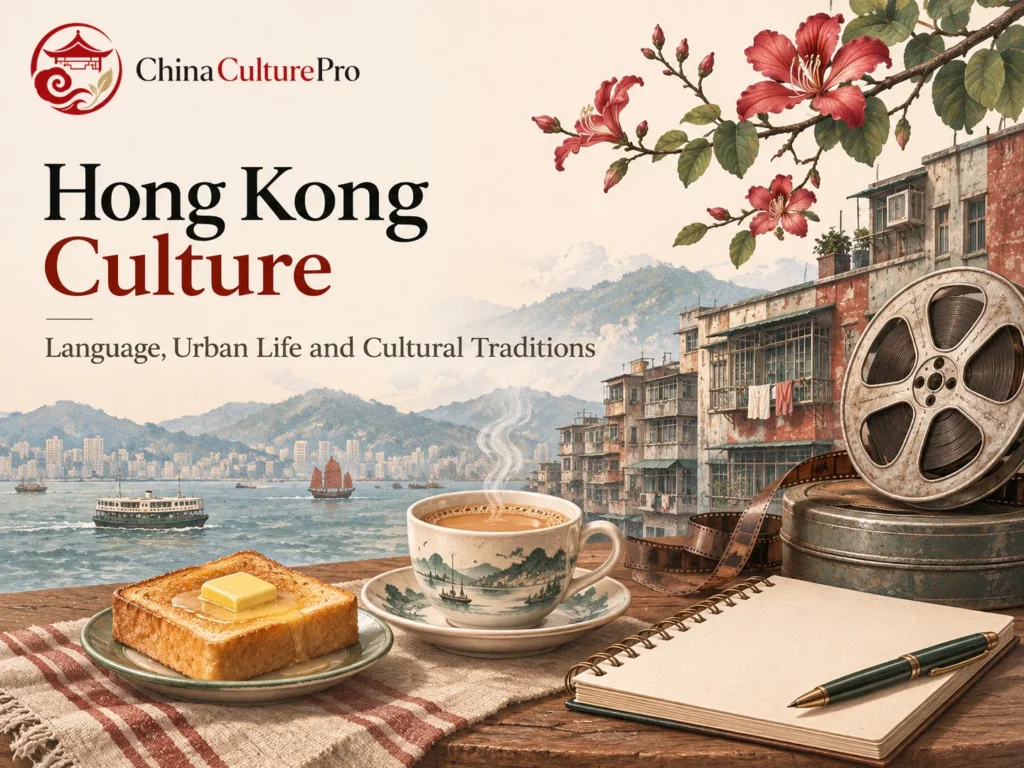
A cafe cup, a residential street and an old film can each carry a different kind of Hong Kong memory. Understanding the settings behind them reveals culture in ordinary routines as well as in festivals, performances and museum collections.
Regional Roots and Changing Historical Settings
Hong Kong shares language and cultural resources with the Pearl River region, while developing distinct local institutions. Cantonese cultural connections are central, but regional Chinese traditions, British colonial experiences and wider international contacts all form part of the setting.[1]
Hong Kong became a Special Administrative Region of the People’s Republic of China on 1 July 1997. That institutional change belongs within a longer history of settlement and urban growth. Cultural life also extends beyond the familiar high-rise skyline to villages and outlying islands, with different local histories and community practices.[2][1]
Language in Conversation and Public Life
The Cantonese language (粤语, Yuèyǔ) has a major role in daily speech and cultural expression. The 2021 census reported that 96.0 percent of people aged five and over could speak it. That is a dated measure of reported ability, rather than a count of everyone’s usual language or a 2026 estimate.[4]
Chinese and English are the official languages. Those labels differ from the list of spoken varieties used in daily life. Putonghua (普通话, Pǔtōnghuà), or standard Mandarin, also appears in public communication. Official interpretation arrangements can involve English, Cantonese and Putonghua, while individuals’ abilities vary.[3]
The pinyin here provides Mandarin readings of Chinese names. It does not transcribe Cantonese pronunciation. The distinction between Mandarin and Cantonese, written language and actual speaking ability helps explain why a bilingual sign cannot tell us which language a household uses.
Neighbourhoods, Homes and Shared Urban Memory
Historic tong lau (唐楼, tánglóu), or tenement shophouses, connect domestic space with street-level activity. The Blue House Cluster in Wan Chai offers a specific example of heritage remaining part of neighbourhood life. Its three buildings date from the 1920s to the 1950s, and the revitalization project retained a residential purpose alongside cultural activities.[5]
The Hong Kong House of Stories provides community activities within that setting. The cluster received a UNESCO Asia-Pacific conservation award in 2017; this is an award for a conservation project, rather than inscription on the World Heritage List. Architecture here carries social value through use and local memory as well as through its appearance.[5]
Cafe Food and the Craft of Milk Tea
The cha chaan teng (茶餐厅, chácāntīng), conventionally named in English from Cantonese, is a local tea-restaurant or diner setting. Toast, eggs, noodle dishes and macaroni can share a menu with other familiar foods. These combinations are established forms of Hong Kong food culture, rather than simply foreign dishes left unchanged.[6]
Hong Kong-style milk tea (港式奶茶, gǎngshì nǎichá) illustrates local craft. Tea blending, infusion and force-pouring contribute to the finished drink. The heritage description traces its development from English milk tea into a local beverage tradition.[7]
This is one form within wider milk-tea traditions. A comparison with bubble tea concerns a different drink category. Its preparation and cafe setting deserve attention in their own right; the presence of tea and milk does not make every drink or serving culture identical.
Festivals and Community Performance
The Hakka unicorn dance (客家舞麒麟, Kèjiā wǔ qílín) in Hang Hau, Sai Kung, brings together music, martial arts and a locally developed movement sequence. The animal is an auspicious symbol in community belief. The practice entered China’s national intangible-heritage list in 2014.[8]
This local expression of Hakka cultural life carries its own movement and musical conventions. Cantonese opera (粤剧, Yuèjù) offers another form of trained performance, combining singing, acting, spoken delivery and martial arts. Its dramatic conventions serve different purposes from a celebratory dance.[11]
Screen Culture, Archives and New Interpretation
Hong Kong cinema survives through objects, recordings and preservation work as well as through remembered stars. The Film Archive’s twenty-fifth-anniversary exhibition, running from June 2026 to March 2027, draws a selection from its holdings of more than 1.3 million film artefacts. Costumes, historical trailers and filmmakers’ reflections help explain how screen culture was made and remembered.[9]
M+ approaches visual culture through design and architecture, moving image and visual art, with works from Hong Kong, elsewhere in Asia and beyond. Its collections also include printed materials and archives of creative processes. This broadens the discussion from individual masterpieces to the many forms through which people make and interpret images.[10]
An archive exhibition and a modern visual-culture collection therefore do different jobs. Together, they show that cultural memory involves selection, research and reinterpretation, while new work continues to enter the story.
FAQs About Hong Kong Culture
Is Hong Kong culture only Cantonese culture?
No. Cantonese traditions are central, but Hong Kong also has distinct local institutions, other community traditions and international cultural connections.
Are Cantonese and English the official-language labels?
The official labels are Chinese and English. Cantonese is a major spoken language; it should not replace Chinese when describing the legal categories.
Is all Hong Kong heritage in old buildings?
No. Performing skills, food-making knowledge, language, film records and community practices also carry heritage.
Is Hong Kong-style milk tea the same as bubble tea?
No. Hong Kong-style milk tea has its own preparation tradition. The shared word “tea” does not make it the same as bubble tea.
Sources
[1] Hong Kong Economic and Trade Office, USA. Art, Culture and Outdoor Activities
[2] Government of the Hong Kong Special Administrative Region. Hong Kong Yearbook 2002: History
[3] Civil Service Bureau. Official Languages Division
[4] Census and Statistics Department. 2021 Census: Use of Language by Hong Kong Population
[5] Commissioner for Heritage’s Office. Viva Blue House
[6] Hong Kong Tourism Board. Cha Chaan Teng Food Culture
[7] Hong Kong Intangible Cultural Heritage Office. Hong Kong-style Milk Tea Making Technique
[8] Hong Kong Intangible Cultural Heritage Office. Hakka Unicorn Dance in Hang Hau in Sai Kung
[9] Hong Kong Film Archive. Treasure Hunting for 25 Years
[10] M+. About the Collection
[11] Hong Kong Intangible Cultural Heritage Office. Cantonese Opera