


Quick Answer: What Is Chinese Design Today?
Chinese design today spans visual communication, products and other fields shaped by people’s needs, available materials and cultural contexts. Traditional influences are one resource among many. A useful starting point is to ask what a work communicates, how it is used and what its makers have changed, rather than looking for one recognizably Chinese appearance.[1][2]
- Graphics: Words, images and layout communicate information and identity.
- Products: Form, materials, assembly and use work together.
- Tradition: Designers can reinterpret knowledge, gestures and visual references instead of reproducing an old object.
The examples here connect mainland and Hong Kong practices while keeping their places, periods and purposes distinct.
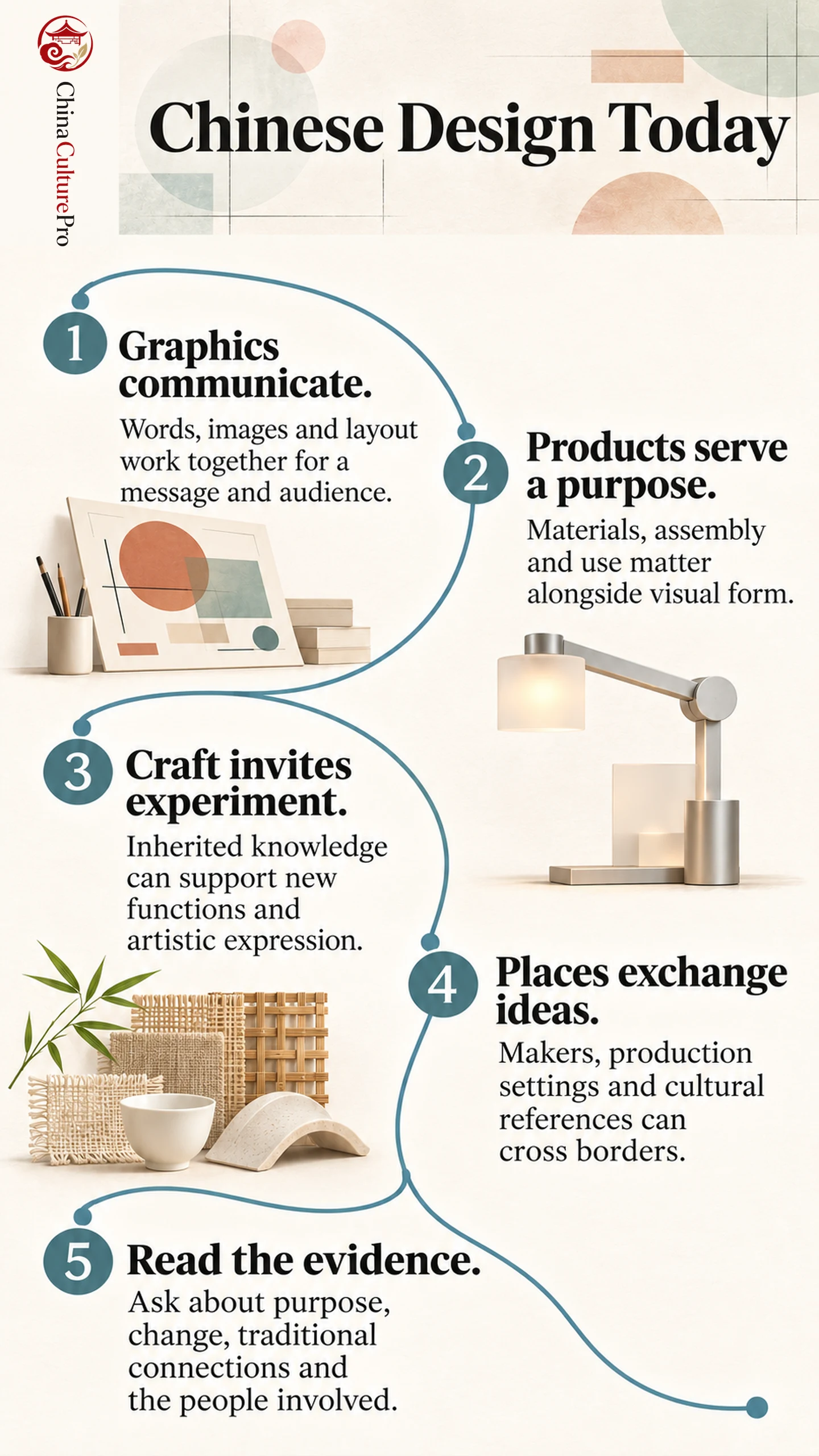
A poster, a modular lamp and a porcelain vessel ask different things of their viewers and users. Looking closely at their purposes reveals how Chinese design combines inherited resources, practical decisions and new ideas within contemporary cultural life.
Graphics: Words, Images and Communication
Graphic design (平面设计, píngmiàn shèjì) organizes visual elements to communicate. Its choices include the relationship between text and image, the arrangement of information and the character of a visual identity. Chinese characters (汉字, hànzì) can function as language while also contributing shape, rhythm and contrast.
Han Jiaying (韩家英, Hán Jiāyīng) provides a recent curatorial example. His 2026 exhibition in Guangzhou examined decades of work, including covers for Tianya (天涯, Tiānyá) magazine designed since 1997. Characters, dots, lines, squares and circles became materials for repeated experiments in form and meaning. The exhibition also connected design with everyday printed matter, such as coupons, certificates and packaging.[2]
Historical references need not produce an antique-looking image. Kan Tai-keung (靳埭強, Jìn Dàiqiáng; Mandarin reading of his Chinese name) designed a poster for the 1970 film The Arch (董夫人, Dǒng Fūrén) using black and white and the sans-serif typeface Helvetica. Its modern visual language served a film with a historical setting. This Hong Kong example helps separate a subject’s period from the style used to communicate it.[3]
Typography can refer to brush traditions, but arranging type is a different activity from calligraphy and everyday writing. Understanding a graphic work requires attention to its message, audience and medium, as well as the shape of its letters or characters.
Products: Function, Materials and Production
Product design (产品设计, chǎnpǐn shèjì) concerns how an object works as well as how it looks. Materials, components and the ways people handle or arrange them can all be part of the design. A photograph of a finished object reveals only some of those decisions.
The Lunar Gleam lighting series, presented by Studio RE+N in 2025, illustrates this distinction. Its components could be assembled into standalone lamps or expanded into larger, self-supporting installations. The project used recycled aluminum and 3D-printed PLA/PETG components. Material selection and configuration were therefore part of the proposal, alongside the appearance of the light.[4]
The same 2025 event presented limited-edition art and collectible design alongside new product collections. A display can therefore bring together objects with different purposes and production contexts. Being shown at a design fair does not by itself establish that an object is mass-produced.[4]
Manufacturing is another part of the process. Making an object requires production knowledge, while design involves decisions about what to make and how it should serve its purpose. The two can interact closely without being interchangeable.
Craft Traditions as Resources for Experiment
Traditional influence can reside in material knowledge and gestures as well as a visible motif. Dehua white porcelain (德化白瓷, Déhuà báicí), also known as blanc de Chine, offers an example. Contemporary work there brings mechanical production and handcrafting into the same porcelain-making environment.[5]
A cup and saucer designed by British Chinese designer Peter Ting in Dehua in 2010 draws on the sculptural language of religious figurines: modeled hands become part of a new vessel. The inherited reference has changed its purpose and relationship to the user. It is not simply an old image printed onto a new surface.[5]
The fuller history of Dehua porcelain helps explain that transformation. Material, place, technique and historical forms provide several possible points of departure, rather than a requirement to recreate one standard traditional design.
Studio craft also crosses the boundary between functional objects and artistic expression. Waxing and Waning No.2, made in Shanghai in 2024, combines ramie fiber and bamboo. Shadow of a Tree, made in Beijing in 2019, uses lacquer, eggshell, ashes and wood. These works show different material possibilities within a field that has expanded artistic experimentation since the 1980s.[6]
Knowing the materials changes what one sees. Lacquerware involves a material tradition; “traditional influence” need not mean a dragon, a familiar color or a copied historical shape.
Connected Places and Cross-Cultural Exchange
Design develops through places and networks rather than in cultural isolation. Shenzhen’s manufacturing infrastructure, suppliers and accumulated production knowledge have supported design activity beyond the conventional studio. Research and exhibitions have examined how that environment contributes to the relationship between making and designing.[1]
In Hong Kong, Henry Steiner’s practice offers another history of exchange. Born in Austria and trained in the United States, he moved to Hong Kong in 1961. His approach combined cultural elements through concept and contrast, rather than treating them as separate decorative ingredients.[7]
These settings are connected but have different histories. A designer’s background, the place of production, the intended audience and the sources of inspiration do not always coincide. Asking about each gives a more precise account than assigning every work a national visual formula.
How to Read a Design Beyond Its Appearance
When looking at a design in a collection, exhibition or everyday setting, four questions help distinguish observation from assumption:
| Question | Evidence to look for |
|---|---|
| What does it communicate or do? | A message, intended use or documented problem the design addresses. |
| What has been changed? | A new arrangement, function, material, component or interpretation. |
| What is the traditional connection? | A named technique, source object, gesture or visual reference. |
| Who and where are involved? | The maker, designer, production setting, date and intended users. |
These questions work across a poster and an object used in the home. They also leave room for a work with several purposes: a vessel might function, communicate an idea and experiment with a material at the same time.
FAQs About Chinese Design
Does contemporary Chinese design have one national style?
No. Graphics, useful objects and studio craft involve different purposes and settings. Particular designers can combine cultural references in very different ways.
Is Chinese graphic design the same as calligraphy?
No. Graphic design can use or refer to brush-written forms, but typography and layout serve communication tasks that extend beyond the act of writing.
Must a traditional influence appear as a recognizable motif?
No. A design can draw on material knowledge, a technique, a gesture or the structure of an older object. The reference may involve more than surface ornament.
Are contemporary craft objects always made for everyday use?
No. Some retain practical functions, while others emphasize artistic expression or explore the boundary between a usable object and a sculpture.
Is manufacturing a product the same as designing it?
No. Production and design involve related forms of knowledge, but a place of manufacture alone does not establish who made the design decisions or where the ideas originated.
Sources
[1] Victoria and Albert Museum. V&A at Design Society, Shenzhen
[2] Guangdong Museum of Art. Han Jiaying’s Design Dictionary A–Z II
[3] M+. Hong Kong: Here and Beyond
[4] Design Shanghai. Design Shanghai 2025: Post-Show Report
[5] Victoria and Albert Museum. Blanc de Chine: White Porcelain from China
[6] Victoria and Albert Museum. Dimensions: Contemporary Chinese Studio Crafts