


Quick Answer: What Is Chinese Night-Market Culture?
A night market (夜市, yèshì) brings vendors and customers together during the evening, often combining food, browsing and social life. This guide focuses on mainland examples, with a separate Taipei comparison. The name can refer to different layouts and operating arrangements, rather than one standardized institution.[3][5]
- Food: Small dishes and snacks can sit alongside full meals.
- Leisure: Eating, walking, shopping and meeting friends can be part of the same outing.
- Urban life: Vendors, residents, visitors and managers shape how the market works.
Evening activity does not mean every market trades through the night or follows the same rules.
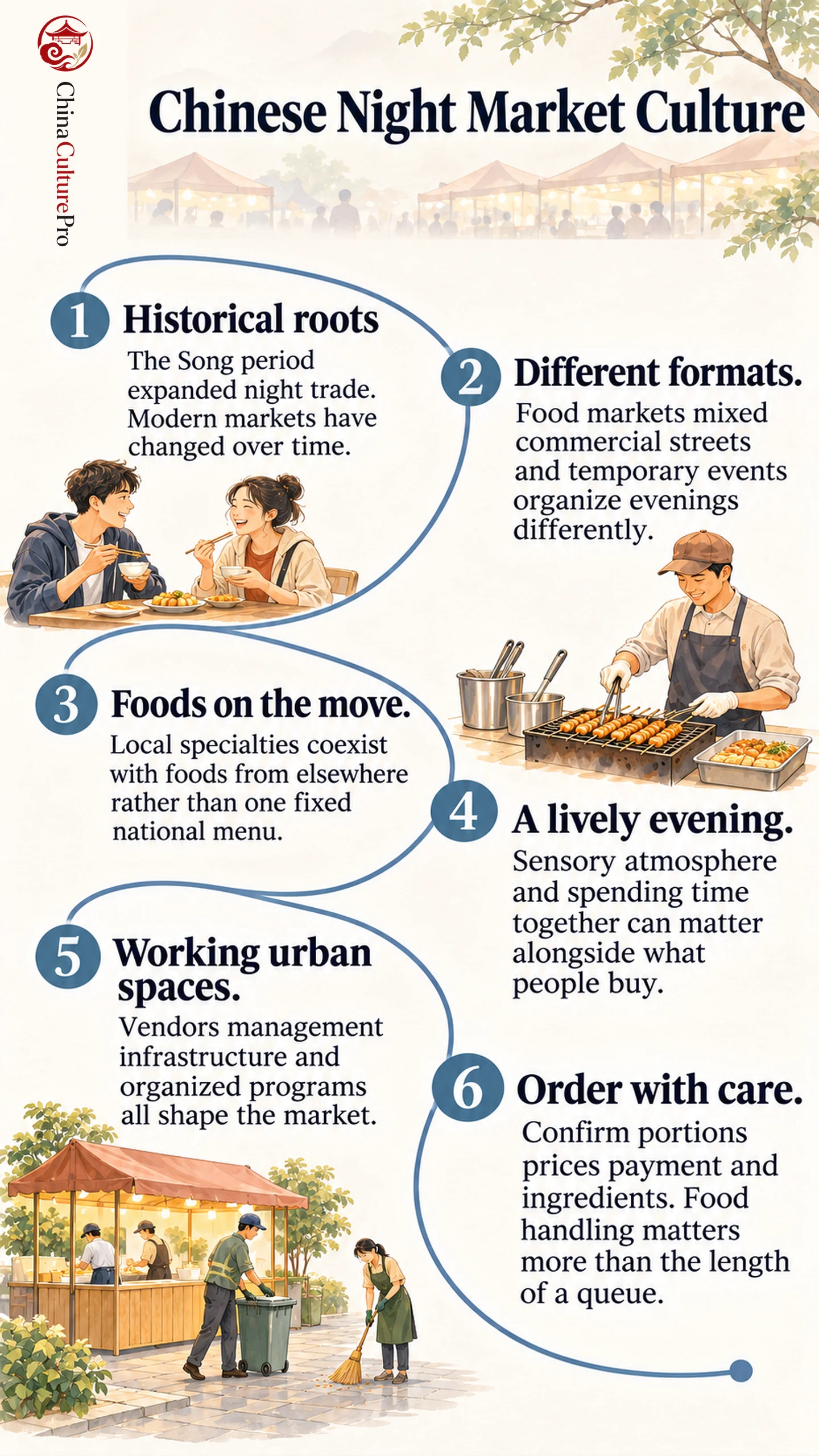
An evening market offers more than a collection of snacks. People browse, eat, meet and linger, while vendors turn temporary or permanent pitches into places of business. These overlapping activities make night markets a useful window onto modern Chinese culture.
Night Trading in the Song Dynasty
Night trading has a substantial history in China. Research on the Song dynasty (宋朝, Sòngcháo; 960–1279) identifies an important expansion of market streets, street vending and commercial entertainment. Night markets served a broader range of customers and developed forms extending beyond businesses simply staying open later.[1]
This history explains why nighttime commerce belongs within urban cultural history. It does not establish one invention date, or prove that a present-day row of stalls has operated unchanged since the Song period. Historical descriptions and contemporary observations answer different questions.
The broader world of Chinese street markets also includes daytime trading and other schedules. A night market is one way commerce organizes urban time, not a synonym for all traditional markets.
Different Formats Behind the Night-Market Name
Three formats help explain why places carrying the same label can feel different. These are reading categories, not an official nationwide classification:
| Format | How it shapes the evening |
|---|---|
| Recurring food market | Numerous vendors gather in a recognizable trading area; Shanghai’s Sijing provides a food-focused example. |
| Mixed commercial street | Food operates alongside shops, restaurants, music and places to linger, as illustrated by Shanghai’s Daxue Road. |
| Temporary event market | A curated program combines stalls with activities for specified dates; its past appearance does not establish permanent operation. |
The Shanghai examples appear in a June 2026 city profile. Separately, the Bailian Night heritage market was advertised for June 5–14, 2026, with crafts and hands-on workshops. The event’s specified dates illustrate why an old announcement is not evidence of current opening.[3][7]
A named night market can also sit within a larger nightlife district. Reading, performances and sports belong to the nighttime economy too, but they do not automatically make every venue a market.[7]
Food: Local Specialties and Traveling Snacks
Xiaochi (小吃, xiǎochī) refers to snacks or small dishes, rather than one cooking technique. A market’s street-food offerings may include grilled items, fried foods, sweets, drinks and substantial bowls or plates. Not every purchase is a portable bite.
Shaokao (烧烤, shāokǎo) means barbecue. A 2026 Shanghai profile lists grilled pork belly, squid and Changsha-style stinky tofu (臭豆腐, chòudòufu) at Shangyuan Road. Sijing’s offerings include rice cakes and duck neck.[3]
Taipei’s Ningxia market offers another local context. Its official food profile includes braised pork rice (卤肉饭, lǔròufàn), oyster omelets, pan-fried dumplings and soups. These examples belong within Taiwanese food culture; they should not be treated as the menu of every mainland market.[4]
Food therefore carries both local associations and the movement of recipes, vendors and tastes. A dish’s presence in a city does not by itself prove that it originated there. Similar stalls can appear in different places without making those places’ food traditions identical.
The Social Appeal of a Lively Evening
Re’nao (热闹, rènao) describes a lively, animated atmosphere. In night markets, sound, smells, light and the presence of other people can become part of what visitors enjoy. The attraction may lie in spending an evening together as much as in buying a particular item.[2]
A study published in 2025 drew on fieldwork at four markets in Shanghai and London during 2021–2022. It examined how sensory surroundings and interactions created different experiences of nighttime sociability. Its Shanghai analysis used re’nao to understand people’s encounters with a busy shared environment, rather than treating atmosphere as scenery alone.[2]
Atmosphere is experienced differently. A crowd that feels enjoyable to one person may be tiring to another. Friends sharing a meal, a resident buying dinner and someone visiting for the first time can experience the same place differently. Liveliness does not remove ordinary consideration for other people’s space.
Vendors, Management and Urban Change
Behind the customer’s evening is a working environment. A 2026 study of Kaifeng’s Gulou Night Market, based on fieldwork in 2023, 2024 and 2025, examined vendors’ responses to standardized trading times and spaces. Vendors adapted their practices and negotiated with management, including through local relationships and cultural presentation.[6]
This is a specific account of livelihoods and regulation, not evidence that every market follows the same model. An orderly row of stalls may reflect considerable preparation, negotiation and practical organization. Describing a market as spontaneous can hide that work.
Infrastructure matters too. Taipei’s market administration describes an underground oil-drainage system at Ningxia, alongside its food and shopping areas. Managing waste and services is part of sustaining a shared trading space, even when those systems are less visible than the stalls.[5]
In Shanghai, the 2026 heritage-market program included crafts from Shanghai and Yunnan, with workshops guided by artisans. These scheduled activities made learning and making part of the evening alongside buying.[7]
Reading a Market and Ordering with Care
Before ordering, establish what the stall is selling, how the portion is measured and what the displayed price covers. Menu terms can help distinguish a dish from a cooking method. With dietary restrictions, ask about fillings, sauces and cooking fats; a vegetable ingredient alone does not settle whether the dish is vegetarian.
For mainland purchases, payment options include mobile services, cash and cards where accepted. A guide published in March 2026 describes these alternatives, but confirm the stall’s accepted methods before ordering. That mainland guidance should not be transferred automatically to Taipei.[9]
Food safety depends on handling, not popularity alone. Relevant principles include hygiene, keeping uncooked and ready-to-eat ingredients apart, thorough cooking, appropriate temperature control and safe water and ingredients. A lively queue cannot verify all of these conditions.[8]
Finally, distinguish a permanent business listing from an event announcement. Check the market’s current local notices for trading dates, changes and access arrangements. Leave passageways clear and use the waste facilities provided; the outing shares space with workers and neighboring residents.
FAQs About Chinese Night-Market Culture
Do Chinese night markets stay open all night?
Not necessarily. The term indicates evening trade, not a promise of overnight operation. Markets and individual vendors can follow different schedules.
Are night markets only about food?
No. Shopping, crafts, performances and workshops may accompany food. The mix depends on the market or event.
Does every market sell the same snacks?
No. Regional traditions matter, while foods also travel between cities. Some venues mix dishes from several regions or countries.
Are night markets only for tourists?
No. Residents may buy dinner or meet friends, while visitors bring other interests. A market can serve several groups at once.
Does a busy stall guarantee safe food?
No. Crowds do not establish whether food has been prepared and stored appropriately. Hygiene and handling remain separate from popularity.
Sources
[1] Zhang Jinhua, Wang Maohua and Wang Hong, Frontiers of History in China. On the Scale, Forms, and Consumers of Night Markets during the Song Dynasty
[2] Jiawei Zhao, Social and Cultural Geography. From Buzz to Re’nao: Atmospheric Encounters and Sensory Landscapes in Urban Night Markets
[3] Shanghai Municipal Government, Municipal Administration of Culture and Tourism. Five Shanghai Night Markets for Hot Summer Vibes
[4] Taipei City Government, Datong District Office. Ningxia Night Market
[5] Taipei City Market Administration Office. Ningxia Tourist Night Market
[6] Guibo Nie and colleagues, Sustainability. From Tactical Resistance to Creative Cadence: The Rhythmanalysis in China’s Gulou Night Market
[7] Shanghai Municipal Government. Shanghai Tonight Warms Up with Markets, Craft Beer, Street Food
[8] World Health Organization. Five Keys to Safer Food
[9] Guangzhou Tianhe District Government. Payment Options in China