

Quick Answer: What Shapes Chinese Home Decoration?
Chinese home decoration brings together practical use, visual preferences, family memory and expressions of good wishes. Traditional influences can appear in furniture, written characters, motifs and seasonal paper arts. This guide uses mainland examples, while distinguishing historical interiors and particular households from a single design formula.[1][4]
- Use: An object can support sitting, storage, hospitality or study as well as decorate a room.
- Meaning: Written words and images can express wishes, beliefs or family connections.
- Change: Festive displays and contemporary reinterpretations have different purposes and time frames.
A museum room, a New Year doorway and a lived-in home each need to be read in their own context.

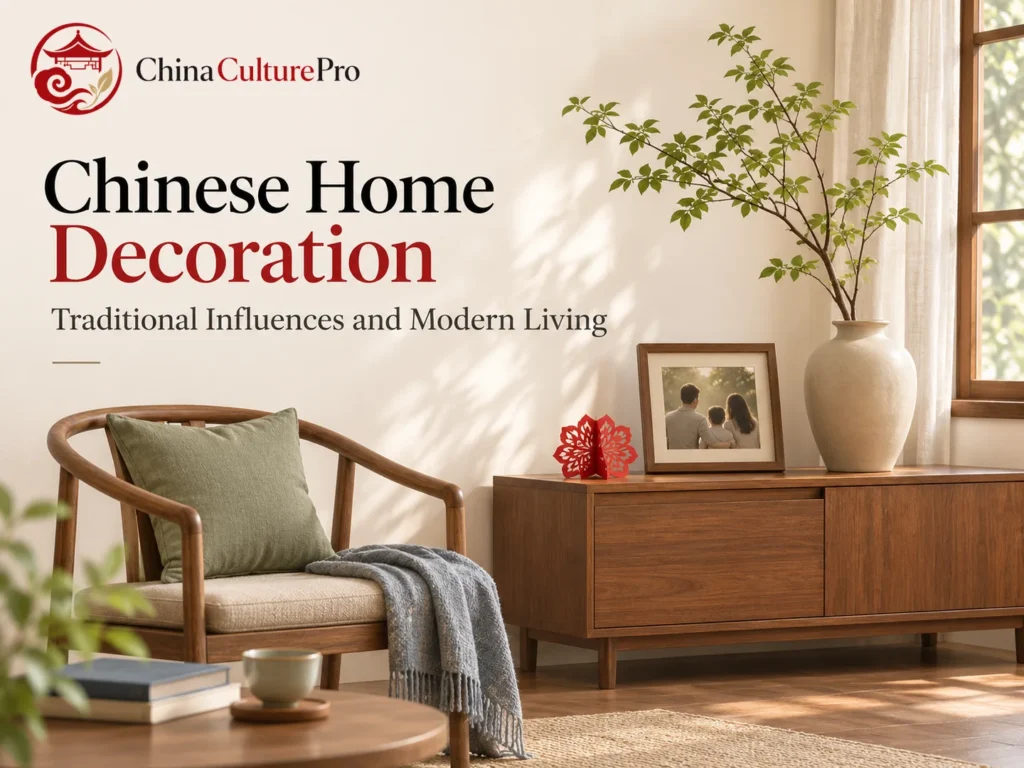
A wooden chair, a family photograph and a piece of red paper belong to different parts of domestic life. Looking at how objects are used and what they mean reveals traditional influences within the changing homes of modern Chinese culture.
Furniture and the Uses of a Room
Furniture shapes what a room can do. Chairs, tables, cabinets and screens support different activities, while their proportions, surfaces and ornament give them visual character. Historical collections include restrained forms alongside carved and inlaid pieces, rather than one uniform look.[2]
The reception-room and study-room reconstructions associated with Ming and Qing furniture offer useful examples. A study could combine reading, painting, calligraphy, collecting objects, receiving friends and relaxation. Tables, shelves, seating and desk objects worked together within those activities. The described study setting also includes white-painted walls and dark blue brick flooring.[2]
This helps explain why traditional furniture and the scholar’s study belong to a history of domestic use as well as decorative style. The surviving masterpieces in museum collections are selected historical objects, not a record of what every household owned.
The room and the object also affect one another. A cabinet provides storage while displaying a finish or carving; a screen changes a view or divides a space while carrying an image. Function and appearance need not be separate.
Words, Motifs and Auspicious Wishes
Auspicious designs can turn language into visible wishes. Their meaning may depend on a character, an image or the sound of a word. These examples show three different mechanisms:
| Word or motif | How the meaning works | Wish expressed |
|---|---|---|
| Fu (福, fú) and bats (蝙蝠, biānfú) | The character means blessings or good fortune; the last syllable of the Mandarin word for bat has the same sound. | Good fortune or blessings.[1] |
| Fish (鱼, yú) and surplus (余, yú) | The two words share a Mandarin pronunciation. | Abundance or having more than enough.[1] |
| Ruyi (如意, rúyì) | The name means “as you wish”; its distinctive head also appears as a decorative motif. | May wishes be fulfilled.[8] |
The wish and the object’s material form are separate. The same motif can appear on furniture, porcelain or another surface. A good-fortune message expresses an aspiration rather than guaranteeing an event.
Calligraphy adds another dimension: a displayed text has words to read as well as brushwork to look at. Understanding a room therefore involves both visual form and language, rather than identifying every object from color alone.
Seasonal Decorations and Household Renewal
Spring Festival (春节, Chūnjié) can bring temporary changes to an entrance or room. Chunlian (春联, chūnlián), or Spring Festival couplets, and fu characters communicate good wishes. Their festive presence should be distinguished from the furnishings and colors used throughout the year.
A January 2025 photo report from Hunan documented calligraphers writing couplets and fu characters for people in residential communities and villages. Residents selected pieces to take home. The example shows decoration as a shared activity of making, choosing and exchanging wishes, rather than only the purchase of a finished display.[6]
Paper-cutting (剪纸, jiǎnzhǐ) has a wider range of uses. Documented traditions include decorating windows, beds and ceilings, as well as marking weddings, birthdays and other occasions. Motifs and techniques vary by region and purpose, so the craft should not be reduced to one New Year design.[5]
The dedicated guides to New Year decorations and couplets explain those seasonal forms. A festive doorway does not establish that a household’s permanent interior must be red and gold.
Family Memory and Ritual Display
Some objects hold a family’s history rather than a general decorative meaning. In a Shanxi village studied through sixteen months of fieldwork in 2009–2010, photographic montages brought together living relatives, family occasions and achievements. The study, published in 2018, examines how kinship and social histories became visible through objects in the home.[4]
Those photographs connected household space with memory and relationships. Their significance lay partly in the people and events represented, rather than simply matching a room’s colors. This is one material expression of family life within a particular rural setting.
Ritual display has another function. Traditional ancestor portraits could be used for veneration, especially at domestic ceremonies, and photographs sometimes replaced costly painted portraits. Such images should be understood through their role in honoring deceased relatives, not treated simply as interchangeable wall art.[3]
Family memory and practices associated with folk religion can overlap, while photographs serve different purposes. The people represented, the occasion and the way an image is used all matter.
New Chinese Style and Contemporary Choice
New Chinese Style (新中式, xīnzhōngshì) brings selected traditional references into contemporary design. It can involve reinterpreting a form or motif rather than reconstructing an entire historical interior.
A 2025 furniture-design study used Lingnan architectural culture as a resource for contemporary seating and surveyed 418 respondents about preferences. It treated cultural references and users’ needs as parts of a design process. This was a regional design investigation, not a national survey establishing how all households should furnish their homes.[7]
This kind of reinterpretation connects with the wider interest in contemporary Chinese cultural style. A new piece of furniture may refer to older visual language while having a different material, scale or use. Referring to tradition and owning an antique are different things.
Personal choices also develop within a particular household. A cherished image, useful cabinet or temporary paper decoration may matter for different reasons. Reading those relationships gives a fuller picture than counting how many conventionally Chinese-looking objects a room contains.
FAQs About Chinese Home Decoration
Must a Chinese home be decorated in red and gold?
No. Festive red paper and selected historic objects do not define every household’s permanent palette. Room use, personal taste and occasion matter.
Can an object be practical and symbolic at the same time?
Yes. A screen or cabinet can perform a task while carrying a motif or visual style. Function and meaning can coexist.
Are all family photographs used for ancestor worship?
No. Some images have ritual roles, while others recall living relatives, gatherings or achievements. Their use and context distinguish them.
Is New Chinese Style the same as furnishing a room with antiques?
No. It involves contemporary interpretation of traditional references. A newly designed object is not an antique because it recalls an older form.
Are paper-cuts used only at New Year?
No. Documented uses also include weddings, birthdays and other occasions, as well as interior decoration. Designs vary with their region and purpose.
Sources
[1] University of Washington, A Visual Sourcebook of Chinese Civilization. Decorative Elements
[2] Shanghai Museum. Chinese Ming and Qing Furniture Gallery
[3] Smithsonian National Museum of Asian Art. Ancestor Portraits: Family Legacy through Art
[4] Charlotte Bruckermann, To Be at Home. From Ancestral Tablets to Patriotic Portraits: Remembering Kinship in Rural Chinese Homes
[5] UNESCO Multimedia Archives. Chinese Paper-Cut
[6] Hunan Provincial Government. In Pics: Spring Festival Couplets, Chinese Character Fu Offered Around Hunan
[7] Scientific Reports. The Influence of Traditional Regional Architectural Culture on Neo-Chinese Style Furniture Design: A Case Study of the Lingnan Region in China
[8] SFO Museum and Asian Art Museum of San Francisco. Hidden Meanings: Symbolism in Chinese Art