

Quick Answer: What Decorations Are Used for Chinese New Year?
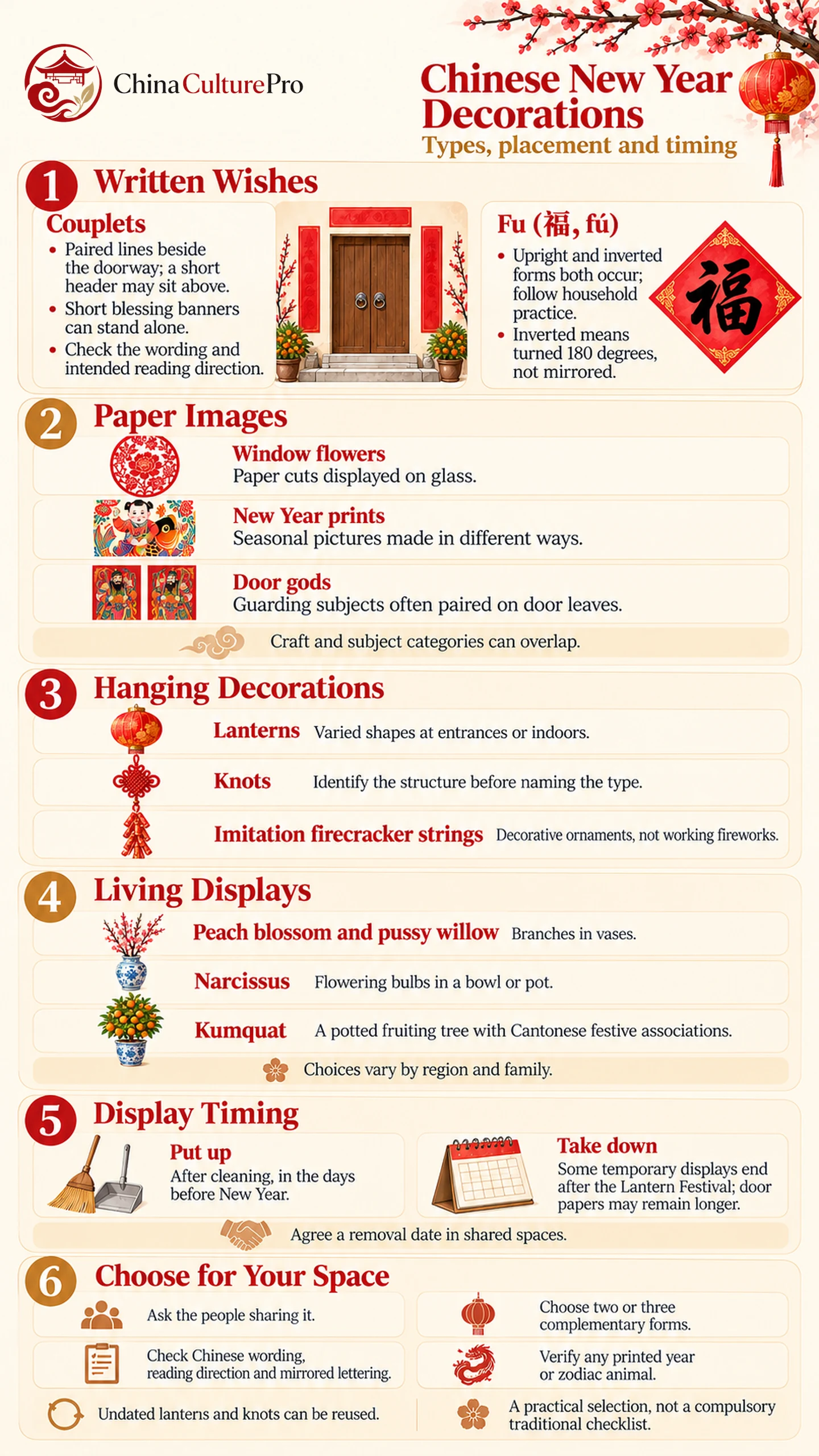
Common Chinese New Year decorations include written wishes, paper images, hanging ornaments and flowering plants. Four useful groups are:
- Door text: Spring couplets (春联, chūnlián), Fu (福, fú) and short wishes express blessings in words.
- Paper images: Paper cuts (剪纸, jiǎnzhǐ), New Year prints (年画, niánhuà) and door gods (门神, ménshén) display festive subjects.
- Hanging objects: Lanterns (灯笼, dēnglong), Chinese knots (中国结, Zhōngguó jié) and imitation firecracker strings create a festive setting.
- Living displays: Flowering branches, bulbs and potted citrus bring seasonal color indoors.
These groups overlap and form no compulsory traditional checklist. Their auspicious meanings express cultural wishes, without guaranteeing wealth, protection or good luck.
Red paper beside a doorway, a cutout on a window and a lantern overhead serve different purposes. This guide explains how to recognize Chinese New Year decorations, where they are commonly displayed and when families put them up, so you can choose a few that suit your space.
Chinese New Year Decorations at a Glance
Use the visible form and display location to identify an item first. A red paper decoration might be calligraphy, a cutout or a printed picture; its material alone does not tell you its meaning.
| Decoration | What to look for | Common display location | Use or limit |
|---|---|---|---|
| Spring couplets and horizontal header (横批, héngpī) | Two vertical text strips, often with a short horizontal strip | Doorframe sides and lintel above | Wishes come from the words; check which line goes where |
| Fu decoration | A large 福 on paper, fabric or another backing | Door panel, wall or window | A wish for blessings; orientation follows household practice |
| Paper cuts and window flowers (窗花, chuānghuā) | Openwork paper designs, sometimes symmetrical | Windows, doors or walls | Window flowers are paper cuts used on windows |
| New Year prints and door-god pictures | Printed or painted figures and scenes | Walls or door leaves | Door gods are one subject, rather than all New Year pictures |
| Lanterns | Paper or fabric shades, tassels and varied shapes | Entrances, rooms and public spaces | A festive object also used at other festivals |
| Chinese knots | Interlaced cord, sometimes with tassels | Indoor walls or hanging points | Identify the knot type before assigning a specific meaning |
| Imitation firecracker strings | Small cylinders linked as a hanging ornament | Beside a doorway or on a wall | Decorative models are different from working fireworks |
| Seasonal flowers | Branches in a vase or flowering plants | Living-room surfaces and entry areas | Plant choices vary by region and family |
| Potted kumquat (金橘, jīnjú) | Small citrus fruits on a living tree | Entrance or reception area | Especially associated with Cantonese New Year displays |
These nine groups are an editorial selection. For detailed motif meanings, see Chinese New Year symbols.
Door Decorations: Spring Couplets, Blessing Banners and Fu
Spring Couplets and Other Written New Year Wishes
Spring couplets place two coordinated lines beside an entrance. A horizontal header may complete the arrangement above. Black or gold lettering on red paper is common; the written message determines whether the wish concerns family harmony, peace or prosperity.[1]
For example, 天增岁月人增寿 (Tiān zēng suìyuè rén zēng shòu) pairs with 春满乾坤福满门 (Chūn mǎn qiánkūn fú mǎn mén). Together, they wish for added years of life and a home filled with springtime blessings. 万象更新 (Wànxiàng gēngxīn), “all things renewed,” can serve as the header.
Short standalone wishes are also displayed. In Hong Kong, huichun (挥春, huīchūn) covers New Year blessing calligraphy in different forms. Its familiar Cantonese name is fai chun; the Jyutping pronunciation is fai1 ceon1.[8] A four-character strip need not be one half of a couplet. Before hanging a set, confirm its paired lines, header and intended reading direction with someone who can read the text.
Fu: Upright, Upside Down and Easy to Misread
Fu expresses blessings or good fortune. It may appear as brush calligraphy, a paper cut or a printed decoration. The paper’s outline and the character’s orientation are separate choices: a diamond-shaped backing does not require an upside-down character.
The inverted form uses Mandarin wordplay: 倒 (dào), “upside down,” sounds like 到 (dào), “arrive.” It expresses the wish that blessings have arrived. Some households favor upright Fu at the main entrance and use inverted versions elsewhere. Both forms express wishes for blessings; regional and family preferences differ.[3]
Follow the household’s preference when helping decorate. Turning a design through 180 degrees produces an inverted Fu; flipping it like a mirror produces reversed writing. The latter is not the custom. The Fu symbol guide explains its broader meanings and display traditions.
Paper Cuts, New Year Prints and Door Gods
Paper cutting describes how a design is made. An animal, flower, character or story describes what it shows. A Fu-shaped paper cut therefore belongs to both a craft category and a written-blessing theme.
Window flowers are cut-paper designs placed on windows. Light passing through their openings makes the pattern visible. Designs may be symmetrical, but regional styles and subjects vary widely; one province cannot be reduced to a single delicate or bold style.[4]
New Year pictures have another distinction: they are seasonal images, not a synonym for one printing technique. Woodblock printing is a major tradition, while painting and modern printing also produce New Year pictures.
Door gods are recognizable by their guarding role and placement at entrances. Pictures may be paired across door leaves, rather than running along the surrounding frame like couplets. Military guardians are familiar examples, but door-god imagery is not limited to one pair of figures.[1]
When identifying a doorway display, read the whole arrangement: words on the frame, pictures on the panels and a cutout on nearby glass may perform different jobs.
Lanterns, Knots and Other Hanging Decorations
Hanging decorations add height and movement to a display. Their shape and construction matter more for identification than a generic red-and-gold color scheme.
- Lanterns: Round red lanterns are familiar, but polygonal, palace-style and animal-shaped forms also exist. They may hang at entrances or indoors, while public celebrations use larger installations. Some are illuminated; others function mainly as ornaments. The Lantern Festival brings a concentrated display of lantern craft, rather than being the only occasion when lanterns appear.[1]
- Chinese knots: Red cord decorations can combine several knot forms with tassels and other attachments. Their interlaced structure can suggest connection and continuity, but a specific name requires a recognizable structure. The Chinese knot guide distinguishes common forms; not every knot is an endless knot.
- Imitation firecracker strings: These repeat the familiar cylinder-and-cord shape as a wall or doorway ornament. They evoke festive firecrackers through appearance. A nonfunctional hanging model should not be confused with a firework or interpreted as an instruction to light it.
Choose a hanging point that fits the object and leaves the entrance usable.
Flowers and Potted Citrus: Living New Year Displays
Living displays need not all take the same form. A vase of branches, a bowl of flowering bulbs and a fruiting tree give a room different shapes and require different amounts of space.
Peach blossom (桃花, táohuā) branches bring a spring theme to a vase display. Pussy willow (银柳, yínliǔ) offers a contrasting branch form. Narcissus (水仙, shuǐxiān) is commonly displayed as bulbs growing in a bowl or pot, rather than being grouped automatically with cut flowers. Potted narcissus is a documented New Year household decoration in Hong Kong.[5] Its cultural meanings extend beyond this seasonal use.
Potted kumquats are especially familiar in Cantonese festive settings. Their golden fruit suggests prosperity, and Cantonese naming adds associations with gold and good fortune.[6] Mandarin 橘 (jú) and 吉 (jí) are not exact homophones; do not present the Cantonese association as a universal Mandarin pun.
Hong Kong’s flower-market displays include kumquat trees and other seasonal plants.[7] Choose a plant for its form and the recipient’s preferences; no particular flower is required for every Chinese New Year home.
When to Put Up and Take Down Chinese New Year Decorations
Many households decorate after cleaning the home in the days before New Year. Written blessings may go up on New Year’s Eve, while flowers, lanterns or public displays may appear earlier. Cleaning followed by hanging blessing scrolls is a documented sequence in Hong Kong.[2] The broader Chinese New Year guide explains the festival calendar.
There is no single removal date for every item. Some families clear temporary displays after the Lantern Festival, on the fifteenth day of the first lunar month. Other decorations, including door papers, may remain longer and be renewed for the next New Year. The visible holiday display can therefore outlast a workplace’s public-holiday break.
If you are decorating with a host family, ask which items they normally replace and which they keep. For an office or shared room, agree on a practical end date with the people using the space. Treat that arrangement as a local choice, not a nationwide cultural deadline.
How to Choose Decorations for a Small Home or Shared Space
Build a modest display around the space you actually have. The following sequence is a practical suggestion, rather than a prescribed traditional ceremony:
- Start with the setting: Identify whether you are decorating a private doorway, a shared office or an event area. Ask the people using it about their preferences before choosing text or religious figures.
- Select complementary forms: Pick two or three types that use different surfaces, such as an entrance message, a window cutout and a tabletop plant. You do not need every item in the overview.
- Check the information: Have Chinese writing read back from the final design. If it features the incoming year’s Chinese zodiac (生肖, shēngxiào) animal or a printed year, verify both before display.
- Review the arrangement: Check the reading direction, mirrored lettering and placement. Reusable lanterns or knots can work again; dated decorations need another look.
For a small home, a matching couplet set with its header, one window cutout and a bowl of narcissus make a simple combination. Red and gold are familiar choices, but the room does not need an entirely new color scheme.
FAQs About Chinese New Year Decorations
Why Are Chinese New Year Decorations Usually Red?
Red is strongly associated with celebration and auspicious wishes in Chinese festive settings. Gold is a familiar accent, but lanterns, paper pictures and flowers can use other colors. There is no universal red-only requirement.
Does Fu Have to Be Hung Upside Down?
No. Upright and inverted Fu both occur in New Year displays. Preferences can depend on the household, region and position. When decorating someone else’s home, follow their custom rather than insisting on one correct orientation.
When Should Chinese New Year Decorations Come Down?
There is no nationwide removal deadline. Some temporary displays end after the Lantern Festival, while door papers may remain much longer. In a shared space, agree on a removal date with its users.
Can You Reuse Chinese New Year Decorations?
Yes. Undated lanterns, knots and containers can be reused if they remain suitable. Check any printed year or zodiac animal first. Replacing every item annually is a household choice, not a universal requirement.
Can Non-Chinese People Decorate for Chinese New Year?
Yes. Understand the wording and cultural context, and consider the people sharing the space. Readable wishes, suitable ornaments and a thoughtful explanation of the occasion help create a respectful display without copying unfamiliar rituals.
Sources
[1] Phoebe A. Hearst Museum of Anthropology. Chinese Folk Art, Festivals, and Symbolism in Everyday Life
[2] Hong Kong Family and Women Portal. Chinese New Year Traditions: A Celebration of Family, Culture, and Virtues
[3] Shanghai Changning District Government Information Office. 【提示】倒着贴“福”字,才是“福到”?
[4] UNESCO. Chinese paper-cut
[5] Hong Kong Centre for Food Safety. 觀賞植物適合食用嗎?
[6] National Parks Board, Singapore. Citrus japonica ‘Fukushu’
[7] Hong Kong Tourism Board. Flower Market
[8] Hong Kong Lexicography. 揮春