

Quick Answer: What Should You Avoid During Chinese New Year?
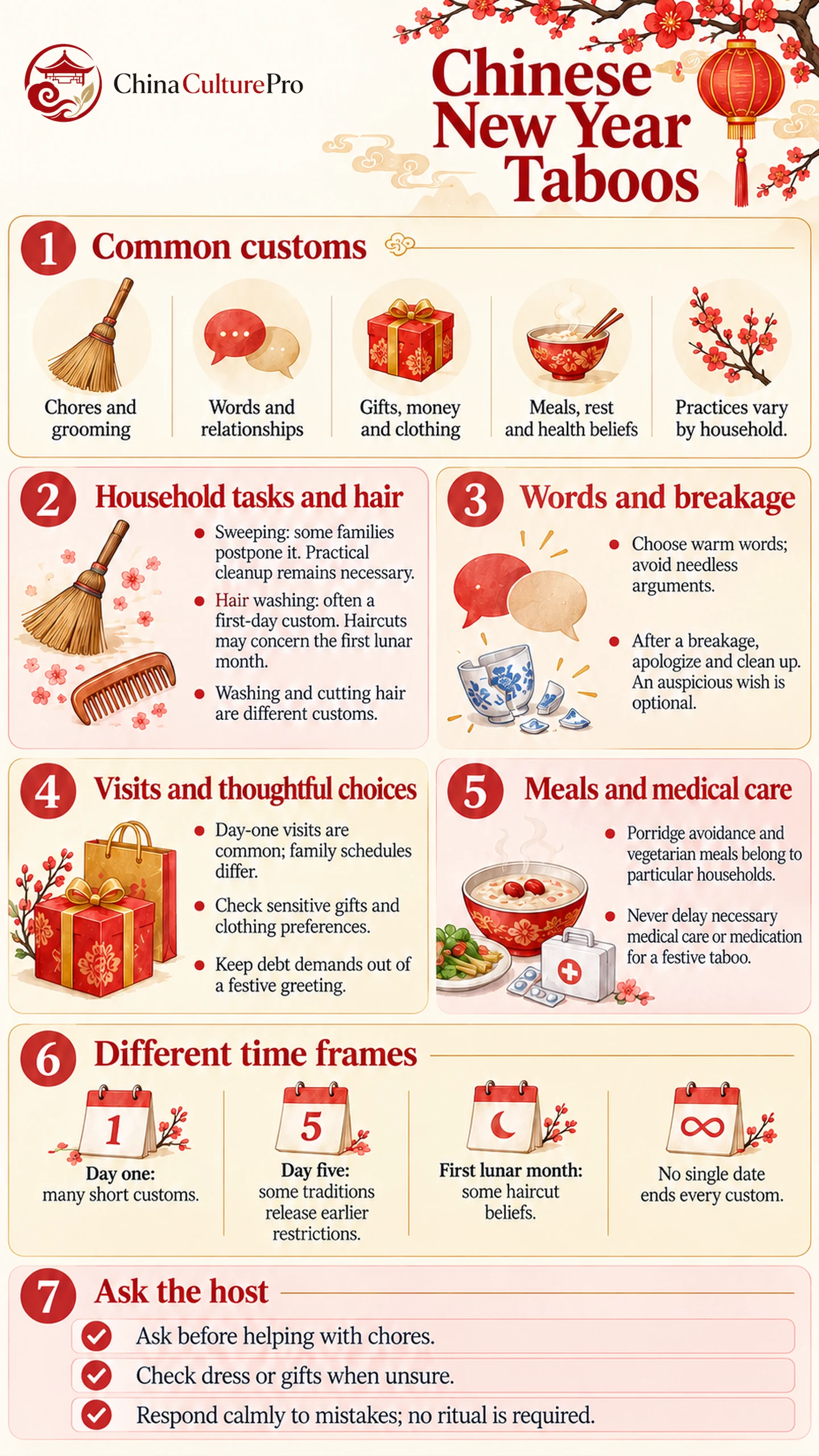
Chinese New Year taboos (禁忌, jìnjì) are avoidance customs tied to hopes for a good beginning. Common examples fall into four groups:
- Household tasks: Some families postpone sweeping, rubbish disposal or laundry to avoid symbolically discarding good fortune.
- Personal grooming: Hair washing and haircuts have different explanations and time frames.
- Words and relationships: Auspicious language and a peaceful atmosphere matter; reassuring wishes may follow an accidental breakage.
- Visits and gifts: Some households have preferences about visiting dates, gifts, money conversations and clothing.
These are regional and family practices, not universal rules or proven causes of luck. Necessary medical care, medication and practical cleanup should not be delayed because of them.
Can you sweep on New Year’s Day, wash your hair or help clear a broken bowl? Chinese New Year taboo lists often combine customs from different places and periods. Understanding the reason and timing behind a household’s preferences is more useful than treating every online warning as a rule.
Common Chinese New Year Taboos at a Glance
Timing follows the Chinese lunar calendar. These are reported beliefs, not universal instructions: a first-day custom does not automatically apply throughout the festival or first month.
| Custom or avoidance | Traditional association | Common time frame | Context to keep in mind |
|---|---|---|---|
| Sweeping and throwing out rubbish | Removing newly arrived luck or wealth | Day one; sometimes longer | Ask before helping with a host’s housework |
| Washing hair or clothes | Washing away blessings; local water-deity beliefs | Day one or first two days | No universal ban on washing or cleanliness |
| Getting a haircut | Hair-related beliefs, including a maternal-uncle saying | First lunar month in some traditions | Separate from the shorter hair-washing custom |
| Using scissors, knives or needles | Cutting fortune or inviting arguments | Day one or an initial holiday period | Household practices differ; ordinary tasks still happen |
| Unlucky words and arguments | An unhappy start setting the year’s tone | Especially day one and festive visits | Avoid unnecessary harshness, without suppressing important conversations |
| Children crying or being scolded | Discord at the year’s beginning | Especially day one | Comfort a distressed child; crying causes no bad luck |
| Breaking crockery or glass | A break in completeness or harmony | Festive gatherings | A reassuring wish is a custom, not a required cure |
| Borrowing, lending or collecting debts | Carrying financial difficulty into the year | Before New Year and during visits | No universal restriction on financial transactions |
| Black, white or damaged clothes | Mourning associations or an unwanted image of hardship | Formal visits and celebrations | The host and occasion matter more than a blanket color ban |
| Porridge or meat at breakfast | Poverty associations; vegetarian observance | Day one in some households | Neither preference defines all Chinese New Year meals |
| Medicine or hospital-related avoidance | Fear of illness recurring all year | Day one or a broader festive period | Continue needed treatment and seek care when necessary |
| Particular family-visiting arrangements | Order of greetings and kinship obligations | Days one and two, or another agreed day | Visiting on day one is not generally forbidden |
| Taking an afternoon nap | Symbolically beginning a lazy year | Day one in some accounts | A folk belief, not a universal rule about rest |
The thirteen groups are an editorial selection. Lists can mix community customs, politeness and folk belief.[1][2]
Cleaning, Hair and Laundry: Why Everyday Tasks Become Symbolic
Sweeping, Rubbish and Washing Clothes
Spring cleaning (扫尘, sǎochén) before the festival creates a clean start. In some households, sweeping after the new year begins reverses that image: instead of removing the old, it appears to remove the newly arrived good fortune. The concern is symbolic, rather than a claim about the broom itself.[1]
Laundry restrictions can have another explanation. Some accounts connect the first two days with a water deity and describe washing as disrespectful or as washing luck away.[2] This is a particular belief, not a shared religious requirement across Chinese communities. Household preferences about scheduled chores need not prevent clearing a spill, collecting broken glass or maintaining ordinary hygiene.
Washing Hair and Getting a Haircut Are Different Customs
Hair washing is often mentioned in first-day or first-two-day lists. Haircuts may instead be discussed in relation to the entire first lunar month. Combining them into one rule obscures both the timing and the explanation.
A common language claim needs care: in mainland standard Mandarin, hair is 发/髮 (fà), while 发/發 in 发财 (fācái), “prosper,” is fā. They have different tones. Hair is not a homophone of 财 (cái), “wealth,” either. The shared simplified character alone does not establish an exact spoken pun.[3]
Another saying links first-month haircuts with harm to a maternal uncle. It has no demonstrated causal basis. The explanation that it developed from “remembering the old” under Qing-era hair regulations is one account, not a settled origin.[4]
Some people choose Longtaitou (龙抬头, lóng tái tóu), the second day of the second lunar month, for their next haircut. That customary choice should not be confused with the exact end of the first lunar month.
Words, Breakage and Family Harmony
Auspicious speech (口彩, kǒucǎi) helps set a warm tone at a celebration. Some families avoid references to death, poverty, illness or loss, alongside quarrels and scolding. This can be understood as a preference for a hopeful beginning; it does not mean difficult events cannot be discussed or that a child’s distress predicts misfortune.[1]
After a cup or bowl breaks, a familiar wish is “peace year after year” (岁岁平安, suìsuì píng’ān). The wordplay connects 碎 (suì), “broken,” with 岁 (suì), “year.” A reassuring phrase can ease embarrassment and turn attention back to the gathering.
For example, a guest might say, “Sorry, I dropped it—suìsuì píng’ān.” A host might answer, “It’s all right.” This illustrates a possible exchange, rather than words every family expects.
Chinese-speaking communities also differ in their preferred euphemisms. Cantonese festive vocabulary includes positive substitutes for certain food names with unwanted sound associations.[5] That does not make every Mandarin word with a similar translation taboo. Read the language and social setting together, and deal with any broken object as an actual cleanup task.
Visits, Gifts, Money and Clothing
A considerate guest needs the household’s preferences more than an exhaustive list of forbidden objects. Four areas are worth checking:
- Family visits: Day-one greetings and visits are common. Some families reserve day two for married daughters to visit their parents, but that schedule is not a rule preventing women from seeing their families on other days. Agree on a convenient time instead of assuming a prohibition.[5]
- Gifts: A clock can be sensitive because 送钟 (sòng zhōng), “give a clock,” sounds like 送终 (sòng zhōng), referring to attending someone’s final moments or funeral arrangements.[6] Pear-related avoidance draws on 梨 (lí) and 离 (lí), “separate.” Reactions vary; neither association makes the object inherently harmful. Ask someone close to the recipient if uncertain.
- Money: Some households prefer to settle obligations before the festival and avoid debt demands during greetings.[2] This does not establish a ban on lending, borrowing or large transactions throughout the first month. Keep a festive visit separate from an unexpected discussion about what someone owes.
- Clothing: Traditional black and white mourning associations explain some families’ preferences. An entirely white formal outfit and a small white detail need not receive the same reaction. Ask about the occasion; red is a familiar choice, not a compulsory uniform. Do not infer someone’s views from their age alone.
Food and Health-Related Taboos
Some households avoid porridge at the first breakfast because it evokes hardship; others choose vegetarian food as part of religious or family practice.[2] These are different explanations. Avoiding meat is not a universal requirement, and eating porridge does not determine a family’s prosperity. A guest can ask what is being served and explain their own dietary needs without treating the meal as a test of cultural knowledge.
Medicine and hospital avoidance needs an especially clear distinction. Some traditional accounts associate taking medicine or visiting a hospital during the holiday with illness continuing into the year. This describes a belief, not how illness works. Do not skip needed medication, put off necessary care or discourage another person’s treatment to comply with a New Year taboo.[2] Visiting someone socially in hospital is also a different decision from seeking treatment yourself. The household’s festive preferences cannot replace the patient’s needs or medical guidance.
Timing and Regional Differences: Day One, Day Five and Beyond
Chinese New Year taboos do not share one start and end date. Use the specific custom and household as your reference:
- Day one: Many lists concentrate on cleaning, speech, grooming and the first meal. A day-one practice is not automatically a fifteen-day commitment.
- Days two and three: Some families arrange natal-family visits on day two. In Hong Kong, Red Mouth Day (赤口日, chìkǒu rì) is associated with the third day and a belief that social visits may lead to arguments. It does not mean everyone stays indoors.[7]
- Day five: Po Wu (破五, pòwǔ), often translated as “breaking the fifth,” is connected in some traditions with releasing earlier restrictions. It is a local cultural explanation, not a national expiry date for every taboo.[8]
- The first lunar month: Haircut avoidance may use this longer period, with some people choosing Longtaitou afterward.
Avoid assuming that northern families follow more taboos or southern families follow fewer. Language, locality, religious practice and individual family choices can all change what is observed. The Chinese New Year guide explains the broader calendar; that calendar and a household’s avoidance period are different things.
How to Respond as a Guest
You can be considerate without anticipating every custom. Start with the people hosting you:
- Ask before helping: “Would you like me to clear this?” is more useful than assuming that every kind of cleaning is unwelcome. Let the host explain any preference about a broom or rubbish.
- Check sensitive choices: Ask about dress or a gift when an invitation gives little guidance. Avoid judging the household as strict or relaxed based on the hosts’ ages.
- Respond proportionately: If you say something awkward, a brief apology or warm wish can be enough. If something breaks, help address the mess; no set phrase or ritual is required.
For example, ask whether you can clear the table after a meal, then follow the host’s answer. A simple question makes room for a preference you may not know.
FAQs About Chinese New Year Taboos
Can You Wash Your Hair on Chinese New Year?
Yes. Some families avoid it on the first day or first two days, but there is no universal prohibition. Ask about a host’s preference if relevant; ordinary grooming does not determine your luck.
Can You Clean on Chinese New Year’s Day?
Yes. Some households postpone sweeping or rubbish disposal for symbolic reasons. That custom need not stop you from dealing with a spill, broken object or practical hygiene need. Ask before taking over a host’s chores.
Can You Wear Black or White at Chinese New Year?
Some families prefer festive colors because black and white can evoke mourning. There is no universal ban, and the outfit and occasion matter. Check the host’s preference for a formal gathering if unsure.
How Long Do Chinese New Year Taboos Last?
It depends on the practice. Some concern day one, some the opening days, and some hair-related customs the first lunar month. Neither the fifth day nor the Lantern Festival ends every household’s observance.
What If You Accidentally Break a Plate?
Apologize briefly and deal with the breakage. A host may offer reassurance or say an auspicious phrase such as suìsuì píng’ān. The phrase is optional; breaking a plate does not establish that bad luck will follow.
Sources
[1] National Library Board, Singapore. Chinese New Year taboos
[2] Singapore Chinese Cultural Centre. Chinese New Year Do’s and Don’ts
[3] Han Dian. 发
[4] Dai Wangyun, East China Normal University. 二月二,为何会成为一年之中最有名的剃头日
[5] Singapore Chinese Cultural Centre, Culturepaedia. Chinese New Year
[6] Ministry of Education, Taiwan. 送終
[7] Radio Television Hong Kong. Crowds try their luck at Che Kung Temple, horse racing
[8] Beijing Municipal Government. 大年初五迎財神 來北京這些活動get新年好彩頭!