
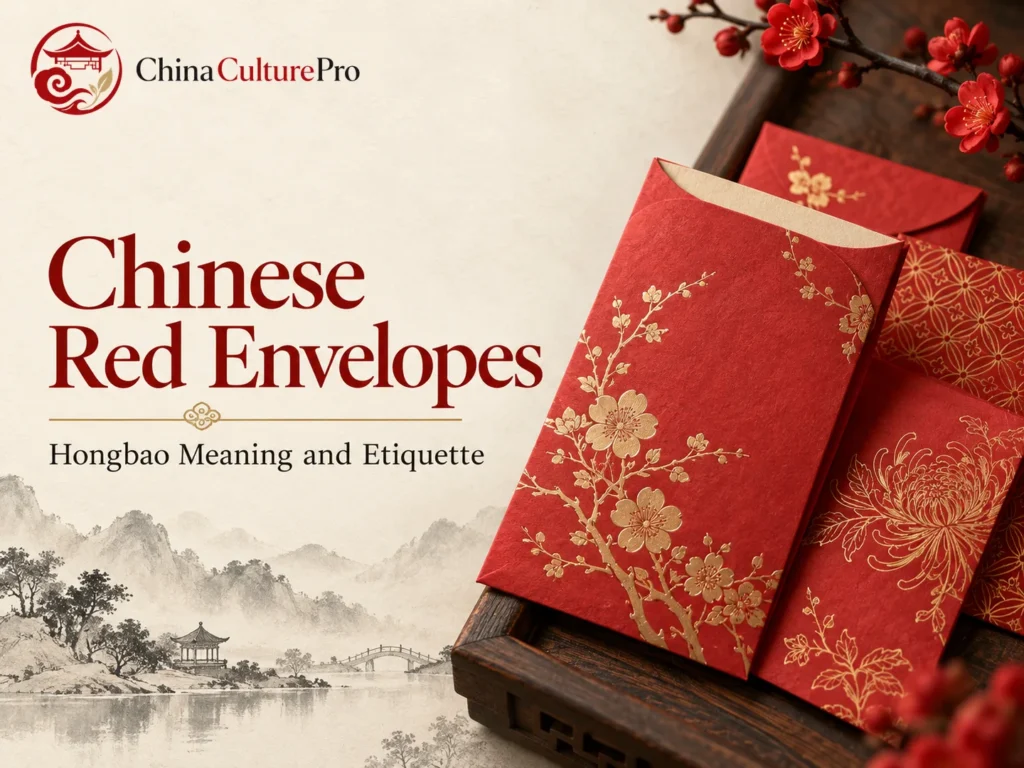

Quick Answer: What Are Chinese Red Envelopes?
Chinese red envelopes are cash gifts traditionally presented in red paper packets to convey blessings, affection or appreciation. They are especially familiar at Chinese New Year, although the custom extends to other celebrations.
- Who gives: Elders commonly give to children; married adults, working children and employers may also give, depending on the relationship and community.
- How much: Choose an affordable amount suited to the occasion and local expectations. Number preferences do not create a universal price list.
- How to exchange: Offer a greeting, give or receive respectfully with both hands, and usually save opening the packet for later.
These are cultural customs with regional and family variations. The gift expresses goodwill; it does not guarantee prosperity or provide supernatural protection.
At a Chinese family gathering, a small red packet can raise surprisingly practical questions: should an unmarried adult give one, how much belongs inside, and should a recipient open it immediately? Chinese red envelopes, or hongbao (红包, hóngbāo), combine cash gifts with personal wishes and social courtesy.
Hongbao, Lai See, Ang Bao and Yasuiqian: What Do the Names Mean?
The names distinguish language backgrounds and, sometimes, the purpose of the gift. In English, “red envelope” and “red packet” usually describe the same custom. The following pinyin gives Mandarin readings of the written characters, rather than pronunciations of the Cantonese or Hokkien names.
| Name and written form | Language or community | Meaning in this guide |
|---|---|---|
| Hongbao (红包, hóngbāo) | Mandarin | Literally “red packet”; a celebratory cash gift. |
| Yasuiqian (压岁钱, yāsuìqián) | Mandarin, New Year context | New Year gift money traditionally given by elders to children. |
| Lai see (利是; Mandarin: lìshì) | Cantonese communities, including Hong Kong | A conventional English spelling of the Cantonese name for auspicious cash gifts. |
| Ang bao / ang pow (红包; Mandarin: hóngbāo) | Hokkien-speaking communities, including Singapore | Common English spellings of the Hokkien name for red packets. |
Lai see and ang bao are conventional spellings, not Mandarin pinyin. Nor is every wedding or birthday packet yasuiqian: that term identifies the New Year money, rather than every cash gift in a red envelope.[1]
Who Gives and Receives Chinese Red Envelopes?
Start with the relationship and the household, rather than the giver’s marital status alone. Giving from elders to children is a familiar pattern, but gifts can also travel upward through generations or from a company to its staff. Hong Kong New Year practice includes elders, bosses and married adults among the usual givers.[2]
| Giving relationship | Common setting | What can vary |
|---|---|---|
| Elders to children or younger relatives | New Year family gatherings | Families decide whether receiving continues through study, employment or marriage. There is no universal age cutoff. |
| Married adults to unmarried younger relatives | Particularly familiar in Hong Kong and Singapore | Marriage can mark a change in role, but families handle newlyweds and unmarried adults differently. |
| Working adult children to parents or grandparents | New Year visits and family celebrations | The gift expresses gratitude; employment can matter more than marriage. |
| Companies or managers to employees | New Year gatherings or returning to work | Some workplaces give a goodwill packet. Participation and amounts depend on the organization. |
In Singapore, employed or married adult children also give packets to parents and grandparents in appreciation for their upbringing. An adult may receive a packet from an older relative and give one to a younger relative at the same gathering.[3]
An unmarried adult who has just started work can ask a parent or host, “Do we usually give packets to the children in this family?” That resolves the immediate question without assuming everyone follows the same rule. Likewise, receiving after turning 18 does not automatically break etiquette.
An overseas guest need not arrive with a packet for every person. Ask the host whether small gifts for the children would fit the gathering; participation should feel comfortable rather than compulsory.
How Much Money Should You Put in a Red Envelope?
Choose by Relationship, Occasion and Local Practice
Set your total gift budget before choosing individual amounts. Then consider who will receive packets, how close you are, and what people normally do in that particular family or community. A trusted relative can explain expectations without turning the exchange into a public comparison.
For a mainland Chinese New Year example, published tourism guidance lists CNY 66, 88, 100 and 200 as possible amounts. It also gives CNY 66 or 88 as examples of a small gift an overseas guest might offer a host’s child. These are illustrative figures, not national rates or required amounts for particular relationships.[4]
Do not convert those figures mechanically into Hong Kong dollars, Singapore dollars or another currency and assume the result is locally appropriate. Ask about familiar local amounts instead. You can also decide a consistent approach for children in similar relationships, so you are comfortable with the total before the gathering.
Wedding, newborn and birthday gifts have different social contexts. A New Year example cannot establish an appropriate wedding gift, and a larger packet is not automatically a more respectful one.
Lucky Numbers: Preferences, Not Fixed Rules
Some families favor even amounts, often associated with good things coming in pairs. Other numerical preferences involve wordplay, with exceptions that make “all odd amounts are wrong” an unreliable rule.
- Four: 四, sì, resembles 死, sǐ, meaning “death,” but the Mandarin tones differ. Some households avoid it in gift amounts.
- Eight: 八, bā, is associated with prosperity through sound-based wordplay with 发, fā. They are not identical Mandarin pronunciations.
- Nine: 九, jiǔ, sounds exactly like 久, jiǔ, meaning “lasting.” This helps explain why an odd digit can still have a favorable association.
- Six: 六, liù, is associated with smooth progress through expressions such as 六六大顺, liù liù dà shùn. It is not a homophone of 顺, shùn.
For the wider context, see Chinese number symbolism. These associations express wishes; they do not make a number powerful or turn an unfamiliar amount into a prediction of bad luck.
How to Give and Receive a Red Envelope Politely
Giving: Prepare the Packet and Offer a Greeting
Prepare the gift before the visit so the exchange can focus on the person receiving it. The following is a practical approach, rather than a mandatory ceremony.
- Choose an appropriate packet: For New Year, use a festive design with a greeting, a seasonal animal or Fu (福, fú), the character for blessings. Double Happiness (囍, xǐ) has a strong wedding association, so choose deliberately rather than treating every red design as interchangeable. The guide to Chinese New Year symbols explains common decorative themes.
- Prepare the money: Use clean, presentable banknotes and a sound envelope. Brand-new notes are a preference, not the only acceptable choice: Hong Kong’s official lai-see arrangements include both new and good-as-new notes.[5]
- Offer it with a greeting: Present the packet with both hands when practical. You can say 新年快乐,身体健康! Xīn nián kuài lè, shēn tǐ jiàn kāng! This means “Happy New Year, and wishing you good health.” A short, warm wish is enough.
Receiving: Accept, Thank and Open Later
Receiving graciously acknowledges the relationship behind the gift. You do not need an elaborate speech, and there is no universal requirement to refuse a fixed number of times before accepting.
- Accept respectfully: Receive the packet with both hands when practical and acknowledge the giver. Follow the family’s lead if children use a particular greeting or gesture.
- Say thank you: A simple response is 谢谢,祝您新年顺利! Xièxie, zhù nín xīnnián shùnlì! This means “Thank you, and wishing you a smooth New Year.” The respectful 您, nín, suits an elder or a formal relationship.
- Put it away and open it later: Usually avoid opening the packet or counting its contents in front of the giver. This is familiar courtesy in Hong Kong. If the host explicitly invites everyone to open gifts together, follow that arrangement instead.[6]
When Are Red Envelopes Given?
At Chinese New Year, packets may be exchanged on New Year’s Eve, during family visits or at a workplace gathering after the holiday. You do not have to hand over every packet at midnight or on one nationally fixed day. In Singapore, family exchanges are documented on the eve or day of New Year; Hong Kong workplaces may distribute lai see when staff return.[3][6]
Other occasions change the purpose of the gift:
- Weddings: A packet congratulates the couple or forms part of a family gift exchange. Its context differs from children’s New Year money; the guide to Chinese wedding symbols explains related designs.
- Births and birthdays: Cash gifts can express welcome, affection or celebration.
- House moves and business openings: Some families and communities give packets to mark a new beginning.
These are examples of occasions, rather than obligations attached to every invitation. Ask what suits the event instead of carrying one New Year rule into every celebration.
Digital Red Envelopes: What Changes and What Stays the Same?
Digital red envelopes send a cash gift through a messaging or payment service instead of a paper packet. They can connect relatives who cannot meet, while group-chat versions can make the exchange more playful. Research on online red packets has examined this group interaction as a distinct form of gift giving.[7]
The recipient still matters more than the medium. Add a personal greeting, and check whether the person is comfortable receiving money that way. For an in-person ceremony, ask the host whether a physical packet is expected rather than assuming that every digital transfer is interchangeable with one.
Hong Kong also promotes electronic lai see alongside physical banknotes. Digital gifts are a modern continuation of the custom, not automatically an impolite substitute.[5]
Where Did the Red Envelope Tradition Come From?
One popular folktale describes a demon called Sui (祟, suì) that threatened children on New Year’s Eve. Parents placed coins wrapped in red paper beside a sleeping child, and their light frightened it away. Versions vary; the story explains a protective folk belief, not a verified event or the proven invention of red envelopes.[3]
Dated objects offer firmer evidence for particular forms of the custom. A surviving 1930 handwritten packet from a Peranakan household was used in a pre-wedding gift exchange and is in the Peranakan Museum collection. A gold-dusted printed packet from the 1930s belongs to the National Museum of Singapore collection. These examples document early twentieth-century gifts and design, rather than identifying the first-ever hongbao.[1]
These objects show how packets served different celebrations before today’s digital formats. They do not establish a single inventor or an uninterrupted history from one ancient prototype.
FAQs About Chinese Red Envelopes
What Does Hongbao Mean?
Hongbao literally means “red packet” in Mandarin. In this gift-giving context, it refers to money presented in a festive envelope to convey goodwill, affection or congratulations, especially at Chinese New Year.
Do You Have to Be Married to Give Red Envelopes?
No universal marriage requirement applies. Some communities associate giving with marriage, while working adults may also give to parents or younger relatives. The relevant family custom matters more than a single eligibility rule.
How Much Money Should I Put in a Red Envelope?
Choose an amount you can afford, considering the relationship, occasion and local practice. Ask a trusted participant when uncertain; published examples from one place do not establish the right amount in another.
Should I Open a Red Envelope in Front of the Giver?
Usually, accept it with thanks and open it privately later. Avoid making the amount a public focus. If the giver or event host specifically invites immediate opening, you can follow that arrangement.
Can Non-Chinese People Give and Receive Red Envelopes?
Yes. An invited guest can participate respectfully by following the host’s customs. You may accept a gift graciously or offer a small packet where appropriate, without assuming that participation requires matching everyone else’s spending.
Sources
[1] Sun Yat Sen Nanyang Memorial Hall / Singapore Chinese Cultural Centre. Red packets (Hongbao)
[2] Hong Kong Tourism Board. The Ultimate Guide to Chinese New Year in Hong Kong
[3] SG101. The Gifting of Red Packets in Singapore
[4] Ministry of Culture and Tourism, China. How to Give Red Envelopes for the Spring Festival?
[5] Hong Kong Information Services Department. Lai-see services announced
[6] Hong Kong Talent Engage. Embrace Local Festivities: A Guide to Lunar New Year Customs and Etiquette in Hong Kong
[7] Yuan Yuan and colleagues. Online Red Packets: A Large-scale Empirical Study of Gift Giving on WeChat