


Quick Answer: What Is Traditional Chinese Furniture?
Traditional Chinese furniture includes chairs, tables, couches and cabinets with different forms for sitting, working, receiving guests and storing belongings. On many wooden pieces, mortise and tenon joinery (榫卯, sǔnmǎo) links the frame members. Shape, material and construction can each tell you something about how a piece was made and used.[1][5][7]
- Form: Start with the outline, height and working surface.
- Construction: Look at where legs, rails and panels meet.
- Date: Read the estimated period and any dates for later parts separately.
A style name is one clue. A collection record can supply more specific evidence about the piece.
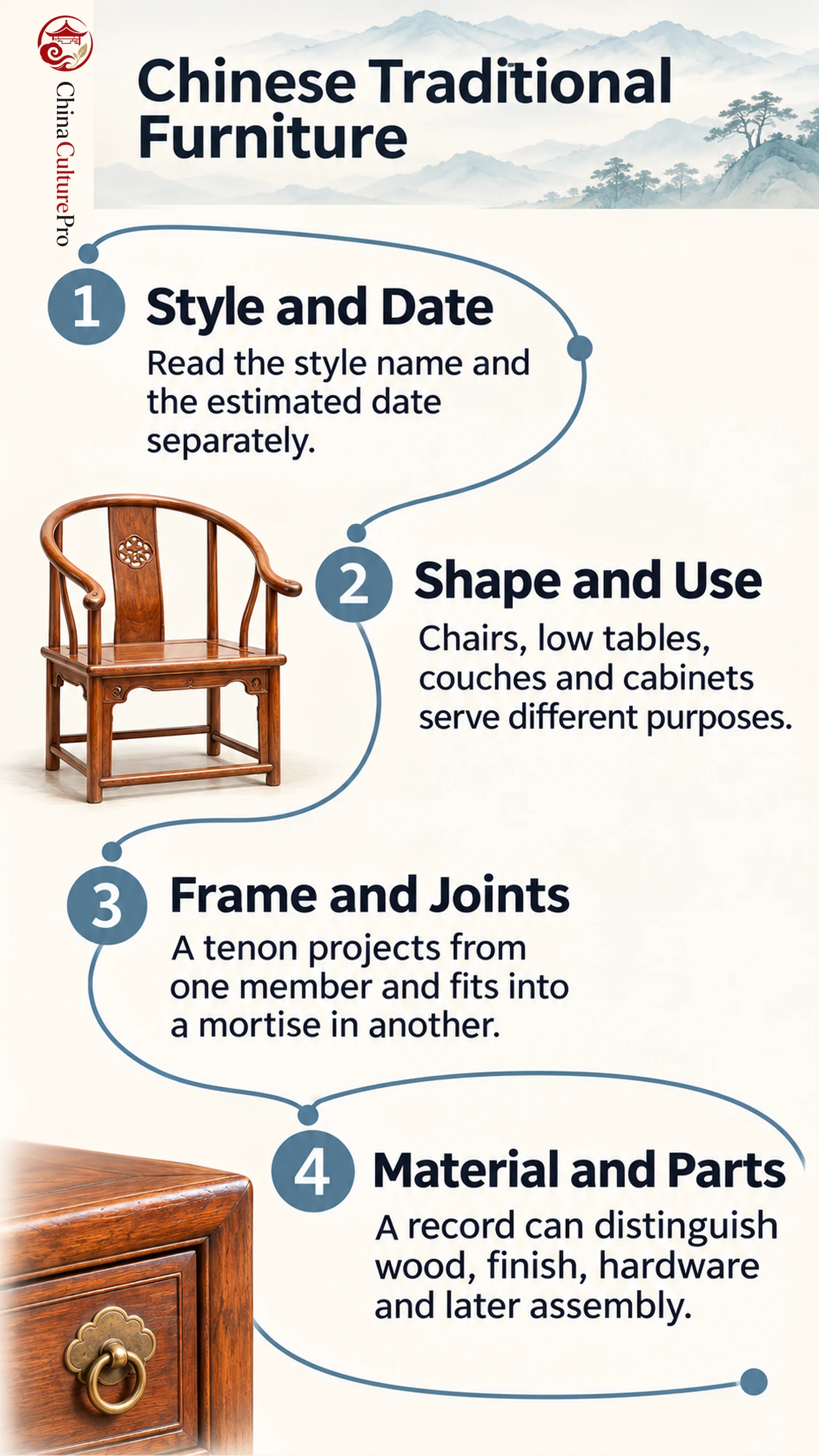
An armchair’s sweeping rail may catch your eye before the small joint that holds it in place. Read the two together. Shape helps explain the chair’s use, while the joints and material reveal choices that a date label alone can miss.
Ming and Qing Dates, Forms and Styles
The Ming dynasty and Qing dynasty are historical periods. A furniture label can also name a design vocabulary. For one example of Ming-style (明式, míngshì) design, look at the Palace Museum’s Ming zitan (紫檀, zǐtán) horseshoe-back chair (圈椅, quānyǐ). Its rounded rail descends into the arms, above an S-shaped back splat and a woven rattan seat.[2]
A mid-Qing throne in the same museum gives a very different impression. Seven screen-like sections form the back and arms, with inset kesi silk tapestry panels. The museum compares its design with a 1726 archival record. Read that comparison as part of the attribution, alongside the catalogue’s broader date.[3]
Carving alone is a poor way to date furniture. The Nelson-Atkins collection includes a deeply carved low table catalogued as probably late Ming. The Met’s seventeenth-century couch carries a late Ming or early Qing date. Use the full wording of the record when the estimate crosses a dynastic boundary.[4][5]
Chairs, Tables, Couches and Cabinets
A low table associated with a heated platform, or kang (炕, kàng), is easier to understand when you picture where the user would sit. Use the seat or work surface as a reference point when comparing the forms below.[1][5]
| Form | What to look for |
|---|---|
| Horseshoe-back chair | A curved rail flows from the back into the arms, giving the seat its enclosing outline. |
| Kang table | A low table used on a raised platform. Its proportions suit a seated user at that level. |
| Couch | A broad platform can accommodate more than one sitting position. A woven surface or added textiles can change how it feels. |
| Cabinet | A tall enclosure combines panels and doors for storage. Look for the frame and separate door hardware. |
The Met’s couch is just over two meters wide, with a rattan mat and a wooden frame of huanghuali (黄花梨, huánghuālǐ). The record describes different ways of sitting and the addition of cushions or quilts in cold weather. Its size and surface help explain how one form could serve different uses.[4]
A Smithsonian armchair from the seventeenth or eighteenth century gives another shape to compare. Its crest rail and handgrips project beyond the upright members. On the Ming chair, the curved rail carries the line of the back into both arms. Those silhouettes distinguish the seat forms even before you inspect the joints.[2][8]
How Mortise and Tenon Joinery Holds the Frame
A tenon is the projecting part of one wooden member. It fits into a corresponding cavity, the mortise, in another. The joint can connect legs and rails or unite different parts of a frame. Other members, such as stretchers, help keep the frame from shifting under use. A guide to mortise and tenon joinery explains the related construction vocabulary.[5][7]
In the Nelson-Atkins kang table, the catalogue describes a floating panel top inside a mitered frame. It also notes two transverse stretchers with their tenons visible in the long rails. The frame encloses the panel, while the crosspieces reach into the frame’s long sides. The exposed ends show one part of the joinery that would otherwise be hidden. On a different piece, you may need an underside image or a conservation note to see the corresponding joint.[5]
Reading Wood, Finish and Later Repairs
Polishing can bring out the grain of a hardwood. Lacquer can give a piece a smooth, colored or decorated surface, depending on how it was applied. Historical collections include a range of woods and finishes, including lacquered wood. Read the catalogue’s medium field when you need to separate the wood from the surface treatment.[1][7]
A label may identify more than one wood or fiber in a single piece. In the Smithsonian armchair, the record distinguishes a wood frame, burl panels in the back and a woven reed seat. A name for the frame material tells you only part of what you are looking at.[8]
A Smithsonian rounded-corner cabinet combines huanghuali and metal hardware. Its catalogue dates the overall object to the first half of the twentieth century and identifies parts from the Ming and Qing periods. That wording gives the assembly and the components different dates. To see what the catalogue has established about the assembly, compare the medium, period and provenance fields in museum records before drawing a conclusion from appearance.[6]
FAQs About Traditional Chinese Furniture
Does Ming-style furniture always date to the Ming dynasty?
Ming-style describes a design vocabulary. Use the object’s date field and the evidence behind it to see when a particular piece was made.
Was traditional Chinese furniture made without metal?
Wooden joints can carry the structure while metal fittings serve other functions. Door hardware is one visible example.
Is all traditional Chinese furniture made of huanghuali?
Museum collections identify a range of woods and finishes. A wood label applies to the piece described in that record.
Can a cabinet contain pieces from different periods?
Yes. A museum can date a cabinet and its older parts separately. Check the full period and construction notes.
Sources
[1] The Palace Museum. Furniture Collection
[2] The Palace Museum. Low zitan horseshoe-back chair with a rattan seat
[3] The Palace Museum. Zitan throne with inset kesi panels
[4] The Metropolitan Museum of Art. Couch, 1976.193.6a–d
[5] The Nelson-Atkins Museum of Art. Kang Table, F88-40/52
[6] Smithsonian National Museum of Asian Art. Rounded corner cabinet, one of a pair with F1989.57
[7] The Metropolitan Museum of Art. Chinese Decorative Arts
[8] Smithsonian National Museum of Asian Art. Armchair, one of a pair with F1989.59