


Quick Answer: What Is Sunmao Joinery?
Chinese mortise and tenon joinery, or sunmao (榫卯, sǔnmǎo), connects fitted members. A projecting tenon (榫头, sǔntou) on one piece enters a matching mortise (卯眼, mǎoyǎn) on another. This principle can connect small furniture parts or members of a timber frame.[1][2][7]
- Fit: The shapes meet inside the joint.
- Visibility: Some tenons reach an outer surface, while others end inside the receiving part.
- Assembly: Pegs, fitted frames or separate hardware may also be present.
To understand a structure, read the joint in relation to the members it connects.
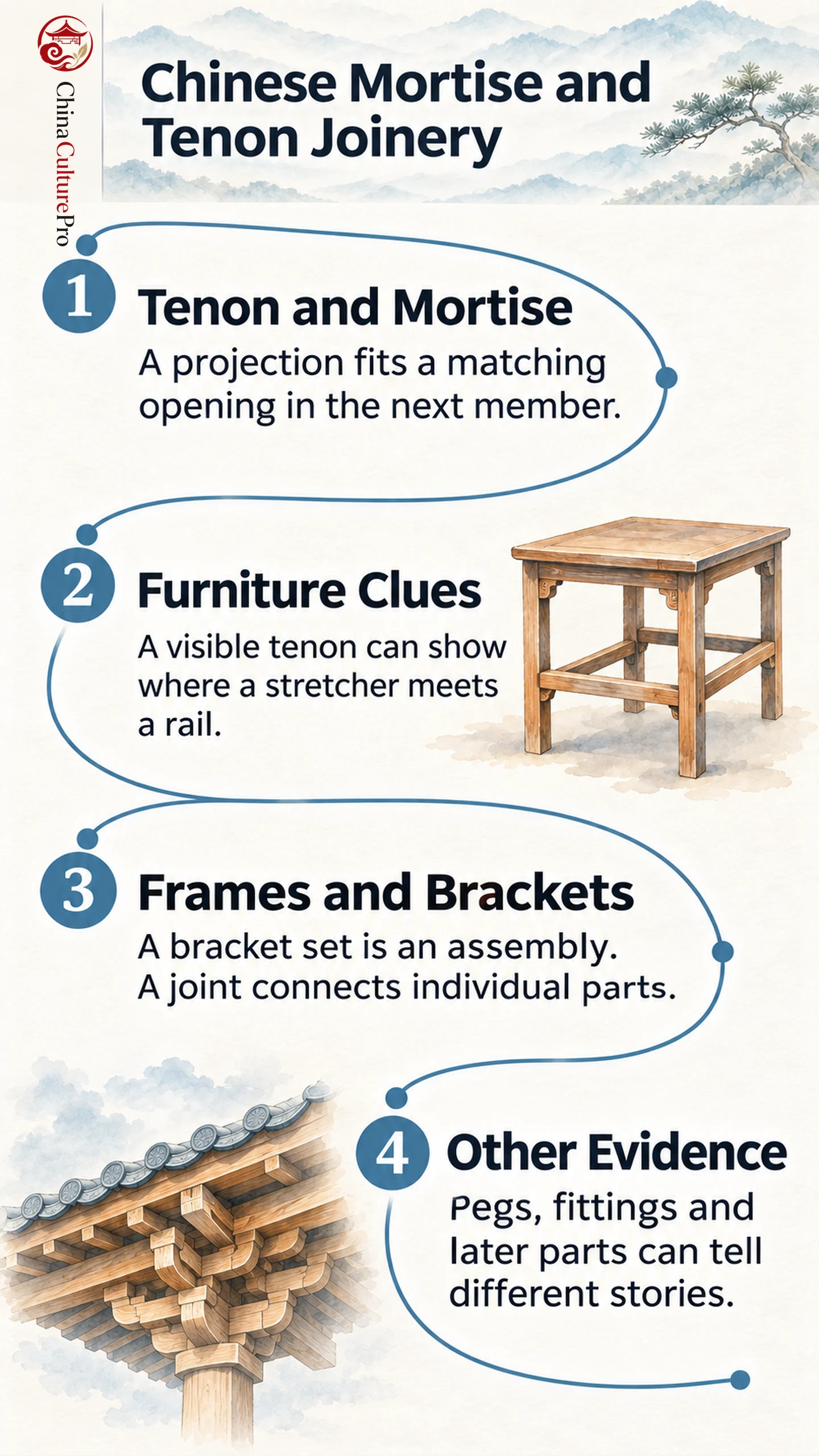
A wooden table can show the end of a fitted joint along one rail while hiding another connection inside the frame. That difference makes it useful to look at how two pieces meet, where the connection sits and which parts remain visible.
How a Tenon Fits a Mortise
| Feature | What it means |
|---|---|
| Through joint | The mortise extends through the receiving part. The end of the tenon can be visible on the far side. |
| Blind joint | The mortise stops inside the receiving part, concealing the end of the tenon after assembly. |
| Pegged joint | A peg can pass through fitted pieces to help hold them in place. |
Where a tenon narrows, the adjoining shoulder can meet the face of the receiving part. The projection and the shoulder work at different points in the connection. In an assembled joint, the mortise can hide or reveal the end of the tenon. A peg describes an additional means of holding the parts, and it can accompany a fitted joint.[2][7]
The view from one side may show only the seam between the pieces. The seam shows where two members meet. A visible tenon end or a description of how the piece was assembled can establish more about the joint.[3][7]
How to Read the Joints in Furniture
On a low table in the Nelson-Atkins Museum of Art, two transverse stretchers have tenons visible in the frame’s long rails. The museum also describes a floating panel within the top. The long rails frame the top, while the stretchers cross it below the panel. The tenon ends on the rails reveal where the stretchers enter them.[3]
In traditional Chinese furniture, look at how a leg, rail or stretcher meets the next member. Then look at the decoration. A carved apron or panel may surround a connection without showing how it fits. The guide to Chinese woodcarving explains how the surface pattern is made.[2][3]
The same table also has mitered edges and a half-lapped connection described near the apron and legs. A furniture record can therefore name several kinds of joinery on one object. An angled seam at a corner tells you something about the edges that meet there, while a visible tenon can reveal how a different pair of members is held together.[3]
Timber Frames, Brackets and Wooden Bridges
In a timber building, the parts can include columns, beams, lintels and other members of a frame. The UNESCO entry describes preparing pieces before assembling them at the building site. Joinery is one of the working skills documented in that intangible cultural heritage entry.[1]
The Met’s garden court publication gives an example of checking fit during assembly. Members could be taken apart and the fit corrected before a peg helped secure them. The resulting frame preserves the location of each member. The account preserves a decision that is difficult to see from the finished surface.[2]
A dougong (斗栱, dǒugǒng) is a bracket set made of fitted components, often seen near the eaves. At the Palace Museum’s Hall of Supreme Harmony, bracket sets are part of the building described in the record. The bracket set is a group of pieces. A mortise and tenon is one type of connection between individual pieces.[1][4]
Traditional wooden arch bridges in Fujian and Zhejiang provide a different case. The heritage record describes beam weaving and fitted joints as part of the bridge system. In this example of traditional craft, the joints work within the arrangement of timber beams that forms the arch.[5]
What Pegs, Hardware and Repairs Tell You
The Met’s garden court publication describes using some wooden pegs in fitted assemblies. A peg may be visible even when the tenon it helps hold is hidden. A cabinet can also use metal fittings at its doors while the wooden parts form a frame.[2][6]
A Smithsonian rounded-corner cabinet is listed with metal hardware and an overall date in the first half of the twentieth century, with Ming and Qing parts. In museum collection records, check the dates for the whole object and the individual parts. A fitted joint can tell you how members meet. The dates of those members may come from records, restoration evidence or comparative study.[6]
FAQs About Chinese Mortise and Tenon Joinery
Is sunmao the same thing as dougong?
Sunmao describes a way of fitting individual parts. Dougong names a bracket assembly that can contain fitted parts.
Does a mortise and tenon joint always show on the outside?
A through joint can show the end of the tenon. A blind joint leaves that end inside the receiving member.
Does sunmao mean a piece has no metal parts?
A fitted joint can coexist with a wooden peg or metal hardware elsewhere in the object. Cabinet fittings are one example.
Can you date furniture from one joint?
The joint gives information about construction. Read it with dated records, material evidence and any information about later parts.
Sources
[1] UNESCO. Chinese Traditional Architectural Craftsmanship for Timber-Framed Structures
[2] The Metropolitan Museum of Art. A Chinese Garden Court
[3] The Nelson-Atkins Museum of Art. Kang Table, F88-40/52
[4] The Palace Museum. Hall of Supreme Harmony
[5] UNESCO. Traditional Design and Practices for Building Chinese Wooden Arch Bridges
[6] Smithsonian National Museum of Asian Art. Rounded Corner Cabinet, F1990.6
[7] Time-Life Books. The Art of Woodworking: Handbook of Joinery