


Quick Answer: What Is Chinese Embroidery?
Chinese embroidery (刺绣, cìxiù) builds designs by stitching onto a ground fabric. A maker can fill areas with smooth strands, change stitch direction to suggest shading or fasten a thicker decorative thread across the surface.[1][2]
- Material: Silk is common in many fine pieces, and makers also work with other fibers and decorative threads.
- Stitch: The size, angle and placement of the stitches affect how the surface catches light.
- Tradition: Workshops and communities use embroidery for different kinds of objects.
Technique, material and place of production are separate clues when reading a textile.
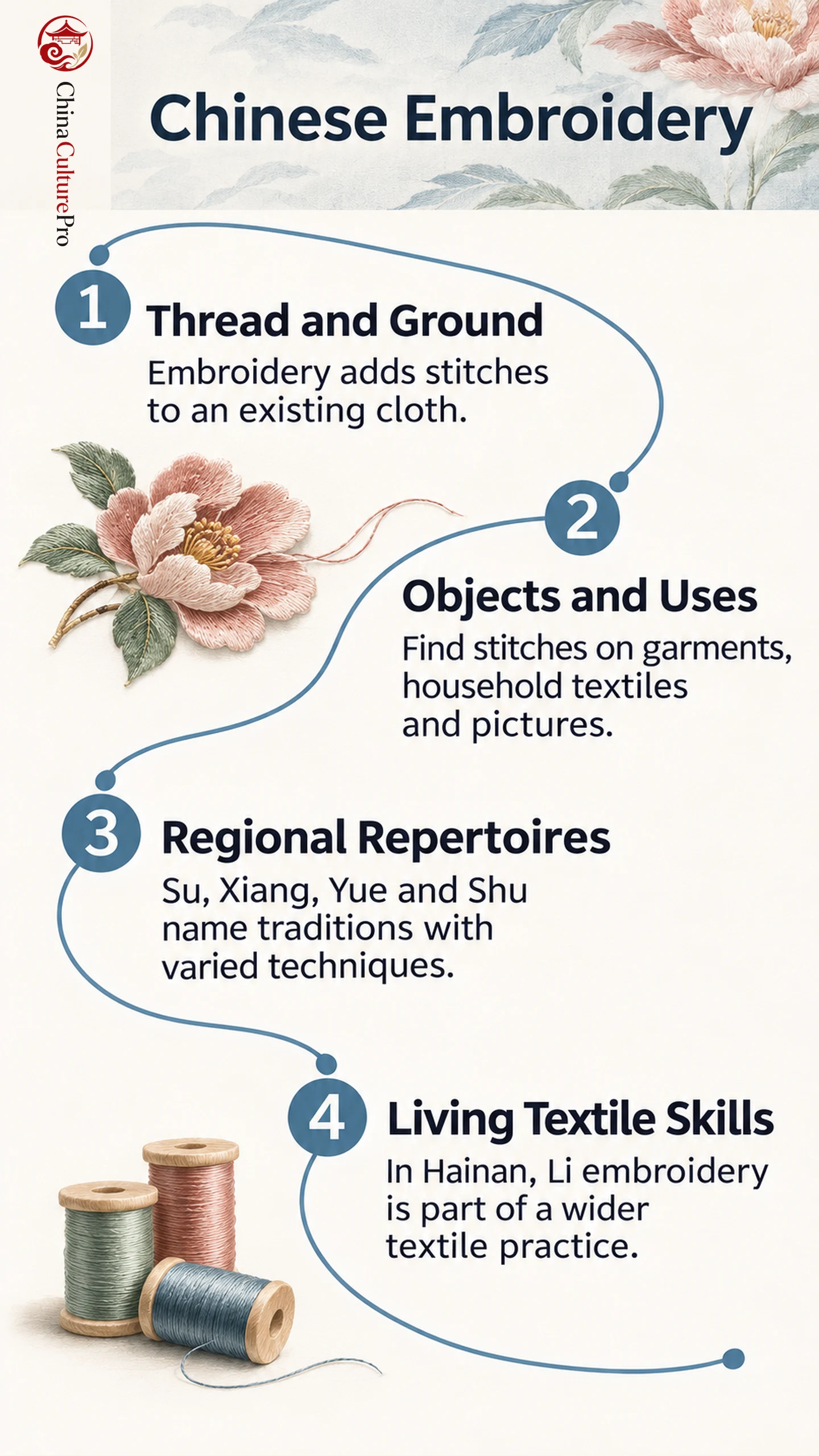
A stitched petal can look smooth from a distance and reveal dozens of directional threads up close. Those details help you distinguish a textile’s ground, its decorative stitching and the choices that give a regional example its particular surface.
How Thread, Ground and Stitch Shape the Surface
The ground is the cloth that supports the stitches. In silk weaving, the pattern can be formed as threads interlace to create the fabric. In embroidery, a maker adds a separate set of threads to an existing ground. Both processes can be present in a single textile.[1][6]
| Stitch approach | What to look for |
|---|---|
| Satin stitch | Adjacent stitches cover an area with largely parallel strands. A change in direction can change the apparent sheen. |
| Staggered filling | Stitches of different lengths can overlap visually and soften a transition between areas of color. |
| Couching | A decorative thread lies on top of the cloth. Smaller stitches catch it at intervals and hold it down. |
Read surface and ground separately in an object description. A silk satin ground describes the cloth. Satin stitch describes the way decorative thread is placed over it. The two terms can appear together because they refer to different operations.[1][7]
Embroidery on Dress, Furnishings and Pictures
A Ming court overvest dated 1595 combines silk satin, canvas and satin stitches, and couched silver and gold threads. The textile shows how multiple techniques can work in one garment. The medium field lists the processes but does not map their positions. Compare it with the image before assigning a technique to a border or figure.[7]
A Qing summer court robe, or chaofu (朝服, cháofú), in the Freer collection uses silk gauze as its ground. The record identifies both silk embroidery and threads wrapped with metal. Next to the Ming overvest, it shows that even formal garments can pair decorative threads with different woven structures.[8]
Embroidery can also be displayed as a picture or stitched onto a household textile. Fine, dyed silk strands can create gradual shading in a flower or landscape. A hanging picture brings those color transitions to the foreground, while a garment also has to carry its design across seams and around the body. The guide to reading museum collection records explains where to look for the material and date, while the entry on paper cutting describes how cut patterns can guide needlework.[2]
Su, Xiang, Yue and Shu Embroidery
The four famous Chinese embroideries are named regional traditions. Their documented repertoires give different reasons to look closely at thread, surface relief and stitch direction.
- Su embroidery (苏绣, Sūxiù): Suzhou embroidery includes fine split silk, shaded pictures and double-sided display work.[2]
- Xiang embroidery (湘绣, Xiāngxiù): A documented Changsha example is Liu Aiyun’s work with specialized stitching for the fur of tigers and lions.[3]
- Yue embroidery (粤绣, Yuèxiù): Guangzhou’s Guang embroidery repertoire includes silk, metal thread and beads, with both flat and raised effects.[4]
- Shu embroidery (蜀绣, Shǔxiù): The Chengdu tradition developed within western Sichuan’s silk textile economy. The heritage entry describes varied stitches for clothing, household pieces and display work.[5]
Treat these as examples of a repertoire. A tiger motif, raised thread or finely shaded petal alone gives limited evidence for where a piece was made.
The Su inventory describes a surviving Yuan-period fragment with nine stitch techniques. That historical example also makes a point about classification. Even within one workshop tradition, the same object may call for several kinds of stitching. A regional name gives context for the choices available to a maker.[9]
Living Traditions Beyond the Four Famous Styles
Among Li (黎族, Lízú) communities in Hainan, embroidery is one part of a textile practice that includes spinning, dyeing and weaving. The UNESCO entry describes cotton and hemp among the fibers used in clothing and daily articles. It distinguishes double-face embroidery from single-face jacquard weaving, even though both contribute to patterned cloth.[6]
UNESCO inscribed the Li textile techniques on its Representative List in 2024. The entry describes teaching through verbal instruction and demonstration. In this context, intangible cultural heritage includes the skills used to make and pass on the textiles as well as the work a viewer can see.[6]
FAQs About Chinese Embroidery
Is Chinese embroidery always made with silk?
Fine silk strands are familiar in many examples. Materials also include metallic threads and other fibers, and the thread can differ from the cloth beneath it.
What is double-sided embroidery?
A maker plans both faces for viewing. Some Su examples show an image on each side of a piece, with the two images sometimes differing.
Can a stitch identify an embroidery’s region?
A stitch helps identify technique. For a regional attribution, check the workshop or maker where known, along with the materials and documented history.
How can you tell embroidery from a woven pattern?
Look for separate stitches added over a ground. In woven patterning, the design is formed as the threads interlace. A textile may combine both methods.
Sources
[1] The Metropolitan Museum of Art. Chinese Textiles: An Introduction
[2] Smithsonian National Museum of Asian Art. Suzhou Embroidery
[3] China Intangible Cultural Heritage Digital Museum. Liu Aiyun, Xiang Embroidery
[4] China Intangible Cultural Heritage Digital Museum. Yue Embroidery: Guang Embroidery
[5] China Intangible Cultural Heritage Digital Museum. Shu Embroidery
[6] UNESCO. Traditional Li Textile Techniques: Spinning, Dyeing, Weaving and Embroidering
[7] The Metropolitan Museum of Art. The Significance of Azurite Blue in Two Ming Dynasty Birthday Portraits
[8] Smithsonian National Museum of Asian Art. Summer chaofu (formal court dress) for a top-rank prince
[9] China Intangible Cultural Heritage Digital Museum. Su Embroidery