
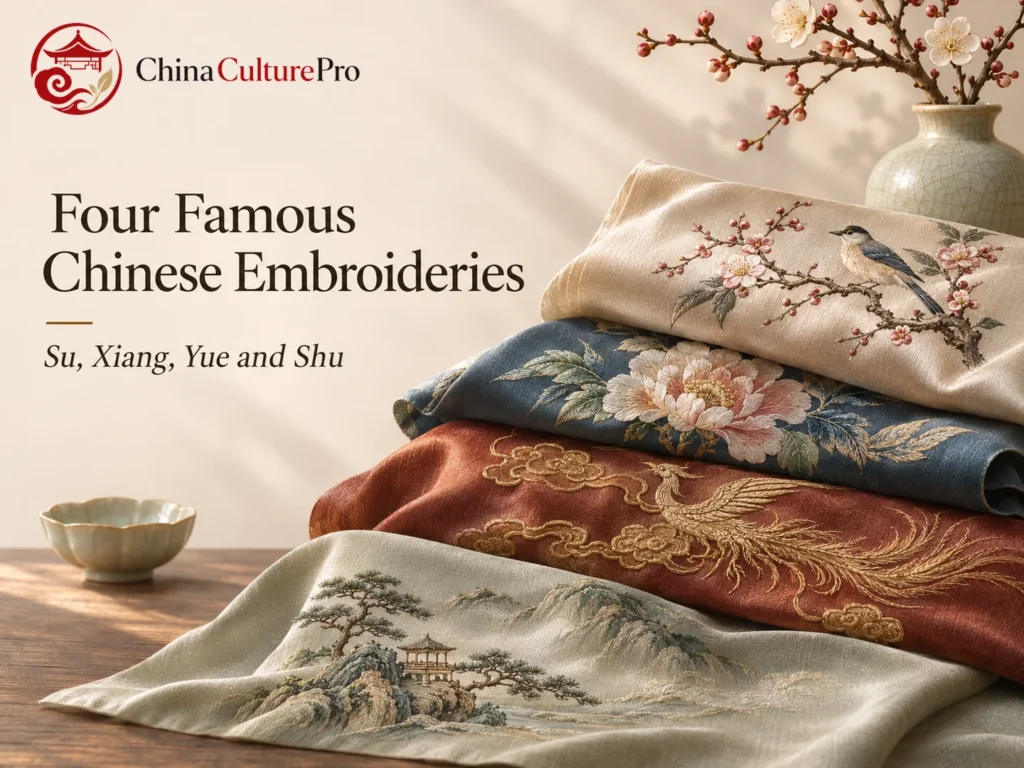

Quick Answer: What Are the Four Famous Chinese Embroideries?
The four famous Chinese embroideries are Su embroidery (苏绣, Sūxiù), Xiang embroidery (湘绣, Xiāngxiù), Yue embroidery (粤绣, Yuèxiù) and Shu embroidery (蜀绣, Shǔxiù). They are associated with Suzhou, Hunan, Guangdong and Sichuan, respectively.[1]
- Compare the thread: Look for fine silk, metal thread or other materials.
- Compare the surface: Shading, layered texture and relief show different ways of working.
- Check the record: A maker or workshop name can support a regional attribution.
The familiar grouping covers four regional traditions within a much wider field.

The four names often appear together, even though their embroiderers work with different threads, subjects and surfaces. The clearest comparisons start with examples. A stitched tiger, a raised gold motif and a silk flower give you different details to examine.
Su, Xiang, Yue and Shu at a Glance
| Tradition | Regional association | Example from the repertoire |
|---|---|---|
| Su | Suzhou, Jiangsu | Fine split silk can create gradual shading in flowers and pictures. |
| Xiang | Changsha and surrounding areas, Hunan | Specialized stitches can create a layered fur effect. |
| Yue | Guangdong, including Guangzhou and Chaozhou | Some workshops use metal threads and padding to build relief. |
| Shu | Chengdu and western Sichuan | Work includes finely stitched pictures and double-sided screens. |
Use the last column to choose a detail to examine, such as thread sheen or relief. A technique in the table may also appear outside the region named beside it. Use the wider guide to Chinese embroidery for the difference between ground cloth, decorative threads and stitch structure.[2][3][5][7][8]
Comparing Silk Shading and Animal Fur
In Suzhou embroidery, fine split silk can build a small transition between colors or follow a narrow contour. On a petal, compare whether the stitches change direction at the edge, where the light catches them differently. Su work also includes pieces intended for viewing from both sides.[2]
Changsha’s Xiang tradition offers a useful comparison. Liu Aiyun (刘爱云, Liú Àiyún) is documented for works depicting tigers and lions and for transmitting specialized animal-fur stitching. Look at how the stitching can follow the turn of a shoulder or the shape of a face. The placement of the fur texture helps suggest the form beneath it. The same maker also worked on birds, flowers and figures.[4]
Liu’s practitioner entry names a tiger drinking and a lion among her works. A different Xiang example at the 2018 national craft biennale depicts a bronze vessel. The two records show the range of subjects that can sit under one regional name.[4][10]
Compare the transitions in the two subjects. A petal’s edges may need a gradual change of tone. Fur may call for a visible change in direction to show where a limb turns.
Comparing Raised Metal Thread and Flat Stitching
Yue includes Guang embroidery (广绣, Guǎngxiù) in Guangzhou and Chao embroidery (潮绣, Cháoxiù) in Chaozhou. The Guang entry lists silk, gold and silver threads, and beads among the materials. The Chao practitioner Lin Zhicheng (林智成, Lín Zhìchéng) used padding and other methods to create raised effects, combining metal-thread decoration with the shaping underneath.[5][6]
In a padded work, material under the embroidery helps create the height. The decorative thread shapes what the light catches on top. A maker may choose a flatter effect elsewhere, so inspect a detail image before treating an entire piece as raised work.[5][6]
In Shu embroidery, documented examples include a hibiscus-and-carp screen and a double-sided screen with aquatic plants and carp. Look at the treatment of the fish and water separately. Each area can call for a different stitch arrangement or surface effect. The screen’s display format and its carp motif describe different things. Read both if a catalogue provides them.[7][8]
Lin’s record also describes him adapting elements of Su technique to Chao work. His two-sided pieces show how a maker can adapt an idea from another tradition and combine it with local relief effects.[6]
How to Identify a Regional Embroidery in a Record
Begin with the name and place of the workshop or maker in a museum record. Compare the medium and technique fields with the image. An object’s Chinese title may name a scene or subject, while the catalogue gives its geographic association elsewhere.
Keep historical evidence at the right scale. Embroidered textiles recovered from the Han tomb at Mawangdui document earlier needlework in Hunan. The archaeological textiles document earlier embroidery. The inventory’s accounts of workshops and makers give more direct evidence about the later regional practice.[3]
A landscape also appears in both the Su and Shu entries in the 2018 biennale. The catalogue identifies one piece from Suzhou and one from Chengdu by maker and place of creation. That pairing shows why a broad subject such as a mountain scene cannot identify one regional tradition by itself.[10]
Domestic heritage inventories describe named practices and representative bearers. They can help you place a maker in context. Other embroidery traditions, such as the Li textile techniques of Hainan, have their own histories and documentation.[3][6][9]
FAQs About the Four Famous Chinese Embroideries
Which regions are the four famous embroideries associated with?
Su is associated with Suzhou, Xiang with the Changsha area of Hunan, Yue with Guangdong, and Shu with Sichuan, especially the Chengdu area.
Is double-sided embroidery exclusive to Suzhou?
No. Su is well known for it, and records also describe two-sided work in other repertoires, including Shu and Chao embroidery.
Are Guang embroidery and Chao embroidery the same?
Both are associated with Yue embroidery, but the names point to different local traditions. The place or maker in the record can help distinguish them.
Does the group cover all Chinese embroidery?
The grouping names four widely discussed traditions. Chinese embroidery also includes other regional and community practices.
Sources
[1] Suzhou Local Gazetteer Office. Suzhou Cultural Arts: Su Embroidery
[2] Smithsonian National Museum of Asian Art. Suzhou Embroidery
[3] China Intangible Cultural Heritage Digital Museum. Xiang Embroidery
[4] China Intangible Cultural Heritage Digital Museum. Liu Aiyun
[5] China Intangible Cultural Heritage Digital Museum. Yue Embroidery: Guang Embroidery
[6] China Intangible Cultural Heritage Digital Museum. Lin Zhicheng
[7] China Intangible Cultural Heritage Digital Museum. Shu Embroidery
[8] China Intangible Cultural Heritage Digital Museum. Shu Embroidery in Chinese Needlework
[9] UNESCO. Traditional Li Textile Techniques
[10] National Museum of China. 2018 Chinese Contemporary Arts and Crafts Biennale