

Quick Answer: What Is Chinese Vegetarian Food?
Chinese vegetarian food (素食, sùshí) includes everyday meat-free dishes and specialized cooking traditions developed in homes, restaurants and religious communities.
- Foods: Soy foods, wheat-based preparations, mushrooms, seasonal vegetables and grains provide different textures and flavors.
- Traditions: Simple household dishes, elaborate restaurant cooking and religious observance all contribute to the repertoire.
- Ingredients to confirm: The stock, cooking fat, sauce and filling matter alongside the visible main ingredients.
A vegetarian meal excludes meat, fish and shellfish, but particular diets differ over eggs and dairy. A vegetable-based name alone cannot establish that the finished dish meets those requirements.
A plate of greens can arrive with an animal-based sauce, while a dish resembling roast poultry may be made from layers of bean-curd sheets. Understanding Chinese meat-free cooking means looking beyond appearances. Its ingredients, restaurant traditions and religious practices offer several ways to approach a meal, each with different expectations about what belongs on the plate.
Vegetarian, Vegan and Buddhist Su: What the Labels Mean
These labels describe overlapping food choices, with different reasons for excluding particular ingredients:
- Vegetarian: Lacto-ovo vegetarian eating (蛋奶素, dànnǎi sù) excludes meat, fish and shellfish while permitting eggs and dairy. Tomato-and-egg stir-fry can fit this category. On a restaurant menu, “vegetarian dishes” (素菜, sùcài) may simply identify a vegetable-focused section, so its seasonings still need checking.
- Vegan: Vegan eating (纯素, chún sù) also excludes eggs, dairy, honey and other animal-derived ingredients. Garlic and onions are compatible with this dietary definition; excluding them is a separate requirement.[1]
- Buddhist su: Buddhist vegetarian cooking (斋菜, zhāicài) follows religious conventions that can add restrictions beyond animal ingredients. Practices differ, so the label should not be treated as a universal vegan certification.
State the foods you exclude rather than relying on a translated label. The distinction is especially useful when a menu contains eggs, dairy-based desserts or dishes prepared in a mixed kitchen.
The Ingredients Behind Chinese Vegetarian Cooking
Ingredients supply more than bulk: soft curds, layered sheets, spongy pieces and crisp vegetables create contrasting mouthfuls. These five groups explain much of that variety.
- Tofu and dried tofu: Tofu (豆腐, dòufu) comes in soft and firm forms suited to different preparations. Dried tofu (豆干, dòugān) is a denser pressed product, usually moist rather than brittle. Cubes, slices and crumbles behave differently in sauces, soups and fillings; “tofu” does not describe one uniform texture.
- Bean-curd sheets and sticks: Yuba (腐皮, fǔpí) forms as a film on heated soy milk. Sheets can be folded, layered or wrapped around vegetables. Dried beancurd sticks (腐竹, fǔzhú) offer another form with a layered bite. Regional terms translated as “tofu skin” can also mean pressed bean-curd sheets, so the actual product matters.[2]
- Wheat preparations: Wheat gluten (面筋, miànjīn) comes from wheat dough after much of its starch is washed away. Kaofu (烤麸, kǎofū) is a fermented, steamed form with a porous structure that absorbs sauces. Its sponge-like appearance can resemble a soy product, but the raw material is different.[3]
- Mushrooms and vegetables: Chinese mushrooms contribute varied textures: shiitake has a substantial bite, while wood ear supplies a firmer, springy contrast. Bamboo shoots, leafy greens and other seasonal vegetables add further variety. A mushroom braise and a crisp vegetable dish can therefore play different roles in the same meal.[4]
- Staples and seasonings: Rice, noodles and other grain foods can provide the meal’s foundation. Soy sauce, vinegar, sesame oil and fermented black beans (豆豉, dòuchǐ) build savory, sour and aromatic layers. Light soy sauce contributes saltiness, vinegar adds acidity, and sesame oil gives a toasted aroma. Prepared sauces and soup bases require a separate ingredient check.
Chinese Vegetarian Dishes to Know
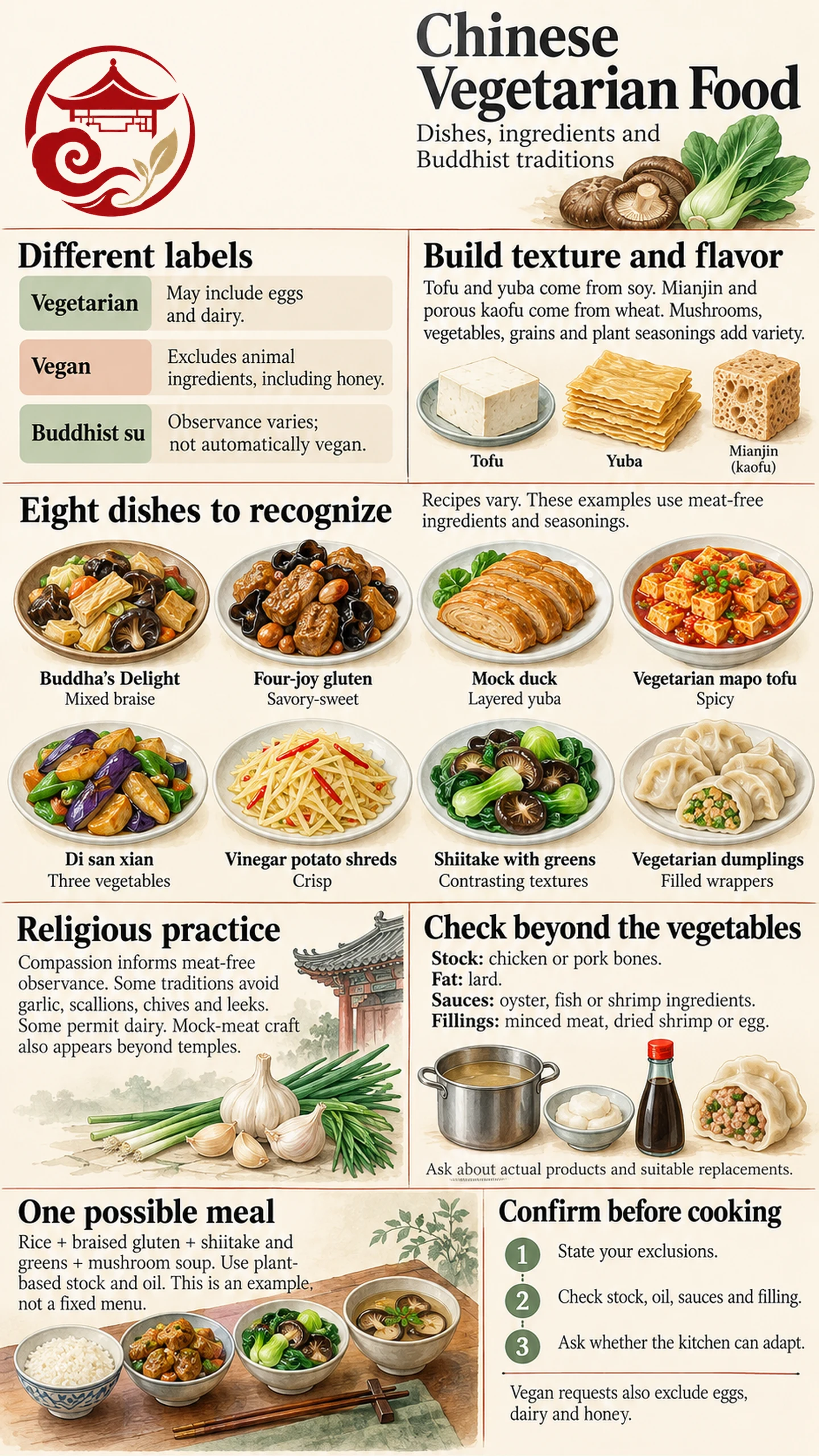
The eight examples below use meat-free ingredients and seasonings. They show a range of textures, from juicy vegetable fillings to richly sauced braises. Restaurant versions can differ, so read the table as food identification rather than a guarantee about every dish carrying the same name. Several work as shared dishes with rice; dumplings can also form a meal on their own.
| Dish | Main ingredients in a vegetarian version | Texture and flavor | Serving context |
|---|---|---|---|
| Buddha’s Delight (罗汉斋, luóhàn zhāi) | An assortment such as mushrooms, cabbage, bean-curd sheets and glass noodles, sometimes with fermented bean curd in the sauce. | Tender vegetables and layered soy foods in a savory braise; combinations vary rather than following one compulsory eighteen-ingredient recipe. | Associated with Buddhist and festive cooking; also served as a shared restaurant dish.[5] |
| Four-joy braised gluten (四喜烤麸, sìxǐ kǎofū) | Kaofu with accompaniments such as wood ear, lily buds and peanuts; other versions add mushrooms or bamboo shoots. | Porous, chewy pieces holding a savory-sweet sauce, contrasted with firmer accompaniments. | A familiar Shanghai cold dish that can be part of a larger spread.[3] |
| Mock duck (素鸭, sùyā) | One established version uses folded yuba, sometimes enclosing mushrooms and vegetables. | Layered sheets provide chew and can develop a crisp surface; the “duck” name refers to the imitation. | A sliced appetizer or shared specialty, with different versions using different plant ingredients.[2] |
| Vegetarian mapo tofu (素麻婆豆腐, sù mápó dòufu) | Tender tofu with chili-bean paste, Sichuan pepper and mushrooms replacing minced meat, using water or plant-based stock. | Soft cubes in a strongly seasoned sauce, with chili heat and pepper numbness. | An adaptation of mapo tofu, the Sichuan dish, served with rice.[6] |
| Di san xian (地三鲜, dì sān xiān) | Potato, eggplant and green pepper brought together with plant-based seasonings. | Tender potato and silky eggplant contrast with peppers, under a glossy savory sauce. | A northern Chinese vegetable dish that can be shared alongside rice and other dishes.[7] |
| Vinegar potato shreds (醋溜土豆丝, cùliū tǔdòusī) | Finely cut potato with vinegar, sometimes including chili or peppers. | Cooked strands retain a crisp bite; acidity distinguishes them from soft mashed or stewed potato. | A home-style vegetable accompaniment, commonly eaten with rice rather than replacing it.[8] |
| Shiitake with greens (香菇青菜, xiānggū qīngcài) | Shiitake and leafy greens such as bok choy, with soy-based or vegetarian mushroom sauce. | Substantial mushrooms contrast with juicy stems and softer leaves. | A shared vegetable dish; the vegetarian version replaces any conventional oyster sauce.[4] |
| Vegetarian dumplings (素馅饺子, sùxiàn jiǎozi) | One plant-based filling combines cabbage, mushrooms, carrots and aromatics inside wheat wrappers. | Juicy chopped vegetables with soft boiled or steamed wrappers, or crisp pan-fried bottoms. | A main meal or shared plate; other dumpling fillings may include egg.[9] |
These dishes also show that vegetarian food can be softly braised, crisp, chewy or spicy. Regional seasoning also remains important: a spicy tofu dish and a savory-sweet gluten braise belong to the same broad vegetarian repertoire without sharing one flavor profile. The variety extends beyond simply substituting imitation meat into every meal.
How Buddhism Shaped Chinese Vegetarian Food
Compassion toward living beings and avoiding killing are important foundations of Chinese Buddhist vegetarian practice. Religious communities helped sustain a repertoire that also reached lay households and commercial kitchens. Some devotees observe meat-free days, including the first and fifteenth days of lunar months, while others follow a continuous vegetarian diet. Neither pattern describes all Buddhists or all Chinese vegetarians.[10]
Some Chinese Buddhist practices also avoid the five pungent foods (五辛, wǔxīn). Lists and their modern interpretation vary, but familiar examples include garlic, scallions, chives and leeks. The restriction belongs to religious discipline and explanations about spiritual practice; it does not classify these vegetables as meat or establish a medical harm. Nor does it prohibit every spice: ginger, pepper and other seasonings can remain part of the food. Eggs may be excluded, while dairy is permitted in some Chinese Buddhist traditions, so a temple-associated meal still should not automatically be assumed vegan.[11]
Mock-meat cooking adds another strand. Layering, shaping and seasoning plant ingredients can evoke familiar meat dishes while retaining meat-free ingredients. This craft also appears in commercial vegetarian cooking beyond monasteries, alongside straightforward vegetable and bean-curd dishes.[12] The deeper relationship between temple meals, observance and imitation dishes belongs to Chinese Buddhist vegetarian cuisine; it is one important influence within a broader food culture.
Hidden Animal Ingredients in Vegetable Dishes
Look beyond the main vegetable and ask about the ingredients used around it. The following checks help distinguish a suitable version from one that needs changing:
- Stock: Chicken or pork-bone stock can season a soup, braise or noodle bowl even when no meat remains visible. Ask whether water, vegetable stock or mushroom stock can be used instead.
- Cooking fat: Lard can be used to cook vegetables or flavor fillings. Specify vegetable oil when animal fat is excluded; removing pieces of meat does not remove fat already incorporated.
- Sauces: Conventional oyster sauce contains oyster-derived ingredients. Fish sauce and shrimp paste also need checking. Vegetarian mushroom sauces offer an alternative, but check the actual product rather than its color or consistency.[13][14]
- Small additions: Minced meat, dried shrimp or egg may occur in tofu dishes, vegetable fillings or toppings. Ask about the whole filling or preparation, including tiny ingredients that may not appear in the translated name.
MSG, plain fermented bean pastes and soy-based seasonings should not be rejected merely because they add savory flavor. Check specific blends and compound sauces for animal ingredients instead of assuming that every flavor enhancer contains meat. A suitable main ingredient and suitable seasoning are both necessary.
What a Chinese Vegetarian Meal Can Look Like
One meal might pair steamed rice with four-joy braised gluten, shiitake and greens, and a clear mushroom soup, all made with plant-based stock and oil. The rice carries the sauces, the gluten supplies chew, the greens add contrasting texture, and the soup offers a different serving form. It is an illustration, not a required three-dish formula.
In Chinese home cooking, a few straightforward dishes can be enough. A specialist restaurant may offer more elaborate imitation dishes or a larger shared spread. Contemporary diners may choose either for religious observance, personal preference or other reasons. This sits within the wider Chinese food culture, rather than forming one separate national menu. Vegetarian dishes can be fried or richly sauced as well as steamed or lightly cooked; the label does not describe one cooking method.
How to Order Chinese Vegetarian Food
Make the request specific before the dish is cooked:
- Explain your exclusions, including whether you eat eggs and dairy.
- Confirm the stock, cooking oil, sauces and filling.
- Ask whether the kitchen can make those changes. State any separate shared-oil or cookware requirement explicitly.
For a vegetarian request: 我吃素,不要肉、鱼虾、肉汤、猪油和蚝油。 Wǒ chī sù, bú yào ròu, yúxiā, ròutāng, zhūyóu hé háoyóu. “I eat vegetarian food: no meat, fish or shrimp, meat stock, lard or oyster sauce.”
For a vegan request: 我吃纯素,不要任何动物成分,包括蛋、奶和蜂蜜。 Wǒ chī chún sù, bú yào rènhé dòngwù chéngfèn, bāokuò dàn, nǎi hé fēngmì. “I eat vegan food: no animal ingredients, including eggs, dairy and honey.” Use it alongside the stock-and-sauce checks above.
If you avoid pungent vegetables, add: 不要葱、蒜、韭菜。 Bú yào cōng, suàn, jiǔcài. “No scallions, garlic or chives.” Specify any additional exclusions yourself. If a prepared filling or stock cannot be changed, choose another dish.
FAQs About Chinese Vegetarian Food
Is Chinese vegetarian food always vegan?
No. A vegetarian meal may include eggs or dairy, and religious labels do not all use the same ingredient rules. For vegan food, confirm the full preparation, including sauces, fillings, dairy ingredients and honey, rather than relying on the dish’s name.
Is mapo tofu vegetarian?
Conventional mapo tofu can include minced beef or pork. A vegetarian adaptation can use mushrooms instead, but the stock and seasonings must also be suitable. Taking visible meat out of a finished bowl does not establish a vegetarian dish.
Why do some Buddhists avoid garlic and onions?
Some Chinese Buddhist practices exclude pungent vegetables as part of religious discipline associated with spiritual cultivation. This is separate from avoiding animal ingredients. It does not mean that garlic and onions are meat or that ordinary vegetarian cooking must exclude them.
Is Chinese vegetarian food gluten-free?
No automatic connection exists. Wheat gluten is made from wheat, while wrappers, noodles and some sauces can also contain it. Conversely, a soy-based imitation dish need not contain wheat. Check the actual ingredients; “vegetarian” describes a different dietary requirement.
Sources
[1] The Vegan Society. Definition of Veganism
[2] Omnivore’s Cookbook. Vegetarian Duck
[3] Shanghai Municipal Government. Cold Dishes for Chinese New Year’s Eve Dinner
[4] Red House Spice. Braised Mushroom with Bok Choy
[5] Made With Lau. Buddha’s Delight
[6] Red House Spice. Mapo Tofu, the Authentic Way
[7] The Woks of Life. Stir-Fried Eggplant, Potatoes and Peppers
[8] Red House Spice. Chinese Potato Stir-Fry
[9] The Woks of Life. Vegetable Dumplings
[10] Singapore Chinese Cultural Centre / Culturepaedia. From Temples to Shopping Malls: A Century of Chinese Vegetarian Food in Singapore
[11] Dharma Drum Mountain. What Is the Buddhist View on Diet?
[12] Ministry of Commerce Time-Honored Brands Digital Museum. Gongdelin Vegetarian Cooking Traditions
[13] Lee Kum Kee. Premium Oyster Sauce: Ingredients
[14] Lee Kum Kee. Mushroom Vegetarian Stir-Fry Sauce: Ingredients