

Quick Answer: What Are Chinese Cold Dishes?
Chinese cold dishes, or liangcai (凉菜, liángcài), are dishes served cool, chilled or at room temperature rather than hot.
- Ingredients: Vegetables, mushrooms and tofu share the category with meat, poultry, seafood and eggs.
- Preparation: Ingredients may be dressed raw, cooked and cooled, or combined after different treatments.
- Place in the meal: Liangcai often opens a banquet, but it can also accompany hot dishes and rice as a shared side.
“Cold” describes the serving state. It does not automatically mean raw, vegetarian, mild or ice-cold, and a Chinese meal does not have to include a cold dish.[1]
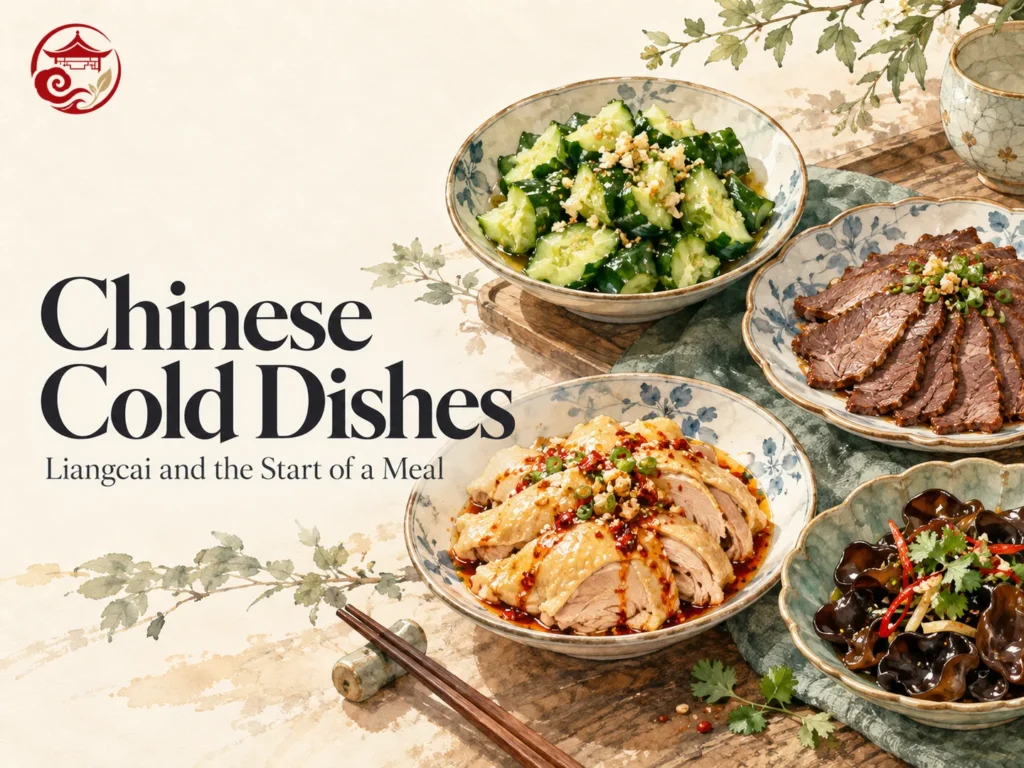
A Chinese menu may put cucumber salad, sliced braised beef and cooked chicken in the same cold-dish section. Their ingredients look unrelated until you consider how they reach the table. Understanding that section helps you recognize the food, choose contrasting textures and see how it fits beside the hot dishes.
Why Cold Does Not Mean Raw
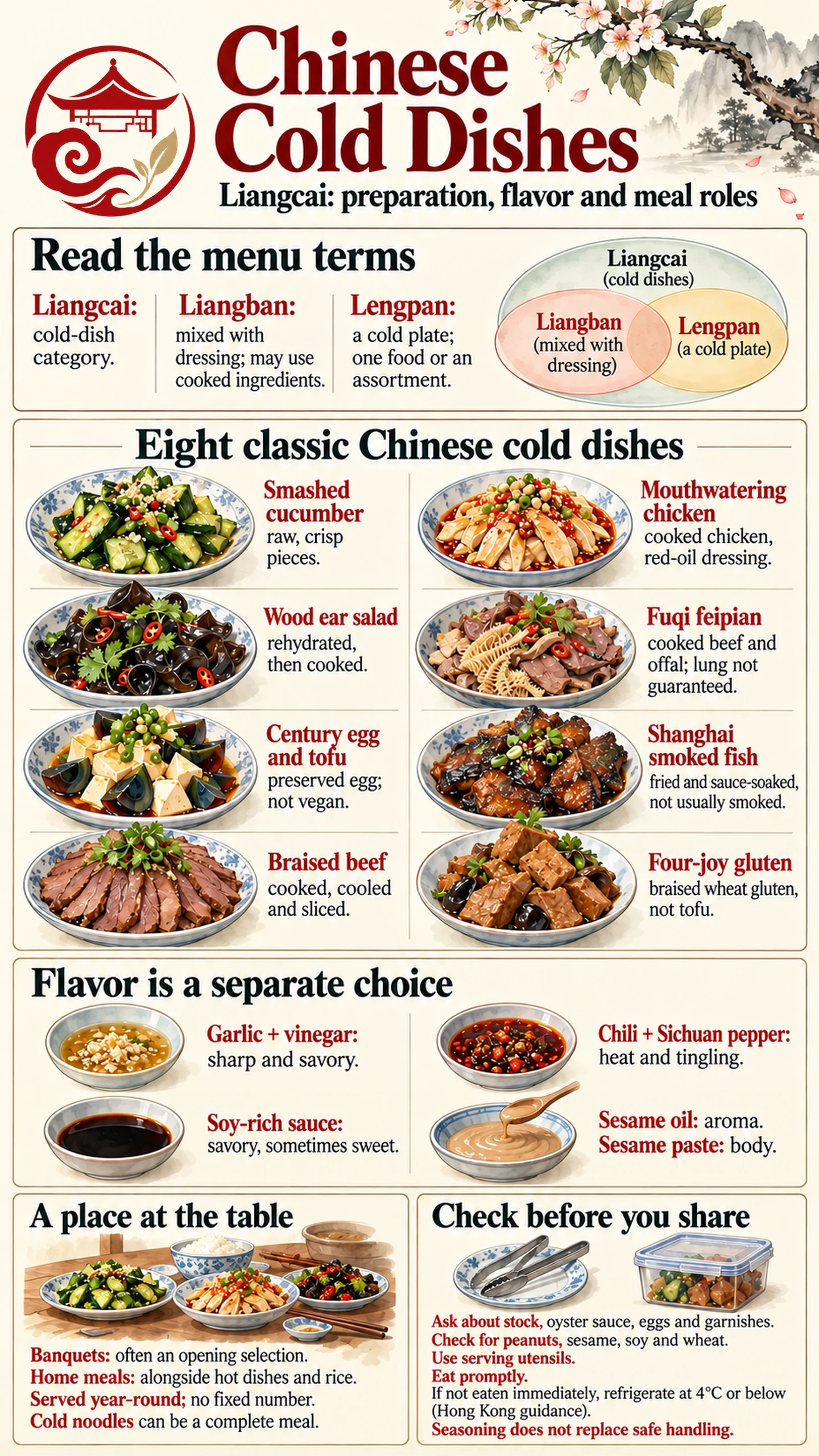
Three menu terms describe overlapping aspects of the food:
- Liangcai: The broad category of cold dishes. It tells you how the finished dish is served, rather than whether its ingredients have been cooked.
- Liangban (凉拌, liángbàn): A mixing or dressing method. A cook can toss raw cucumber or previously cooked mushrooms with seasonings; the word does not establish rawness.[2]
- Lengpan (冷盘, lěngpán): Another menu label for cold dishes, also used for a cold-plate presentation. One plate may contain one food or several arranged together; it need not be an assortment.
The preparation routes explain the apparent contradiction. Suitable raw vegetables can be washed, cut and dressed. Other vegetables and fungi are cooked before cooling and dressing. Meat may be poached, steamed or braised, then cooled and sliced. A finished plate can also combine cooked meat with uncooked cucumber or herbs. These routes are explicitly distinguished in food-safety guidance for Chinese cold dishes.[1]
Recognizing Chinese cooking methods helps you read beyond a menu heading. The category describes the finished plate; the method describes earlier work in the kitchen. Our guide to Chinese food names explains more of those naming clues.
Chinese Cold Dishes to Recognize
These eight examples cover several ingredients and preparation styles. They are recognition aids, rather than a fixed national ordering list. Recipes, garnishes and serving temperatures vary between kitchens.
| Dish | Main ingredients | Treatment before serving | Texture and recognition clues |
|---|---|---|---|
| Smashed cucumber (拍黄瓜, pāi huángguā) | Fresh cucumber; often garlic and vinegar | Served raw after smashing, cutting and dressing; chili is optional | Crisp, juicy pieces with irregular cracks that hold dressing. Usually a light, sharp contrast to richer dishes.[3] |
| Wood ear salad (凉拌木耳, liángbàn mù’ěr) | Wood ear mushrooms; garlic or herbs | Dried mushrooms are rehydrated, cooked in boiling water, then cooled and dressed | Dark, ruffled pieces with a springy crunch. Soaking alone does not make dried wood ears ready to eat.[4] |
| Century egg and tofu (皮蛋豆腐, pídàn dòufu) | Soft tofu and preserved egg | Alkaline-cured egg is sliced over tofu and dressed; curing is different from heat cooking | Soft white tofu contrasts with dark, jelly-like egg white and a rich yolk. Contains egg, so it is not vegan.[5] |
| Sauce-braised beef (酱牛肉, jiàng niúròu) | Usually beef shank | Cooked in a seasoned, often soy-based braising liquid, then cooled and sliced | Firm, savory slices with visible muscle and connective-tissue patterns. It may arrive plain or with dipping sauce.[6] |
| Mouthwatering chicken (口水鸡, kǒushuǐ jī) | Cooked chicken and red-oil dressing | Chicken is poached or steamed, cooled and cut before dressing | Tender chicken under glossy chili oil; Sichuan pepper can add tingling. Bone-in and boneless presentations exist, and heat levels vary.[7] |
| Fuqi feipian (夫妻肺片, fūqī fèipiàn) | Beef and offal such as tripe or tongue | Meat and offal are cooked, cooled, thinly sliced and dressed | A Sichuan dish combining chewy and tender textures in red-oil seasoning. Despite the translated name “husband-and-wife lung slices,” lung is not guaranteed.[8] |
| Shanghai smoked fish (上海熏鱼, Shànghǎi xūnyú) | Fish pieces; often freshwater carp | Fried, then soaked in a sweet-savory seasoned sauce; typically not smoke-cured | Brown, sauce-coated pieces with firm flesh and a fried exterior. A classic Shanghai cold dish that can also be served warm.[9] |
| Four-joy braised gluten (四喜烤麸, sìxǐ kǎofū) | Wheat gluten, mushrooms and varying additions such as peanuts or lily buds | Gluten is braised with accompaniments, sometimes after browning, and served cooled | Porous pieces absorb the sauce. This is wheat gluten, not tofu; the accompaniments are not identical in every version.[10] |
For unfamiliar plant ingredients, compare our guides to Chinese vegetables and tofu types. Similar colors or shapes do not establish the same ingredients.
Dressings, Aromatics and Regional Flavors
Serving temperature and flavor are separate choices. A cold plate can be sharp, savory, sweet, nutty or intensely spicy. These three patterns help explain familiar examples without turning whole regions into one flavor:
- Garlic and vinegar: Rice vinegar or fragrant Chinese black vinegar, garlic and soy sauce can create a light, salty-sour dressing. A little sugar may round out the acidity without making the dish taste like dessert. Chili can be added, but it is not essential to every cucumber or mushroom salad.[3][4]
- Red oil and tingling spice: In the chicken and beef examples from Sichuan cuisine, chili provides heat while Sichuan pepper contributes a tingling sensation. Soy sauce, vinegar, sesame and sugar may balance the dressing. The proportions vary, and red-oil dishes do not represent every Sichuan cold dish.[7][8]
- Soy-rich and gently sweet: Some Shanghai dishes get much of their flavor from a soy-based sauce during braising or soaking, rather than from a dressing added at the end. Smoked fish and braised gluten illustrate this approach; it does not make every Shanghai cold plate sweet.[9][10]
Sesame oil and sesame paste also perform different jobs. Both come from sesame, but oil adds liquid fat and aroma, while ground sesame paste thickens a sauce and gives it body. They are not interchangeable spoon for spoon.
How Liangcai Fits into a Chinese Meal
At a formal Chinese banquet, cold plates often greet guests before the hot dishes arrive. They provide something to share as people settle in. This opening selection can be carefully arranged, but there is no universal requirement for a particular platter, number of plates or order of individual foods.
The opening is also not necessarily a separate course that must be cleared away. As hot dishes arrive, the cold plates may remain on the table, allowing diners to alternate between them. Shanghai New Year’s Eve spreads, for example, can include cold chicken, braised gluten and fish alongside the wider celebration meal.[11]
In home cooking and casual restaurants, the sequence is looser. One cold side may arrive with the rice and hot dishes. A crisp vegetable plate beside sliced cooked beef gives contrasting textures without requiring an elaborate appetizer selection. Summer brings an obvious setting for cool dishes, yet their role extends to winter gatherings and year-round menus.
Portion and purpose matter too. A bowl of cold noodles or liangpi may be a substantial individual meal; a smaller serving can be a shared side. Temperature alone does not decide which role it plays. The broader pattern of shared dishes and staples is explained in our Chinese food culture guide.
Ordering and Handling Cold Dishes
Check the whole dish, including what you cannot see in the main ingredients:
- Dietary ingredients: A vegetable base may come with oyster sauce, meat stock or an animal-derived garnish. Ask about the dressing as well as the solids. Century egg and tofu can suit someone who eats eggs, provided its seasonings are suitable, but it cannot be vegan. Our Chinese vegetarian food guide explains the distinctions. Some cold-salad dressings explicitly include oyster sauce or a vegetarian substitute.[12]
- Allergens: Peanuts, sesame, soy and wheat can appear in the dish or sauce. Braised gluten contains wheat gluten; it is not a tofu substitute for someone avoiding wheat. An ingredient omitted from the English dish name may still be present, so explain the specific restriction to staff rather than relying on a photograph.[10]
- Shared serving: Use serving chopsticks or a serving spoon to transfer food to your own bowl or plate. Avoid sorting through the communal dish. These habits fit the wider Chinese table-manners guidance for shared meals.
- Time and temperature: Cooked food can be contaminated again after cooking. Garlic, vinegar and chili oil do not replace hygienic handling or safe temperature control. Hong Kong consumer guidance advises eating purchased cold dishes promptly and refrigerating them at 4°C or below if they will not be eaten immediately. Room-temperature presentation is not permission for prolonged storage on a table.[13]
FAQs About Chinese Cold Dishes
Are Chinese cold dishes always raw?
No. A cold plate may contain braised beef, cooked chicken or mushrooms cooked before dressing. Some dishes combine raw and cooked ingredients. The menu category describes how the finished food is served, rather than a single preparation method.
Are all Chinese cold dishes spicy?
No. Cold dishes include mild savory beef, garlic-vinegar vegetables and sweet-savory fish. Chili may be optional in some recipes and central to others. Ask about the actual dressing if avoiding heat, rather than using serving temperature as a clue.
Are Chinese cold dishes vegetarian?
Some are; others contain meat, fish or eggs. Plant-based main ingredients do not guarantee a vegetarian sauce. Century egg and tofu contains egg, so it can suit egg-eating vegetarians with suitable seasoning, but it is not vegan.
Are cold noodles and liangpi the same as cold appetizers?
They can overlap on menus, but a noodle bowl may supply the starch and substance of a complete meal. A small portion can instead be shared as a side. Look at the serving size and accompaniments, not just its temperature.
Sources
[1] Hong Kong Centre for Food Safety. Food Safety Guidelines for Chinese Cold Dishes
[2] Julian K. Wheatley and Tong Chen / MIT OpenCourseWare. The Chinese Menu
[3] The Woks of Life. Smashed Asian Cucumber Salad
[4] The Woks of Life. Wood Ear Mushroom Salad
[5] Woks of Love. Silken Tofu with Century Egg (Pi Dan Dou Fu)
[6] Maggie Zhu / Omnivore’s Cookbook. Chinese Braised Beef Shank (酱牛肉, Jiang Niu Rou)
[7] Taylor Holliday / The Mala Market. Mouthwatering Sichuan Cold Chicken (Kou Shui Ji, 口水鸡)
[8] Xueci Cheng / The Mala Market. Husband and Wife Lung Slices (Fuqi Feipian, 夫妻肺片)
[9] The Woks of Life. Shanghai Smoked Fish, Xun Yu (上海熏鱼)
[10] The Woks of Life. Hong Shao Kao Fu: Braised Wheat Gluten with Mushrooms
[11] Shanghai Municipal Government. Cold dishes for Chinese New Year’s Eve dinner
[12] The Woks of Life. Chinese Cold “Salad” Dressing (凉拌汁)
[13] Hong Kong Centre for Food Safety. Microbiological Quality of Chinese Cold Dishes in Hong Kong