
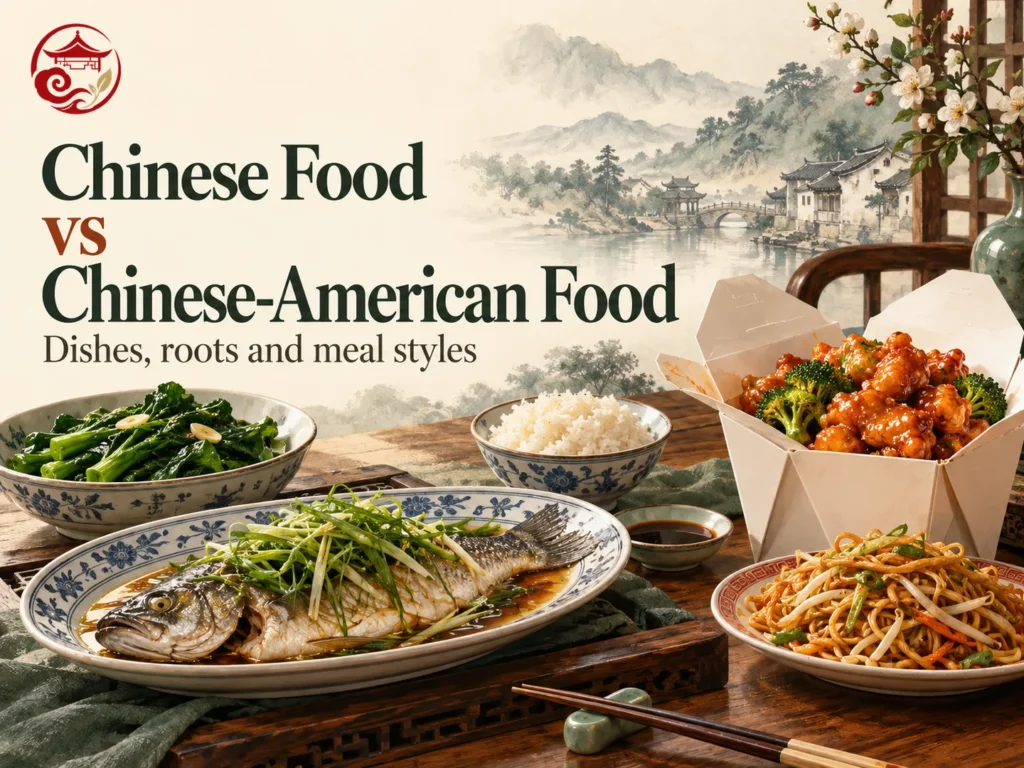

Quick Answer: How Does Chinese Food Differ from Chinese-American Food?
Chinese-American food developed through immigration and life in the United States. Food in China encompasses many regional traditions, rather than one original menu against which every American dish can be measured.
- Roots: Early Guangdong immigrants brought an influential Cantonese foundation, later joined by other regional cooking traditions.
- Menu patterns: Familiar takeout dishes can feature sweet-sour sauces, crisp coatings and boneless meat. Those features describe particular dishes, not every restaurant.
- Range: Chinese-American food includes home cooking, regional specialists and newer creations as well as classic takeout.
The most useful comparison names the setting: a takeout counter, family kitchen or particular regional restaurant. Location alone does not tell you what is served.
A familiar order of General Tso’s chicken and beef with broccoli can create expectations that a menu in China does not match. Some dishes carry family cooking traditions across borders; others develop through restaurant work and new customers. Understanding those connections makes the differences easier to recognize without ranking one tradition above another.
How Chinese-American Food Took Shape
Chinese migration to the United States expanded in the nineteenth century, including workers who came for mining, railroad construction, agriculture and other employment. Restaurants fed immigrant communities and provided livelihoods amid discrimination and restricted opportunities. As their customer base widened, owners adjusted familiar cooking to the ingredients and expectations around them.[1]
Many early migrants came from Guangdong, bringing a strong Cantonese cooking foundation. Using locally available foods with familiar techniques helped cooks build dishes that customers would recognize and order again.[2] An ingredient change could reflect supply, cost or preference. It need not mean a cook had abandoned the skills learned at home. Recipes could retain a stir-frying method or sauce-making approach while changing the vegetable, meat cut or balance of seasoning.
The audience mattered too. A restaurant feeding workers, one serving a neighborhood’s families and one attracting customers unfamiliar with Chinese food could make different choices. This is why “Americans like sweet food” is an incomplete explanation: it leaves out the cooks, their circumstances and the different people they served.
Immigration changes after 1965 helped expand the regional repertoire, including Sichuan and Hunan cooking.[1] Established restaurant dishes continued alongside new arrivals’ cooking and changing family habits. The wider Chinese-American cultural history gives this food story its community context; Chinese food history follows developments within China over a much longer period.
Ingredients, Flavors and Cooking Methods Compared
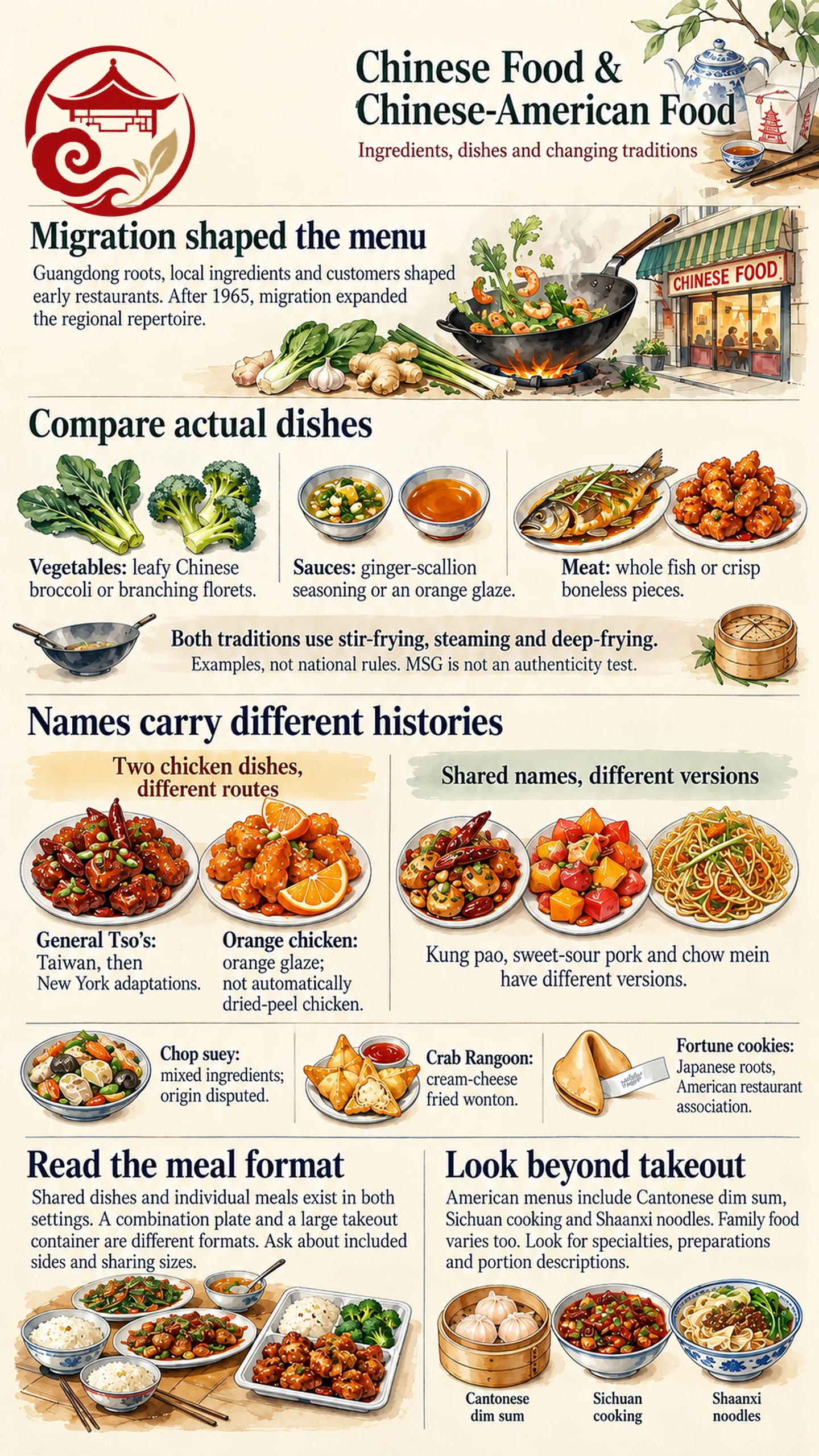
Compare identifiable dishes rather than treating two enormous food traditions as fixed recipes. The examples below contrast familiar regional preparations with classic American takeout choices. They show useful differences, but the columns overlap.
| Feature | Examples from regional Chinese cooking | Examples from classic American takeout |
|---|---|---|
| Vegetables | Cantonese beef with Chinese broccoli uses leafy greens and firm stems. | Beef with broccoli uses the familiar branching florets. Celery, onions and bean sprouts also appear in restaurant stir-fries. |
| Sauces and flavor | Ginger-scallion seasoning, fermented black beans, vinegar and sweet-sour sauces all have places in different dishes. | Orange-flavored and sweet-sour glazes are prominent in several familiar chicken and pork dishes; other dishes use savory sauces. |
| Meat and texture | A whole steamed fish or poached, bone-in chicken presents the ingredient differently from sliced meat in a stir-fry. | Boneless pieces with crisp coatings are familiar in chicken entrees. Sliced beef or shrimp stir-fries offer another texture. |
| Cooking methods | Steaming, braising, poaching, roasting, stir-frying and deep-frying serve different regional dishes. | Wok cooking and deep-frying are recognizable features of many takeout menus, alongside soups and steamed dishes. |
The vegetable difference is easy to recognize: Chinese broccoli has broad leaves and substantial stalks, whereas regular broccoli has branching heads of florets.[3] Both can be eaten with beef. This does not make regular broccoli foreign to present-day Chinese kitchens, or mean leafy Chinese greens are unavailable in America. The question is which vegetable a particular dish uses.
Cooking methods and sauce choices should also be read separately. A dish can be fried before receiving a light coating of sauce; another can be steamed and finished with a savory dressing. A glossy sauce does not reveal how much sugar it contains. Nor does a sweet-sour dish establish the flavor of an entire cuisine.
MSG, or monosodium glutamate, is a flavor enhancer, not a marker separating the two traditions. Its commercial history began in Japan, and it is used beyond any single national cuisine.[4] Authenticity cannot be established by a seasoning label, just as deep-frying is not exclusive to American restaurants.
Familiar Dishes That Show the Differences
Some names travel with a recognizable preparation; others describe restaurant creations with more complicated routes. These examples distinguish a dish’s ingredients, its place of development and the versions that later became familiar.
General Tso’s Chicken and Orange Chicken
General Tso’s chicken is associated with Peng Chang-kuei, a Hunan-born chef who developed a version in Taiwan during the 1950s. Its flavors reflected his home province. When he later cooked it in New York in the 1970s, sugar became part of the adaptation for American customers.[5] The historical general supplied the name, not the recipe. Calling it an old household staple throughout Hunan would misrepresent that history.
Today’s familiar takeout version often features coated chicken in a sweet, tangy sauce, with heat that varies by restaurant. It is also misleading to assume that every later version follows one unchanged recipe.
Orange chicken usually means crisp chicken pieces coated in an orange-flavored sweet-tangy glaze. One influential American fast-food version was developed by chef Andy Kao in 1987.[6] That identifies a particular version’s history, rather than proving nobody had ever combined citrus and chicken before. An orange-flavored glaze is distinct from a preparation built around dried tangerine peel, so the English name alone does not identify the latter dish.
Shared Names, Different Versions
- Kung pao chicken: Kung pao chicken (宫保鸡丁, gōngbǎo jīdīng) links diced chicken, peanuts and dried chilies with a balance of savory, sour and sweet flavors. A Sichuan version may include Sichuan pepper; some American versions add bell peppers and emphasize sweetness.[7] The amount of heat and sauce varies. The kung pao chicken guide explores those adaptations.
- Sweet and sour pork: Gulu rou (咕噜肉, gūlūròu) is associated with Cantonese sweet and sour pork. American restaurant versions can include crisp pork, pineapple, peppers and a vinegar-sugar sauce.[8] Frying and sweet-sour seasoning connect the versions; neither feature alone establishes an American invention. Sweet and sour pork has its own regional variations.
- Chow mein: Chow mein (炒面, chǎomiàn) can describe different noodle presentations. A Cantonese crisp noodle cake with a saucy topping differs from noodles tossed through a stir-fry. Some older American versions use crisp noodles as a topping for meat and vegetables.[9] Check the actual dish; chow mein and lo mein names need context.
Chop Suey, Crab Rangoon and Fortune Cookies
- Chop suey: Chop suey (杂碎, zásuì) became a prominent American restaurant dish built around mixed ingredients such as meat, vegetables and sauce. Its Cantonese connections matter, but the precise origin remains disputed. Neither a visiting dignitary nor an improvised leftovers story should be presented as its established invention.[2] It is not a single recipe that every Cantonese kitchen shares.
- Crab Rangoon: These fried wonton wrappers usually enclose cream cheese with crab or an imitation-crab filling; versions vary. The dish is associated with American tiki-restaurant cooking, and a crab-and-cream-cheese version appears in a 1968 cookbook from that restaurant tradition.[10] Its wrapper connects it to Chinese cooking forms; the filling gives it a distinct identity. The name is not a promise of a traditional Burmese dish.
- Fortune cookies: The crisp cookies with paper messages are familiar companions to American Chinese restaurant meals. Their history connects Japanese fortune-cracker traditions with production in California and later Chinese restaurant distribution.[11] They are not a standard traditional dessert across China. This history does not imply that Chinese cooking lacks sweets; it explains this particular cookie’s association with restaurant meals.
How Meals Are Ordered and Shared
A shared dinner in China might combine rice with several dishes of vegetables, fish or meat. Each diner takes portions from the common dishes. Yet a bowl of noodles or a rice bowl with toppings can also be an individual meal. The Chinese home cooking guide explains everyday combinations beyond restaurant menus.
At an American takeout counter, a combination plate might pair one entree with rice and an egg roll. That plate is arranged as a meal for one person. A separate order of chicken or vegetables, however, may come in a small or large container for sharing. Family meals can combine several entrees and sides. Packaging does not establish a universal serving size.
Both settings therefore allow individual meals and shared spreads. When ordering, ask whether rice is included, what a size label means and whether the dish is intended for sharing. These questions reveal more than assuming every carton serves one diner or every platter must serve a whole table.
The useful distinction is how the menu assembles a meal. It is part of Chinese food culture, rather than a rule that people in one country always share and people in the other always eat separately.
Regional Chinese Cooking in America Today
Chinese food in America can mean a Cantonese dim sum meal, a Sichuan restaurant, a Shaanxi noodle specialist or a neighborhood takeout counter. Chef and home-cook histories document this range of regional influences and personal experiences.[12] Availability differs by place; the United States does not reproduce every Chinese region’s cooking in every city.
Family food is broader still. Household meals can preserve ancestral regional dishes, combine several influences or adopt ingredients from other American food traditions. A family’s takeout favorites may coexist with very different food cooked at home.[13]
To understand a restaurant’s menu:
- Look for its specialty: A regional name or a focus on noodles, roasts or dim sum tells you more than the broad label “Chinese.” The eight-cuisine framework provides one starting point.
- Read the preparation: Ask about ingredients, sauce and texture when a familiar name is ambiguous. Chinese food names can help decode those clues.
- Check the meal format: Confirm included sides and sharing sizes rather than inferring them from the container.
A Chinese-language menu or the ethnicity of fellow diners is not a reliable test of the cooking’s identity or quality.
FAQs About Chinese and Chinese-American Food
Is Chinese-American food real Chinese food?
Yes. It is a tradition shaped by Chinese immigrants and their descendants in the United States. Differences from a particular regional dish do not make it fake, and familiar takeout dishes represent only part of its range.
Is General Tso’s chicken common in China?
It is not a standard everyday dish across China. Its history runs through a Hunan-born chef’s work in Taiwan and later American adaptations. A restaurant in China may serve it, but the name does not guarantee a traditional Hunan preparation.
Are fortune cookies a traditional Chinese dessert?
They are associated especially with American Chinese restaurants, rather than ordinary meals throughout China. Their background includes Japanese fortune-cracker traditions and California production. That specific history should not be confused with the much wider range of Chinese sweets.
Can you find regional Chinese food in the United States?
Yes. Regional specialists include Cantonese, Sichuan and Shaanxi cooking, among others. The choices depend on the local restaurant community. Look at the kitchen’s stated specialties and actual dishes rather than expecting every city to offer the same range.
Is food in China always healthier than Chinese-American food?
No national label tells you a meal’s nutritional composition. Ingredients, preparation, sauce, portions and what else you eat all matter. Comparing a home-cooked meal with a takeout feast also changes the setting, so it cannot establish a country-wide ranking.
Sources
[1] USC U.S.-China Institute. Sweet & Sour: A Look at the History of Chinese Food in the United States
[2] Andrew Coe / American Heritage. Mixed Bits: The True History of Chop Suey
[3] Red House Spice. Beef and Chinese Broccoli Stir-Fry
[4] U.S. Food and Drug Administration. Questions and Answers on Monosodium Glutamate
[5] Fuchsia Dunlop / Saveur. General Tso and His Chicken
[6] Panda Restaurant Group. Our Story: 1987 Orange Chicken Milestone
[7] Clarissa Wei / Food Network Kitchen. What Is Kung Pao Chicken?
[8] The Woks of Life. Sweet and Sour Pork
[9] The Woks of Life. Chicken Chow Mein: Different Versions
[10] Andrea Nguyen / Viet World Kitchen. Upgraded Mid-Century Crab Rangoon
[11] Smithsonian Magazine. Cracking Open the History of Fortune Cookies
[12] Museum of Chinese in America. Sour, Sweet, Bitter, Spicy: Stories of Chinese Food and Identity in America
[13] Deanna Ting / Resy. Chinese American Food Is Its Own Great Cuisine