

Quick Answer: What Is Chinese Buddhist Vegetarian Cuisine?
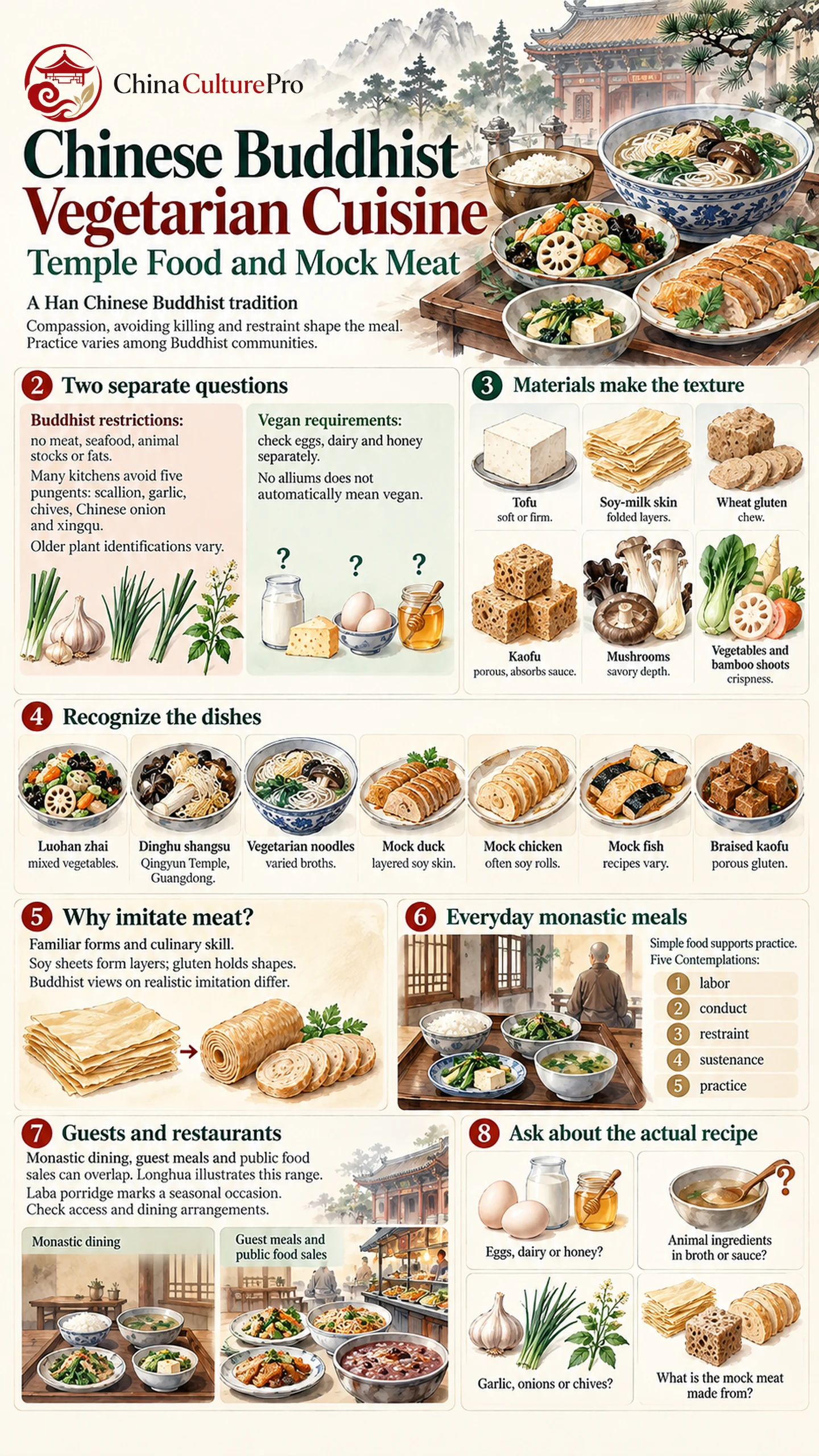
Chinese Buddhist vegetarian cuisine developed through the food practices of Chinese-speaking Buddhist communities, especially the Han Buddhist tradition. Compassion, avoiding killing and restraint in eating shape its cooking.
- Buddhist principles: Food supports religious practice, with attention to how it is obtained, prepared and received.
- Ingredients and restrictions: Vegetables, grains, mushrooms and soy foods are central. Many kitchens also avoid the five pungent plants (五辛, wǔxīn), including garlic and onions.
- Temple meals: Everyday monastic meals, food for guests and restaurant menus serve different purposes and can differ considerably.
- Mock meat: Plant ingredients can be layered, shaped and seasoned into foods called vegetarian duck, chicken or fish.
This describes a particular Chinese food tradition. It does not mean every Buddhist follows the same diet, or that every Buddhist-style vegetarian dish meets vegan requirements.
A plate of mock duck can raise an obvious question: why make vegetarian food look like meat? A bowl of temple noodles raises another: does “Buddhist vegetarian” always mean vegan? The answers involve both ingredients and context. Simple meals in a monastic dining hall, carefully shaped dishes for guests and food in an independent vegetarian restaurant belong to related but different settings. Understanding those settings makes the names and practices easier to read.
Buddhist Principles and the Chinese Vegetarian Tradition
Compassion and avoiding the taking of life help explain the importance of vegetarian eating in Chinese Buddhism. Restraint matters too: a meal sustains the body and religious practice, while its preparation depends on the work of many people.
Several Chinese terms occur in this setting. Sushi (素食, sùshí) broadly means vegetarian food; it is unrelated to the Japanese rice dish spelled the same way in English. Suzhai (素斋, sùzhāi) often refers to Buddhist-style vegetarian food or a vegetarian meal. Zhaifan (斋饭, zhāifàn) commonly describes food associated with religious observance or a temple meal. Their everyday uses overlap rather than forming three rigid menu categories.
Chinese Buddhist vegetarianism developed through texts, community expectations and local practice. Early Indian monastic codes permitted meat under particular conditions, whereas a strong expectation of vegetarianism emerged in Chinese Buddhist life. The early chronology is debated, with evidence of vegetarian ideals preceding the sixth-century court support often emphasized in popular accounts.[1]
Emperor Wu of Liang, who reigned from 502 to 549, promoted vegetarian practice among monastics. His role should be understood within that longer development, rather than as the invention of vegetarian food.[1] Monastic communities, lay households, donors and professional cooks subsequently helped maintain and reshape the cooking. Lay observance could also be periodic rather than year-round, adding another setting in which vegetarian meals were prepared.
What Buddhist Vegetarian Cooking Includes and Avoids
Meat, Seafood and the Five Pungent Plants
In the vegetarian tradition discussed here, meat, fish and shellfish are excluded, along with meat stocks and animal cooking fats. Traditional monastic discipline also avoids alcoholic drinks. The restriction on pungent plants is a separate part of the practice.[2]
A common Chinese list names onions or scallions (葱, cōng), garlic (蒜, suàn), chives (韭, jiǔ), Chinese onion (薤, xiè), and xingqu (兴渠, xīngqú), an old plant name often identified with asafoetida. The group is also called wuhun (五荤, wǔhūn); in this historical usage, hun refers to pungent plants rather than meat.[3][10]
The botanical identities attached to older names have not always been interpreted consistently. Modern English lists can therefore differ, and the category should not be reduced to exactly five interchangeable modern onion-family names.[2] For a particular kitchen, asking about garlic, onions and chives gives concrete information alongside the broader “no five pungents” description.
The explanations belong to Buddhist discipline and religious interpretation. Odor, shared monastic space and ideas about restraint feature in that background. They should not be presented as established medical claims about hormones or temperament. Nor does the word “pungent” mean that every aromatic or strongly flavored ingredient belongs to this group.
Eggs, Dairy and Vegan Requirements
Buddhist vegetarian and vegan describe different sets of expectations. Some Chinese Buddhist teachings permit milk and dairy while avoiding eggs. Practice also varies among households, institutions and commercial vegetarian kitchens, so a general vegetarian label does not settle every ingredient question.[4]
A vegan diet excludes animal-derived foods, including dairy, eggs and honey.[5] Avoiding garlic and onions is a separate restriction: an entirely plant-based dish may contain them, while a dish without them may still contain milk. These two questions need separate answers.
For a diner, the useful distinction is therefore specific. Ask whether a dish contains the animal-derived ingredients you avoid, and ask separately about the pungent plants. A religious association explains the tradition behind the food; its actual recipe determines what is in the serving.
Ingredients That Build Texture and Flavor
The materials in this cuisine do different jobs. Some produce tender pieces or sheets; others supply chew, crispness or a broth’s savory depth. A cook can build a satisfying dish through these contrasts without giving every ingredient a meat-like shape.
| Ingredient group | Texture or flavor | Typical culinary role |
|---|---|---|
| Tofu and pressed tofu | From delicate and soft to compact and firm | Simmered pieces, soups, braised slices and cold dishes; the type determines how well it holds its shape. |
| Soy-milk skin and dried sticks | Thin sheets can be layered or rolled; dried forms absorb liquid | Wrappers, layered preparations, braises and soups. These are distinct from pressed tofu sheets that may also be called doufupi (豆腐皮, dòufupí) in regional usage. |
| Wheat gluten (面筋, miànjīn) and kaofu (烤麸, kǎofū) | Gluten preparations can be elastic or dense; kaofu has a porous, sponge-like structure | Shaped foods and sauce-absorbing braises. These are wheat products, rather than forms of tofu. |
| Mushrooms | Savory flavor with textures ranging from delicate to firm or springy | Broths, vegetable medleys, fillings and substantial pieces within a mixed dish. |
| Seasonal vegetables, roots and bamboo shoots | Crispness, sweetness, moisture and color | Everyday cooked dishes, soups and contrasts with softer soy foods or mushrooms. |
Names can obscure the material. The English word “tofu skin,” like the Chinese term doufupi, is used inconsistently on menus. A sheet pressed from bean curd and the film lifted from heated soy milk behave differently when folded or cooked. The Chinese soy products guide explains those distinctions, while Chinese wheat gluten covers the separate wheat-based family.
Temple Foods and Mock Meat Dishes to Recognize
These names identify recognizable foods, rather than a standardized menu served in every monastery. Some also appear in household cooking and independent vegetarian restaurants. Chinese characters and Mandarin pinyin help distinguish a dish name from the material used to make it.
| Name | Common ingredients and appearance | Context or regional association |
|---|---|---|
| Luohan zhai (罗汉斋, luóhàn zhāi), often called Buddha’s Delight | A mixed preparation of vegetables, mushrooms, bamboo shoots and soy foods. Ingredients and sauce vary; eighteen-ingredient versions are one convention, not a universal formula. | Temple-associated vegetarian cooking and restaurant menus. |
| Dinghu shangsu (鼎湖上素, dǐnghú shàngsù), Dinghu-style vegetarian dish | An arranged combination of mushrooms and other ingredients such as bamboo fungus, tremella, bamboo shoots or lotus seeds. | Associated with Qingyun Temple on Dinghu Mountain in Zhaoqing, Guangdong.[7] |
| Vegetarian noodles (素面, sùmiàn) | Noodles with vegetable or mushroom broth and toppings such as greens, tofu or bamboo shoots. Broth, seasoning and noodle form differ by kitchen. | A familiar format for public temple dining, as well as ordinary vegetarian restaurants. |
| Mock duck (素鸭, sùyā) | Often layered soy-milk skin, sometimes enclosing vegetables or mushrooms, colored through seasoning and cooking. Slices may reveal folded layers rather than meat fibers. | Vegetarian restaurant cooking, including Jiangnan traditions; not exclusive to temples. |
| Mock chicken (素鸡, sùjī) | Often a compact roll or block made from soy sheets; gluten-based versions also exist. It may be sliced for cold dishes or further cooking. | Vegetarian menus and household dishes. The name does not identify one recipe. |
| Mock fish (素鱼, sùyú) | Shaped preparations can use soy, gluten, konjac or combinations. Seaweed may suggest a fish-skin surface; not every version imitates a whole fish. | Some festive or guest menus and commercial vegetarian cooking. |
| Braised kaofu | Porous gluten pieces cooked with ingredients such as mushrooms, wood ear, peanuts or daylily buds, absorbing a seasoned sauce. | A familiar part of Shanghai cuisine and the wider Jiangnan vegetarian repertoire, served warm or cold. |
Regional supplies, culinary skills and the occasion influence which preparations appear together. Vegetable-centered dishes are as much a part of this repertoire as shaped foods.
Why Mock Meat Has a Place in Buddhist Vegetarian Cooking
Mock meat uses the behavior of plant ingredients to create a recognizable food. Thin soy sheets produce layers when folded and compressed. Gluten can provide chew or hold a shape, while a porous preparation takes up sauce. Browning, braising and seasoning change the surface, color and flavor. The result may suggest duck skin, a firm slice or a fish-shaped centerpiece without reproducing the original ingredient.
Familiar names and forms can help diners approach a vegetarian meal through foods they already recognize. They also provide a setting for culinary skill, especially in guest meals and festive restaurant cooking. The craft is part of a longer Chinese vegetarian repertoire, rather than a recent invention attached only to modern commercial meat substitutes.[8]
Buddhist views on imitation are not uniform. Some regard familiar forms as a useful way to encourage vegetarian eating; others question whether highly realistic dishes encourage attachment to meat’s appearance or taste.[4] There is no need to assign one motive to every cook or diner.
This distinction also separates an elaborate visitor menu from everyday nourishment. A temple may be known publicly for skillful vegetarian specialties while the community’s ordinary meals remain simpler. Understanding the setting is more informative than assuming that monastics eat a banquet of mock meats each day.
Temple Meals and Restaurant Dining
Everyday Monastic Meals
A monastic dining hall may be called a zhaitang (斋堂, zhāitáng) or wuguantang (五观堂, wǔguāntáng), a name associated with reflections on receiving food. Guotang (过堂, guòtáng) refers to the formal communal meal practice. It places eating within the rhythm of Chinese Buddhist monastic life, rather than treating the dining hall as an ordinary restaurant.[6]
The Five Contemplations (五观, wǔguān) connect the meal with five reflections:
- Origins: Consider the labor and conditions that brought the food.
- Conduct: Reflect on whether one’s conduct merits receiving it.
- Restraint: Guard against greed and other unhelpful responses to food.
- Sustenance: Receive food to maintain the body.
- Practice: Accept nourishment in support of the Buddhist path.
Rice or porridge, vegetables, soy foods and soup can form a modest meal. The proportions, dishes and routines differ among communities. Formal dining arrangements and contemplations give that simplicity a religious setting, without requiring every temple to follow identical seating, hand signals or serving times.[6]
Guest Meals and Vegetarian Restaurants
Three useful contexts are everyday monastic meals, food offered to guests and vegetarian food sold to the wider public. They can overlap within one institution, but neither the menu nor the service should be assumed identical.
Shanghai’s Longhua food tradition illustrates that range. Its documented activities distinguish traditional vegetarian meals, guest banquets and foods for public sale, including noodles, soy preparations and pastries.[9] This is one institutional example of how religious, culinary and commercial settings can coexist.
Seasonal occasions add another context. Laba porridge, for example, may be shared by temples to mark the Buddha’s enlightenment; the practice also appears in Chinese Buddhist communities outside China.[8] Such food sharing is different from an everyday restaurant service.
For visitors, check whether the particular temple offers public dining. Follow staff instructions, take manageable portions and respect requests for quiet in a formal dining hall. An independent restaurant near a temple may have its own management and menu. The broader Chinese temple etiquette guide covers conduct beyond the meal.
Checking Ingredients and Reading Menu Labels
Sushi and other vegetarian labels describe a category of food, but the details still matter. Jingsu (净素, jìngsù) often signals a stricter Buddhist-style preparation, particularly avoidance of meat and pungent plants. For vegan requirements, ask explicitly about eggs, dairy, honey and other animal-derived ingredients rather than treating the term alone as a complete recipe.
Four questions help turn the menu description into useful information:
- Eggs, dairy and honey: 这道菜含有蛋、奶或蜂蜜吗? — Does this dish contain eggs, dairy or honey?
- Broth and sauce: 汤底或酱料里有没有动物来源的原料? — Are there any animal-derived ingredients in the broth or sauce?
- Pungent plants: 这道菜放葱、蒜、韭菜等五辛吗? — Does this dish contain onions, garlic, chives or other five-pungent ingredients?
- Mock-meat ingredients: 这个仿荤菜主要是什么做的? — What is the mock meat mainly made from?
The Chinese vegetarian food guide covers broader food choices. For unfamiliar preparation words and ingredient names, Chinese food names provides a menu-reading companion.
FAQs About Chinese Buddhist Vegetarian Cuisine
Do All Buddhists Eat Vegetarian Food?
No. Diet differs across Buddhist traditions and among lay followers. This article focuses on the vegetarian food culture associated with Han Chinese Buddhism. Its practices should not be treated as a single rule followed by every Buddhist worldwide.
Is Chinese Buddhist Vegetarian Food Always Vegan?
No. Some Chinese Buddhist teachings permit dairy, and the composition of restaurant food varies. Vegan diners should check eggs, dairy, honey and other animal-derived ingredients. Avoidance of the five pungent plants is a separate question from vegan suitability.
Why Do Some Buddhists Avoid Garlic and Onions?
The restriction belongs to religious discipline and ideas about restraint, odor and communal monastic life. It does not mean that these plants are meat. Traditional explanations should be understood within that religious setting, rather than as established medical findings.
Why Do Buddhist Restaurants Serve Mock Meat?
Familiar forms can make vegetarian dishes approachable and provide a way to express culinary skill. Some guest or festive menus feature them prominently. Views on highly realistic imitation differ, and these foods do not define every ordinary monastic meal.
Can Visitors Eat at Chinese Buddhist Temples?
Some temples offer public meals or operate vegetarian dining facilities; others do not. A monastic dining hall is not automatically open as a restaurant. Check the actual venue’s access, arrangements and charges before planning to eat there.
Sources
[1] Eric M. Greene. A Reassessment of the Early History of Chinese Buddhist Vegetarianism
[2] Ann Heirman. The Consumption of Garlic: Vinaya Rules
[3] Hong Kong Buddhist Association. 去除五辛 清心寡欲
[4] Hsing Yun. 佛教對「素食問題」的看法
[5] The Vegan Society. Definition of veganism
[6] Lingyin Temple. 丛林系列(9):丛林殿堂介绍之钟楼、鼓楼、五观堂
[7] China Culture. Dinghu-style vegetarian dish
[8] Singapore Chinese Cultural Centre, Culturepaedia. From temples to shopping malls: A century of Chinese vegetarian food in Singapore
[9] Shanghai Municipal Ethnic and Religious Affairs Bureau. 龙华禅食:古刹素食飘香海内外
[10] Merit Times. 興渠與阿魏