


Quick Answer: What Is Cantonese Culture?
Cantonese culture (广府文化, Guǎngfǔ wénhuà) encompasses language, food, performing arts and community traditions associated especially with Guangzhou and the Pearl River region, with important forms in Hong Kong, Macao and communities overseas.[1]
- Language: Spoken traditions connect daily conversation with performance and cultural expression.
- Shared occasions: Tea meals and festivals bring people together in different local settings.
- Performing arts: Opera combines trained voices, movement, instrumental music and storytelling.
The label is useful for recognizing connections, but it does not describe every person in Guangdong or every household’s habits. Specific places and institutions reveal how the culture is lived.
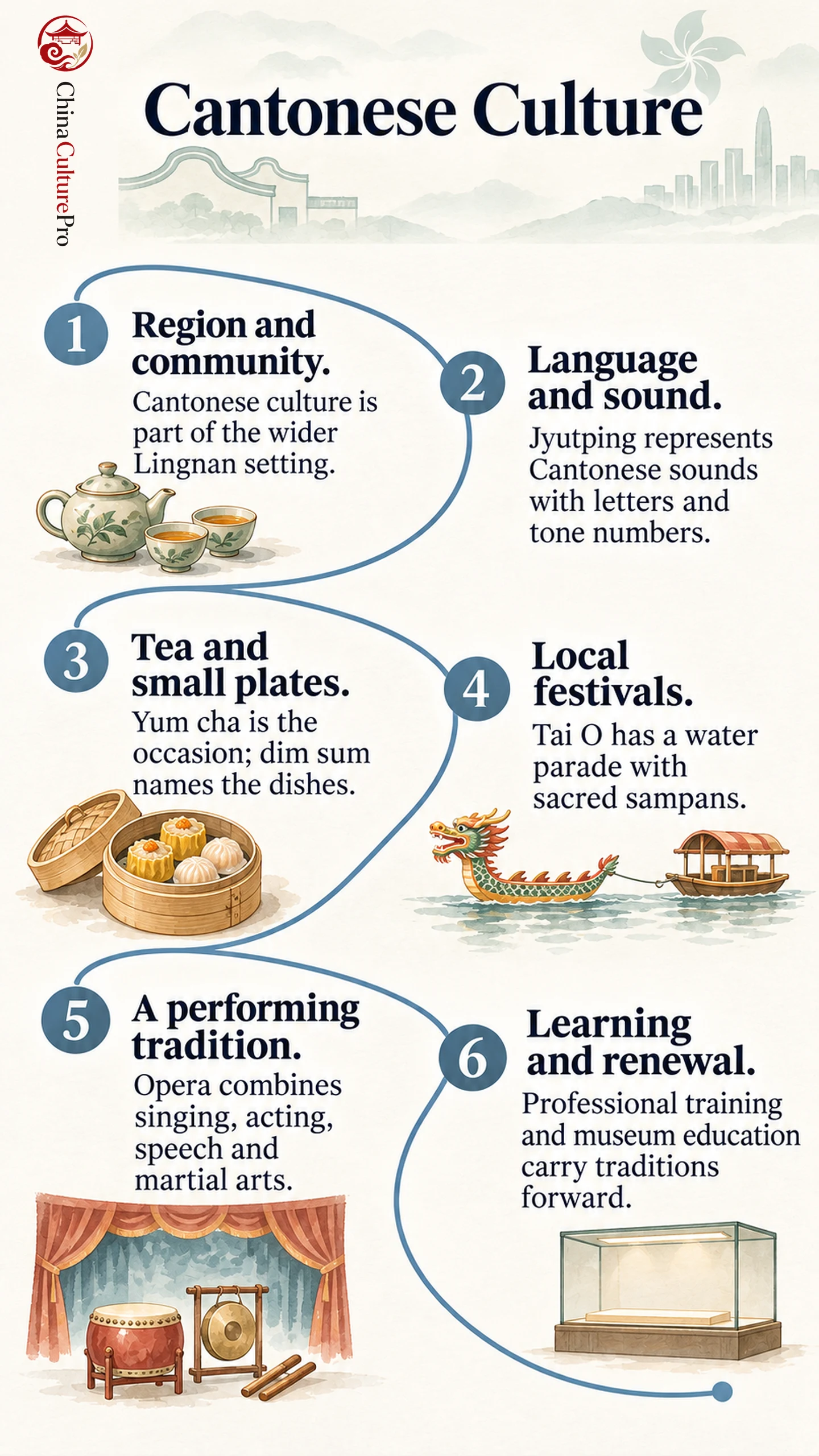
A shared tea table, a dragon boat procession and an opera stage show different sides of Cantonese culture. Looking at the language, people and setting behind each reveals how regional traditions connect with local community life.
Cantonese, Guangdong and the Wider Lingnan Region
Guangdong is a province; Cantonese culture is a cultural category; Lingnan (岭南, Lǐngnán) names a broader historical and regional setting. These overlapping labels answer different questions. The Pearl River region is central to Cantonese cultural history, while Guangdong also contains substantial Hakka and Teochew traditions.[1]
Hong Kong and Macao share Cantonese cultural resources while having their own local histories and institutions. Migration also places familiar speech, food and performance in new surroundings. A family’s province of ancestry therefore does not by itself identify its home language or every custom it follows.
Language, Written Chinese and Jyutping
The Cantonese language (粤语, Yuèyǔ) is used in conversation and the arts. For readers learning pronunciation, Jyutping (粤拼, Yuèpīn) is the Linguistic Society of Hong Kong’s romanization scheme. Its letters represent initials and finals, with tone numbers at the end of syllables. Those conventions differ from English spelling and Mandarin pinyin.[2]
The tone-marked pinyin in this article gives Mandarin readings of Chinese names; it is not Cantonese pronunciation. Established English menu spellings can belong to another naming history. When comparing Mandarin and Cantonese, distinguish the spoken language, the characters on a page and the romanization used to represent sound. They are related resources, rather than interchangeable labels.
Yum Cha, Dim Sum and Shared Tables
Yum cha (饮茶, yǐnchá), conventionally written in English from Cantonese, refers to drinking tea and the associated shared meal. Dim sum (点心, diǎnxīn) names the small dishes served with it. The distinction between the occasion and its food helps explain why a tea meal involves more than one particular dumpling.[8]
The table can include sweet and savory foods, with steamed, baked or fried forms. Different dim sum dishes offer different wrappers, fillings and textures. Hong Kong’s tea-house repertoire includes traditional and inventive presentations, as well as dedicated vegetarian menus. A bamboo steamer alone does not define the full range.[3]
Dim sum belongs within Cantonese cuisine, which extends beyond tea-house snacks. Recognizing the setting matters: a family tea gathering and a restaurant banquet organize food and social time differently.
Festivals as Local Community Traditions
The Dragon Boat Festival (端午节, Duānwǔjié) takes different local forms. In Tai O, three fishermen’s associations organize a water parade in which deity statues travel on sacred sampans towed by dragon boats. Statues are brought from temples for the observance and later returned. The practice entered China’s national intangible-heritage list in 2011.[4]
This is a specific community tradition within wider festival customs. A procession carrying sacred images has a different purpose from competitive dragon boat racing, even when the same festival name surrounds both. The organizers, objects and sequence explain what participants are doing more precisely than the boat’s appearance alone.
Cantonese Opera and Living Performance
Cantonese opera (粤剧, Yuèjù) tells stories through four central skills: singing, acting, spoken delivery and martial arts. Costume, makeup, props, gongs and drums work with the performers’ movements to create the dramatic world. It can be public entertainment and can also appear in religious thanksgiving settings.[5]
Its UNESCO inscription dates to 2009. This recognizes a living performing tradition, rather than a requirement that every production use one fixed stage or audience setting. Training and conventions allow a small gesture or prop to carry meaning beyond its literal appearance.[5]
The English name “Yueju” needs care. Zhejiang’s Yue opera (越剧, Yuèjù) is a different tradition: the Mandarin syllables match, but the first Chinese character, regional history and performance language differ. The different Chinese characters identify the forms more clearly than that shared romanization.[9]
Learning and Renewal Across Generations
Transmission includes sustained professional education. The Hong Kong Academy for Performing Arts trains students in both opera performance and music, with semester productions and industry experience. Its account of a 2026 collaboration with an Italian jazz ensemble provides a concrete example of new artistic exchange alongside established training.[6]
Museum education offers another route. A 2026 school-program description links Guangzhou Museum objects with Hong Kong collections to explore regional history. Such teaching connects material objects with historical questions rather than presenting culture solely as a festival spectacle. These activities sit within Hong Kong’s local cultural life while drawing on wider regional resources.[7]
FAQs About Cantonese Culture
Is all Guangdong culture Cantonese?
No. Guangdong includes Cantonese, Hakka, Teochew and other cultural traditions. Provincial location alone does not identify a person’s language or practices.
Is Cantonese opera the same as Zhejiang Yue opera?
No. Cantonese opera is 粤剧, while Zhejiang Yue opera is 越剧. The shared Mandarin romanization Yueju can hide the distinction.
Are yum cha and dim sum identical terms?
They overlap in use, but yum cha describes the tea-drinking meal or occasion, while dim sum refers to its small dishes.
Does every dragon boat event involve racing?
No. Tai O’s water parade has a religious and community purpose. Competitive racing is another form of festival activity.
Sources
[1] Tsinghua University Press. Overview of Lingnan: Unit 1
[2] Linguistic Society of Hong Kong. Jyutping: Cantonese Romanization Scheme
[3] Hong Kong Tourism Board. Dim Sum in Hong Kong
[4] Hong Kong Intangible Cultural Heritage Office. Tai O Dragon Boat Water Parade
[5] Hong Kong Intangible Cultural Heritage Office. Cantonese Opera
[6] Hong Kong Academy for Performing Arts. School of Chinese Opera
[7] Chinese Culture Promotion Office. South of the Five Ridges: The Evolution and Essence of Lingnan Culture
[8] Hong Kong Heritage Museum via Government Information Services. Exhibition on Pu’er Tea and Teaware
[9] Macao Cultural Centre. My Grand View Garden: Yue Opera