

Quick Answer: What Is Dragon Boat Racing?
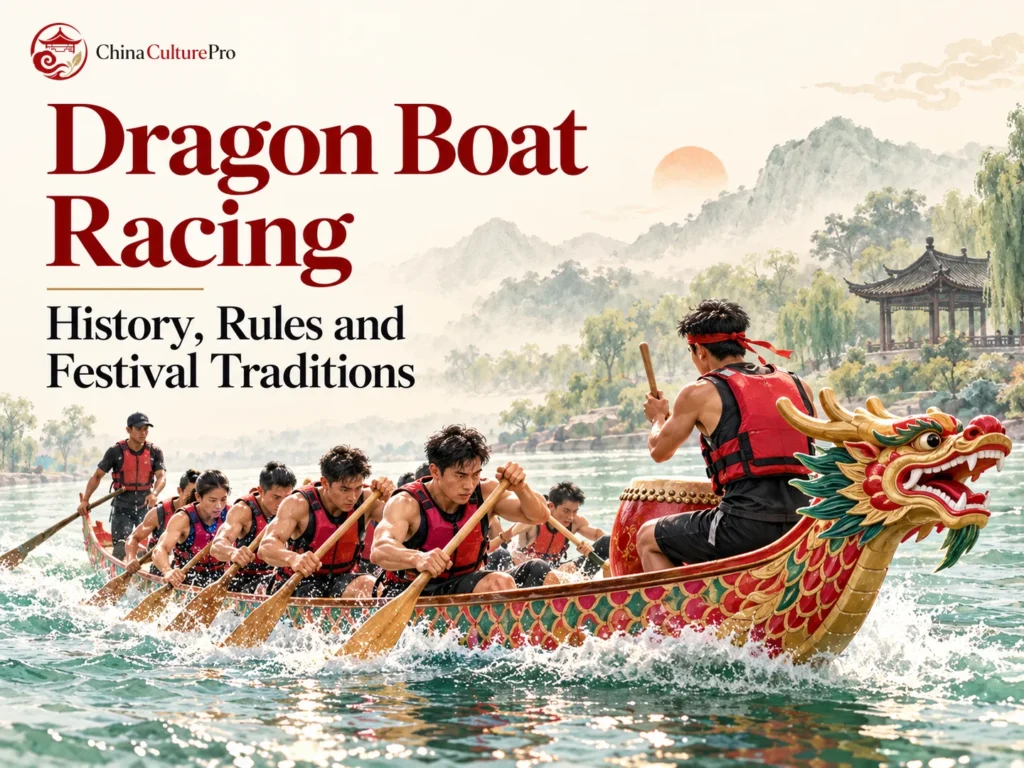
Dragon boat racing (龙舟竞渡, lóngzhōu jìngdù) is a team paddling sport using long dragon boats (龙舟, lóngzhōu). Crews propel the boat together over a defined course.
- Cultural connection: Racing is closely associated with the Dragon Boat Festival (端午节, Duānwǔ Jié), although local traditions differ.
- Shared effort: Paddlers provide power, while a drummer and steerer help coordinate the crew and its direction.
- Modern competition: International championships and club races give the tradition a sporting life beyond the festival.
Traditional celebrations and standardized sport overlap, but their boats, crews and rules are not identical. Check the particular event before assuming one format applies everywhere.
Watching a dragon boat (龙舟, lóngzhōu) race raises questions beyond who wins: why is there a drummer, and must every crew have twenty-two people? This guide explains dragon boat racing (龙舟竞渡, lóngzhōu jìngdù), its rules and its connection with the Dragon Boat Festival (端午节, Duānwǔ Jié).
The Dragon Boat and Its Crew: Paddlers, Drummer and Steerer
A recognizable racing dragon boat has a long hull, a dragon head at the bow and a tail at the stern. Paddlers generally sit in pairs, facing forward, and use single-bladed paddles. This is paddling: unlike conventional racing rowing, their paddles are not mounted in oarlocks, and they face the direction of travel.[1]
| Role | Usual position | Main job |
|---|---|---|
| Paddlers | Paired seats along the hull | Propel the boat through coordinated paddle strokes. |
| Drummer | Near the bow, facing the paddlers | Help coordinate timing and communicate with the crew. |
| Steerer, also called helm | At the stern | Control direction with the steering oar and help manage the boat safely. |
The drummer works with the paddlers rather than supplying rhythm in isolation. Coordinated movement matters more than the spectacle of a loud drum; the crew must respond together while the steerer keeps the boat on its intended course.
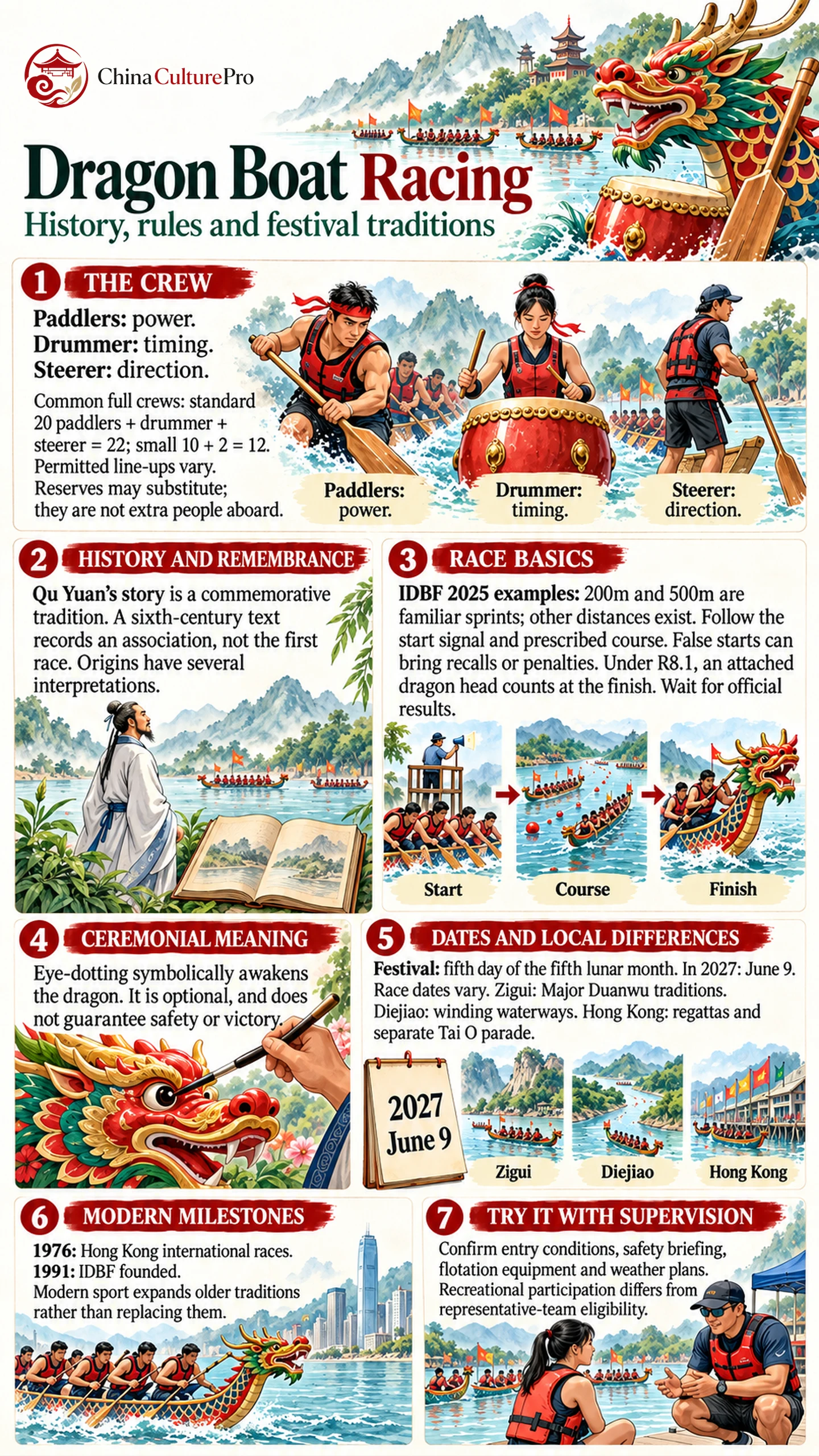
A full standard racing boat commonly carries twenty paddlers, one drummer and one steerer: twenty-two people aboard. A small racing boat commonly has ten paddlers plus those two roles, making twelve.[1] Under IDBF’s 2025 regulations, standard boats in world and continental championships normally allow eighteen to twenty paddlers; other permitted arrangements depend on the event.[2]
Reserves belong to the registered crew list, not an extra row of people aboard. Eligible reserves may substitute under the competition rules. Traditional local boats can have different designs and complements, so these figures do not define every dragon boat.
Open, women’s and mixed competitions are separate classes. Their entry conditions are set by the relevant competition regulations.[2]
Where Did Dragon Boat Racing Come From?
Qu Yuan and the Story of Remembrance
The best-known commemorative story connects the races with Qu Yuan (屈原, Qū Yuán), a poet and political figure of the ancient state of Chu. In the familiar account, people take to their boats to search for him after his death in the Miluo River. Later racing is understood as remembrance of that search.[3]
This story is an important part of the tradition, but it is not evidence that all dragon boat racing began with one rescue attempt. Qu Yuan’s historical identity and the later explanations attached to festival activities are different kinds of evidence. The distinction lets readers appreciate the story without treating each detail as a documented event or a universal account of every community’s customs.
Earlier Traditions and Historical Evidence
Researchers have proposed several explanations for early boat competitions, including water-related rituals, dragon worship, everyday river activity and military practice. These are interpretations, not interchangeable facts establishing one precise birthplace or invention date. Some interpretations place boat traditions before the later prominence of the Qu Yuan narrative.[3]
One useful textual reference is Jingchu Suishiji (荆楚岁时记, Jīngchǔ Suìshí Jì), compiled by Zong Lin in the sixth century. It records fifth-day-of-the-fifth-month boat competition and explains it through remembrance of Qu Yuan. That tells us an association was recorded by that period; it does not date the first race or prove the commemorative explanation was the only one.[3]
Regional practice provides another kind of evidence. In Zigui, Hubei, documented festival customs place remembrance of Qu Yuan at the center of river activities and boat racing.[4] Such records describe a particular community’s tradition. They should not turn one local calendar or ritual into a compulsory pattern for all Chinese communities.
How Does a Dragon Boat Race Work?
The following outline uses IDBF’s ninth-edition regulations and racing rules, effective from January 2025 and checked in October 2026. Other federations and local organizers may use different provisions.
Race Distances and Formats
Two hundred and five hundred metres are familiar sprint distances. IDBF regulations also recognize other distances, including 250, 1,000 and nominally 2,000 metres. A longer race can involve turns rather than a single straight sprint.[2]
For spectators, first identify the distance and course, then the competition class. A mixed-crew heat, a women’s final and a traditional local race need not have the same entry conditions or format. Read the race heading instead of judging solely by the boats’ appearance. Heats and later rounds also make a regatta different from one isolated contest: the fastest-looking boat in an early race has not necessarily won the whole event.
Starts, Lanes and Penalties
Crews assemble and align before the starter gives the signal. Starting prematurely can bring a recall and a penalty; a false start does not automatically mean immediate exclusion in every case. Crews must follow their prescribed course and avoid interfering with other boats.[5]
Watch for the official start and any recall signal rather than assuming the first movement counts. During the race, a boat’s apparent lead is only part of the picture: course infringements or interference can affect the result. The applicable rules and officials determine the response. A quick spectator explanation cannot replace the race briefing, and a penalty from one event should not be generalized to all regattas.
Finishing and Official Results
Under IDBF Rule R8.1, a boat finishes when its foremost part crosses the finish line, with the same number of racers aboard as at the start. An attached dragon head counts as part of the boat.[5]
After a close finish, wait for the published result. What appears obvious from an angled bank-side view may not reflect the finish officials’ view, and the final classification can incorporate an official decision or penalty. The same rule should not be assumed for a local event using a different finishing system. Check which code governs the race before explaining a disputed result.
Dragon Heads, Drums and Festival Ceremonies
The dragon-shaped decoration connects a working boat with a mythical creature associated in Chinese traditions with water and rain. Scholarly explanations of dragon-related rites concern what people believed and hoped for, not proof that a decorated boat could control weather.[3]
Drumming has both a practical racing role and a public festive presence. Its sound helps make a race recognizable from the bank, while the decorated boat gives spectators a shared visual focus. Neither the decoration nor a louder drum determines who wins.
Some events include eye-dotting (点睛, diǎnjīng), symbolically awakening the dragon. A documented example is the public awakening ceremony held before New York’s Hong Kong Dragon Boat Festival in 2024.[6] The ceremony carries wishes for a successful occasion; it does not guarantee protection or a race result. Other events use different ceremonial arrangements or none. Observing a ceremony and participating in its religious meaning are separate choices, so visitors should follow the organizers’ invitation rather than assume a required ritual role.
When and Where Are Dragon Boat Races Held?
The Dragon Boat Festival falls on the fifth day of the fifth lunar month. In 2027, that is June 9.[7] The festival date does not establish every race date: local celebrations can follow a longer calendar, and sporting events can take place at other times of year.
| Place | What the example shows | Important limit |
|---|---|---|
| Zigui, Hubei | Qu Yuan remembrance is central to local river and racing customs. Major Duanwu (大端午, Dà Duānwǔ), on the fifteenth day of the fifth lunar month, is a documented local milestone. | This traditional calendar is not a published timetable for every future competition.[4] |
| Diejiao, Nanhai, Foshan | Long boats negotiate narrow, winding waterways in distinctive turning races. | Do not assume every bend, start arrangement or event uses a standard straight championship course.[8] |
| Hong Kong | International regattas coexist with neighborhood races in places such as Stanley. Tai O’s water parade is a separate religious procession. | A festival boat activity is not necessarily a ranked race; each event needs its own programme.[9][10] |
These are examples of different settings, not a complete geographical list or a ranking of places to watch. International crews, village teams and ceremonial processions may share dragon imagery while serving different purposes. Before attending, check the organizer’s current date, venue and spectator arrangements. An earlier year’s announcement can explain an event’s character, but cannot confirm that its next edition will follow the same schedule.
How Dragon Boat Racing Became a Global Sport
Hong Kong’s international races, first held in 1976, were an important landmark in the sport’s international development.[9] They were not the first boat races in Chinese history, nor the moment when all local traditions acquired one format.
The International Dragon Boat Federation was founded in Hong Kong in 1991, creating an international organizational framework for the sport.[11] Its technical rules support its competitions; that does not mean every festival or another federation’s event follows identical provisions.
Club training, representative championships and cultural celebrations now coexist. A team can practise for a sporting season while also taking part in a festival occasion. This is better understood as an expanded range of activities than a replacement of older customs. It also explains why a race held outside the traditional festival period can still be a dragon boat event.
Can Beginners Try Dragon Boat Racing?
Beginners can look for an organized introductory session with qualified supervision. An invitation to try paddling is different from eligibility for a championship. Before booking, confirm:
- Entry conditions: Minimum age, any swimming or fitness requirements, and the level the session assumes.
- Supervision: Who leads the session, gives the safety briefing and controls the boat.
- Equipment: What suitable flotation equipment is supplied and what participants must wear.
- Conditions: How weather, water conditions or other concerns change or cancel the activity.
Learn through the organizer’s instruction rather than entering the water independently. Cultural background need not prevent recreational participation, but competition entries can have membership, residency or representative-team requirements.[2] Observing a race is also a worthwhile way to learn before deciding whether to join a session.
FAQs About Dragon Boat Racing
How Many People Are in a Dragon Boat?
A full standard racing crew commonly has twenty-two people: twenty paddlers, a drummer and a steerer. Small racing boats commonly carry twelve. Permitted line-ups vary, and reserves are separate from the people aboard.
Is Dragon Boat Racing the Same as Rowing?
No. Dragon boat paddlers face forward and use single-bladed paddles without oarlocks. In conventional racing rowing, athletes generally face backward and use mounted oars. Calling both activities “rowing” hides that practical difference.
Are Dragon Boat Races Always 500 Metres?
No. Five hundred metres is one familiar distance among several. Short sprints, longer courses and local turning races can all occur; check the programme for the distance and format being contested.
Is Dragon Boat Racing Only Held During the Festival?
No. The festival supplies an important cultural setting, but club and championship calendars extend beyond it. A race’s actual date comes from its organizer, not simply from the fifth lunar month.
Can Non-Chinese People Join Dragon Boat Racing?
Yes. Recreational dragon boating includes people from different backgrounds. Participation still depends on the activity’s entry and safety conditions; international representative competitions may impose additional rules that an introductory session does not.
Sources
[1] Paddle Worldwide / International Canoe Federation. Dragon Boat discipline overview
[2] International Dragon Boat Federation. Competition Regulations, Edition 9, effective January 2025
[3] National Ethnic Affairs Commission. Scholarly interview on dragon boat traditions and origins
[4] China Intangible Cultural Heritage. Dragon Boat Festival customs in Qu Yuan’s hometown, Zigui
[5] International Dragon Boat Federation. Rules of Racing, Edition 9, effective January 2025
[6] Hong Kong Economic and Trade Office, New York. Dragons awaken in Times Square
[7] Hong Kong Observatory. Gregorian–Lunar Calendar Conversion Table of 2027
[8] General Administration of Sport of China. Dragon boat racing in Foshan
[9] Hong Kong Tourism Board. What to see and do during the Dragon Boat Festival
[10] Hong Kong Intangible Cultural Heritage Office. Tai O Dragon Boat Water Parade
[11] International Dragon Boat Federation. About Us