

Quick Answer: What Are Zongzi?
Zongzi (粽子, zòngzi) are leaf-wrapped parcels made mainly from glutinous rice (糯米, nuòmǐ), also called sticky rice. They are tied and cooked by boiling or steaming.[1]
- Construction: The rice and any filling are eaten; the wrapping leaves and ties are removed.
- Flavor: Sweet, savory and sweet-savory versions exist, with recipes varying by place and household.
- Festival: They are closely associated with the Dragon Boat Festival (端午节, Duānwǔjié), but are also eaten at other times.
“Sticky rice dumplings” is a useful English name, although zongzi usually contain rice grains rather than a wheat-dough wrapper.
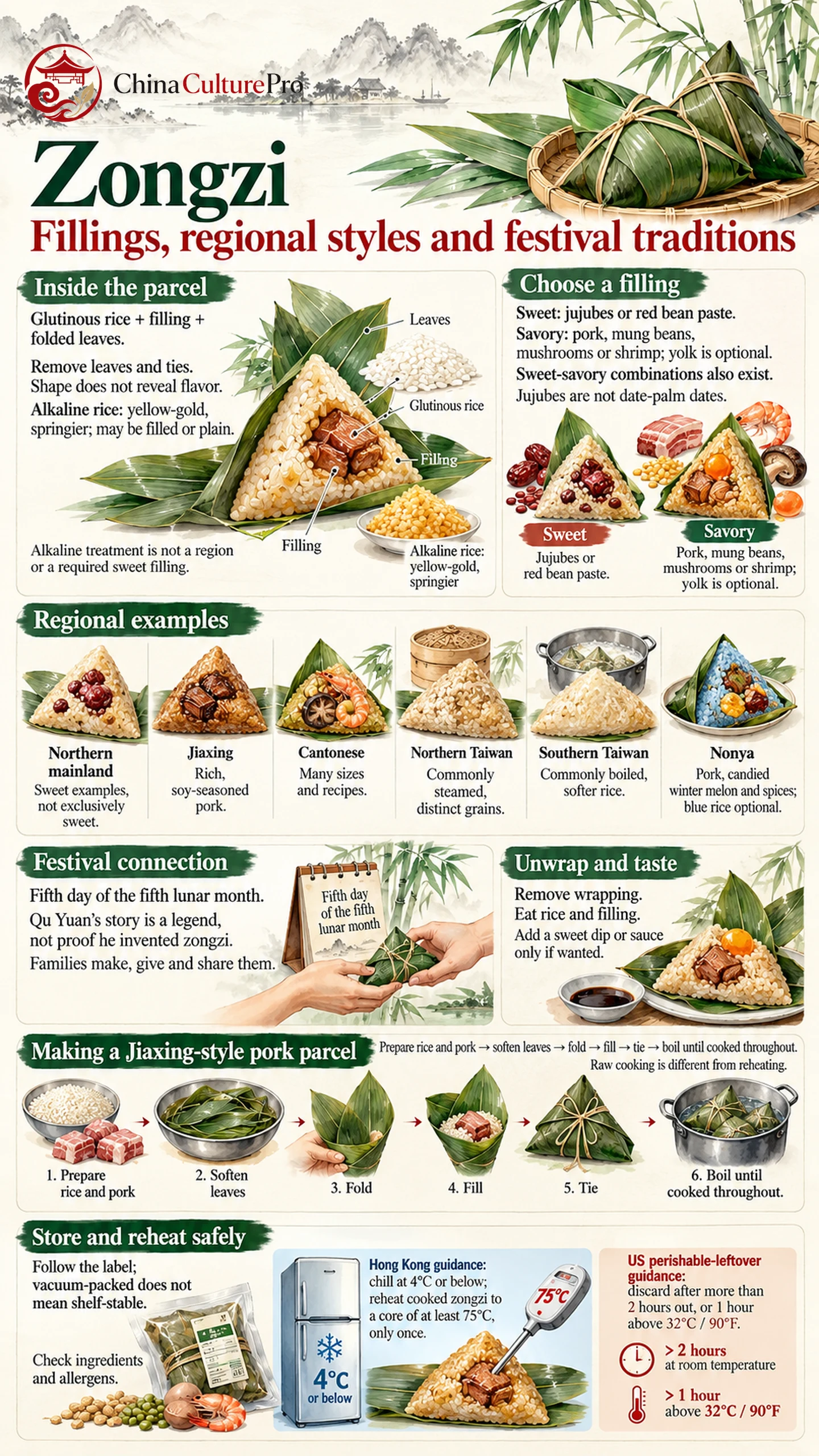
Zongzi (粽子, zòngzi) hide their fillings beneath folded leaves, so their shape rarely tells you whether they are sweet or savory. This guide explains the ingredients and regional styles, then covers eating, storage and reheating. For wider customs, see our Dragon Boat Festival (端午节, Duānwǔjié) guide.
What Zongzi Are Made Of: Rice, Leaves and Shapes
Glutinous rice becomes soft, cohesive and chewy when cooked. It forms the body of most zongzi, rather than a thin skin around a separate filling. Some versions use plain rice; others season it so the grains carry flavor throughout. The rice itself is not necessarily sweet, despite another English name, “sweet rice.”
Alkaline rice dumplings (碱水粽, jiǎnshuǐ zòng), or jianshui zong, use rice treated with food-grade alkaline water. The finished rice is generally yellow-gold and springier. They may be unfilled or contain a filling; sugar or syrup can supply sweetness at serving.[10] “Alkaline” identifies a treatment, not one province or a mandatory sweet center.
Bamboo and reed leaves are common wrappers. Other broad leaves occur locally, so neither one leaf species nor one folding style defines all zongzi. Leaves help hold the parcel together and contribute aroma. Tetrahedral and elongated pillow-like shapes are familiar examples; similar shapes can hold entirely different fillings.
Regional rice-flour versions, including guozong (粿粽, guǒzòng), are exceptions to the whole-grain pattern. For choosing a parcel, treat region, filling, rice treatment, shape and wrapper as overlapping descriptions. A pork-filled zongzi can also be a regional style and a triangular parcel.
Sweet and Savory Zongzi Fillings
Choose a flavor first, then ask what is actually inside. A familiar shape or a dark patch of seasoned rice is not a reliable ingredient list.
Sweet Fillings and Plain Rice
Red jujubes, candied jujubes and red bean paste are common sweet choices. Jujubes are the Chinese fruit often called red dates, not date-palm dates. Candied jujubes have been processed with sugar, while dried red jujubes contribute a different texture and their own sweetness.
Red bean paste creates a smooth, concentrated center, unlike a parcel containing whole fruit. Plain rice versions can be eaten without additions or dipped in sugar, syrup or honey, depending on the style and personal taste.
“Unfilled” does not mean “unsweetened,” and a sweet accompaniment changes the result. Likewise, the alkaline treatment describes the rice; it does not guarantee either a filling or a particular sweetness.
Savory and Mixed Fillings
Marinated pork belly, salted duck egg yolk, split mung beans, mushrooms, dried shrimp and chestnuts appear in various savory combinations. The ingredients play different roles: pork enriches the rice, egg yolk adds crumbly, savory richness, and mushrooms or shrimp provide concentrated flavor.[5]
Fresh pork marinated for a recipe is different from cured ham. Mung beans are also different from red bean paste and need not make the parcel sweet. Not every pork zongzi contains an egg yolk, seafood or the entire list of ingredients.
Sweet and savory are useful starting points, not mutually exclusive rules. Some regional combinations deliberately mix the two. When an ingredient matters to you, ask about it rather than treating “meat zongzi” as a complete description.
Regional Zongzi Styles at a Glance
These are representative examples, not six exclusive categories or a complete national catalogue. Family recipes, migration and contemporary production blur regional boundaries. The table’s northern-mainland example concerns flavor preference; the two Taiwanese entries chiefly distinguish preparation and cooking.
| Regional or community example | Typical fillings | Rice and preparation | What to expect |
|---|---|---|---|
| Northern mainland China, especially North China | Red or candied jujubes; sometimes bean paste | Often pale rice with a sweet filling | A useful sweet-style example, not proof that northern households never eat savory zongzi |
| Jiaxing zongzi (嘉兴粽, Jiāxīng zòng), Zhejiang | Marinated pork; some versions add salted egg yolk | Soy-seasoned rice cooks with the filling | Soft, rich rice flavored by meat juices; sweet styles also exist.[9] |
| Cantonese zongzi (广式粽, guǎngshì zòng), Guangdong and Cantonese communities | Pork, mung beans and optional yolk; sweet alternatives also occur | Wrappers, sizes and recipes vary considerably | Zhaoqing’s large wrapped parcels are one local example, not the pattern for all Guangdong.[5] |
| Northern Taiwanese zongzi (北部粽, běibù zòng) | Pork, mushrooms, shrimp and other additions | Rice and ingredients are commonly prepared separately before wrapping and steaming | More distinct grains and a firmer bite.[4] |
| Southern Taiwanese zongzi (南部粽, nánbù zòng) | Pork, peanuts, shrimp or other household choices | Soaked rice and fillings are commonly wrapped, then boiled | A softer, more cohesive texture; preparation varies.[4] |
| Nonya zongzi (娘惹粽, niángrě zòng), also spelled Nyonya, in Peranakan Chinese communities | Pork, candied winter melon and spices | A regional adaptation with Chinese and Malay culinary influences | Sweet-savory flavor; some versions have butterfly-pea-colored blue rice.[3] |
The zhong leaves (柊叶, zhōngyè) used for Zhaoqing’s large parcels should not be assigned to every Cantonese style. Blue rice is similarly a clue to some Nonya versions, not an obligatory feature. Nor does “northern” versus “southern” Taiwan mean sweet versus savory: both examples above are commonly savory.
Why Zongzi Are Eaten at the Dragon Boat Festival
The festival falls on the fifth day of the fifth lunar month. Zongzi connect the occasion with seasonal food, remembrance and the shared work of preparing something for others.
The best-known story concerns Qu Yuan (屈原, Qū Yuán), the poet associated with the ancient state of Chu. In the legend, people cast rice into the river after his death so fish would leave his body alone. It is a commemorative narrative, not evidence that Qu Yuan invented zongzi or that every regional variety began with the same event.[2]
Early descriptions of jiaoshu (角黍, jiǎoshǔ), angular grain parcels associated with millet, occur in Jin-period accounts. They point to an older food tradition than a single modern recipe, but do not establish one inventor or an exact starting date. An early reference does not establish that today’s fillings, names and festival customs already existed in their present form.[1]
Today, wrapping, giving and sharing zongzi can carry family memories as well as a connection to the festival. Some households make them together; others buy them. Eating one outside the holiday does not make it less authentic, and a family need not follow every associated custom to enjoy the food.
How Zongzi Are Wrapped and Cooked
A Jiaxing-style fresh-pork parcel illustrates the general sequence below. In this example, the rice and marinated pork are raw when wrapped. The sequence explains how the parcel is built. Quantities, soaking requirements and cooking time must match that particular size and method.
- Prepare the ingredients: Rinse and prepare the glutinous rice and season the fresh pork for the chosen recipe. Keep raw meat separate from cooked food and ready-to-eat ingredients.
- Prepare the leaves: Clean and soften suitable food-wrapping leaves so they can fold without splitting. Fresh and dried leaves may need different treatment.
- Form the container: Overlap and bend the leaves into a closed pouch or cone, with no open gap at its point.
- Add rice and filling: Layer rice, pork and more rice inside. Leave room for the rice to expand rather than packing the parcel solidly.
- Close and tie: Fold the leaves over the opening and secure the parcel with food-safe ties so the filling stays enclosed.
- Cook the raw parcel: Use the boiling method appropriate to this style, cooking until both the rice and the pork are done throughout.
Rice preparation, parcel size and equipment change the time required. A steaming method for prepared Taiwanese-style rice cannot simply replace boiling a raw-rice pork parcel. Reheating an already cooked zongzi is a separate task; a warm exterior does not establish that a raw center is cooked.[6]
How to Eat, Store and Reheat Zongzi
Unwrap and Serve
Undo or cut the tie, unfold the leaves and transfer the rice and filling to a plate. Remove any remaining pieces of leaf before eating. You can use chopsticks, a fork or another comfortable utensil; there is no compulsory serving ritual.
Taste before adding anything. A sweet parcel may suit sugar or honey, while a rich pork version may need no sauce. Some people enjoy cooled alkaline dumplings, but a preference for cool food does not make prolonged room-temperature storage safe.
Storage and Reheating
Check whether a purchased parcel is raw, fully cooked, chilled, frozen or specifically labeled shelf-stable. Follow its instructions; vacuum packaging alone does not settle the storage question.[5]
- Chill promptly: Hong Kong guidance recommends refrigeration at 4°C or below unless the product label specifies another suitable arrangement. Keep cooked food covered and separate from raw ingredients.[6]
- Limit time out: For perishable cooked leftovers, US guidance calls for disposal after more than two hours at room temperature, or one hour above 32°C/90°F. Cool promptly rather than leaving a batch on the counter.[8]
- Heat the center: For cooked rice dumplings, Hong Kong guidance recommends reheating to a core temperature of at least 75°C. Follow the product’s method, reheat only once and eat promptly.[6]
Frozen parcels need heat through to the center, not merely a soft surface. There is no single storage life or microwave duration covering every size, filling and package. Check ingredients for relevant allergens, which may include egg, peanuts, soy or shellfish.
FAQs About Zongzi
Do you eat the leaves around zongzi?
No. Remove the wrapping leaves and ties, then eat the rice and filling. The wrapper holds the parcel together and may contribute aroma; it is not an edible skin like the dough around a dumpling.
Are zongzi gluten-free?
Not automatically. “Glutinous” refers to stickiness, and rice is naturally gluten-free. Sauces, fillings and cross-contact can change the finished product’s suitability.[7] Check the full ingredient list and an appropriate gluten-free label rather than relying on the rice alone.
Are sweet zongzi vegetarian?
Some are, but sweetness is not a dietary certification. Check the paste, added fats and other ingredients, and ask the maker when necessary. Vegetarian and vegan are also different requirements; an apparently simple sweet filling does not answer every ingredient question.
Can vacuum-packed zongzi be stored at room temperature?
Only when the manufacturer’s label permits it. A vacuum seal alone does not mean the contents are shelf-stable.[5] Follow any refrigeration, freezing and after-opening instructions, and reject damaged or swollen packaging rather than assuming the seal guarantees safety.
Are zongzi eaten only during the Dragon Boat Festival?
No. Their festival association is strong, but they are also everyday food in some places and are sold beyond the holiday season. Availability and household habits vary; there is no rule that they must be eaten only on the festival date.
Sources
[1] Shanghai Municipal Government. Tradition with a Twist: Shanghai’s Zongzi Guide
[2] Singapore Chinese Cultural Centre. Dragon Boat Festival
[3] Singapore Chinese Cultural Centre. Peranakan Chinese Food in Singapore
[4] Taiwan Food and Drug Administration. Southern or Northern Zongzi: Which Would You Choose?
[5] Dongguan Administration for Market Regulation. Dragon Boat Festival Consumer Advice from Twelve Guangdong Cities
[6] Hong Kong Centre for Food Safety. Rice Dumplings and Food Safety
[7] US Food and Drug Administration. Questions and Answers on Gluten-Free Food Labeling
[8] US Department of Agriculture. Leftovers and Food Safety
[9] Zhejiang Provincial Commission for Discipline Inspection and Supervision. The Fragrance of Zongzi Returns
[10] The Woks of Life. Jianshui Zong: Alkaline Rice Dumplings