

Quick Answer: What Are Chinese Lanterns?
Chinese lanterns (灯笼, dēnglong) are lighting and decorative objects that typically place a light inside a protective or ornamental covering. The familiar red globe is one example of a much wider tradition.
- Uses: Lanterns provide illumination, decorate buildings and contribute to community celebrations.
- Forms: Frames, coverings, shapes and lighting effects vary, from small handheld objects to elaborate display pieces.
- Contexts: A lantern’s significance depends on the occasion, its imagery and the community using it.
These descriptions overlap. A wooden palace-style lantern can hang from a beam, while the same shape may be used for several different display methods.
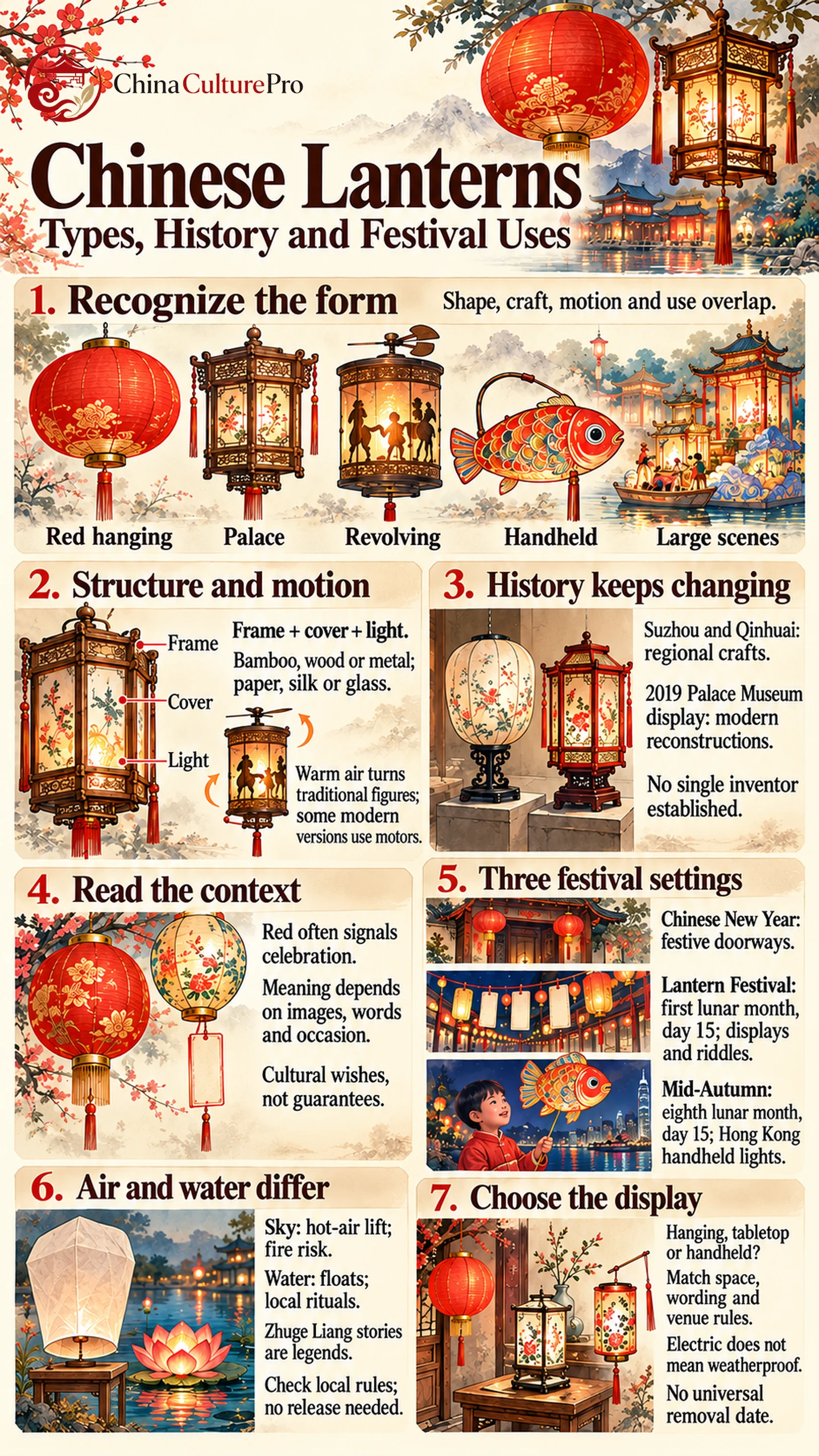
A red globe outside a doorway, a painted wooden lamp and a lantern with moving silhouettes can look like unrelated objects. This guide explains how Chinese lanterns (灯笼, dēnglong) differ in structure, materials and festival use, so you can recognize what you are seeing and understand its context.
Chinese Lantern Types at a Glance
Identify a lantern by its color and shape, construction, moving effects, and display method. “Red,” “palace-style” and “hanging” can all describe one object. The following examples are useful recognition groups rather than a fixed traditional classification.
| Name | Visible clues | Typical display | Important distinction |
|---|---|---|---|
| Red hanging lantern | Often rounded or cylindrical, with red paper or textile over a frame; sometimes tasselled | Doorways, eaves and festive streets | Frames may be bamboo or wire. Shape alone does not tell you whether it hangs or is carried. |
| Palace lantern (宫灯, gōngdēng) | Decorative wooden frame with painted silk gauze or glass panels | Halls, interiors and exhibitions | Polygonal forms are common, but there is no single required number of sides. |
| Revolving lantern (走马灯, zǒumǎdēng) | Moving figures or silhouettes within an illuminated structure | Festival viewing and decorative displays | The name identifies a moving effect; a palace-style casing may contain that mechanism. |
| Handheld shaped lantern | Compact animal, fruit or other imaginative form with a handle or carrying stick | Children’s lantern walks and local celebrations | A fish or lotus shape does not make an object suitable for release into water. |
| Large lantern installation | Framed, illuminated figures, architecture or complete scenes | Public lantern exhibitions | This is a display scale, not one material, shape or regional craft. |
| Sky lantern (孔明灯, Kǒngmíngdēng) | Lightweight paper envelope, open underneath, lifted by heated air | Certain local celebrations | It is an airborne device, with different risks from a stationary decorative lamp. |
| Water lantern (河灯, hédēng) | Floating light, sometimes lotus-shaped or boat-shaped | Particular waterside ceremonies | Buoyancy distinguishes it from a handheld lantern that merely looks similar. |
Museum descriptions of Beijing lanterns include wooden, gauze-covered examples alongside several other forms; Hong Kong exhibitions show equally varied figurative designs.[1][2]
Materials, Frames and Moving Images
Three components help explain a lantern: its supporting frame, its covering and its light source. Bamboo strips can support a light paper shell; a wooden frame can hold painted panels. Metal framing and synthetic coverings also appear in contemporary displays. A candle, bulb or LED describes the illumination, not the lantern’s cultural category.
The covering matters visually. A translucent surface allows the internal light to show through, while painted panels, cut-out shapes and structural ribs create different patterns. Looking at those parts is more useful than assuming that every lantern is made from paper.
A traditional revolving lantern adds a moving assembly. Rising warm air drives a small wheel connected to an axle and figures or silhouettes. As those elements turn, their images appear to move around the illuminated screen. In a familiar arrangement, the outer casing stays still while the inner figures rotate.[3]
The component that moves depends on the particular construction. Modern versions may use a motor instead of heat. Likewise, “palace lantern” describes a craft form, whereas “revolving” describes an effect: the two labels need not exclude each other.
How Did Chinese Lanterns Develop?
The history of lanterns brings together practical lighting, decorative craftsmanship and festival display. It cannot be reduced to one inventor replacing an ordinary lamp with the first red paper globe. A reference to lamps in an old text also does not establish the invention of every later lantern form.
Regional histories give a clearer picture. Suzhou’s lantern tradition developed elaborate architectural forms and moving figures, with accounts describing its prominence during the Tang and Song periods. In the Qinhuai region around Nanjing, lantern craft brought together painting, paper cutting and other decorative skills; during the Ming and Qing periods, public viewing became an important part of the Lantern Festival (元宵节, Yuánxiāo Jié).[4][5]
Court display followed its own setting. In 2019, the Palace Museum exhibited reconstructed ceremonial lanterns made using historical research and surviving objects. These were modern reconstructions of historical arrangements, not newly discovered intact ancient lanterns.[6]
Today’s illuminated landscapes and contemporary characters continue that process of change. Traditional motifs coexist with ships, rockets and city scenes in Qinhuai craft. New subjects do not, by themselves, make an object unrelated to the tradition; materials, makers and display practices can change together.[5]
What Do Lantern Colors and Designs Mean?
Red lanterns commonly signal festivity in Chinese celebrations, especially in New Year settings. Their association with good wishes is a cultural expression, rather than a claim that hanging them changes a household’s fortunes.[7]
Design adds more specific information. Painted landscapes or story figures may invite viewing and storytelling; an animal-shaped children’s lantern can be playful. A written greeting communicates through its actual words, so check the characters before assigning it a meaning. Color alone cannot explain the whole object.
Context also changes interpretation. A light displayed for family celebration and one used in a memorial ceremony have different purposes even if their materials resemble one another. Avoid a universal color dictionary in which every red, white or gold lantern has one fixed message. The occasion, inscription and local practice are better guides than a color viewed in isolation.
When Are Chinese Lanterns Used?
Chinese New Year: Doorways and Community Displays
At Chinese New Year (春节, Chūnjié), hanging lanterns can make entrances and shared streets visibly festive. Hong Kong’s celebrations provide a familiar example, with red lanterns appearing among the city’s seasonal decorations.[7]
A household display and a public installation serve different spaces: one marks a doorway, while the other may create a communal setting for celebration. Families need not reproduce an entire street display at home. There is no universal requirement to hang a pair, choose only red, or remove everything on the same date.
Lantern Festival: Viewing Lights and Guessing Riddles
The Lantern Festival falls on the fifteenth day of the first lunar month. Here, lanterns become objects of public viewing, from individual works to illuminated scenes. Riddles may accompany displays, adding a word game to the visual experience.
Qinhuai traditions illustrate this connection between crafted objects, scenery and local festivities. A lotus-shaped lantern, an architectural display and a contemporary subject can share the same exhibition without belonging to one identical design category.[5]
The Lantern Festival guide covers the holiday’s wider customs. The festival date does not determine every exhibition’s opening night or duration.
Mid-Autumn Festival: Handheld Lanterns and Local Displays
At the Mid-Autumn Festival (中秋节, Zhōngqiū Jié), celebrated on the fifteenth day of the eighth lunar month, lantern use has its own local forms. In Hong Kong, handheld lanterns and public displays are familiar parts of the season.
A 2023 exhibition at Victoria Park included rabbit-themed works alongside starfruit, fish, ball and airplane-shaped lanterns. It offers a documented example of the variety; it does not establish when each shape was invented.[2]
These practices do not represent every Chinese household. See the Mid-Autumn Festival guide for the broader holiday, which is separate from the first-month Lantern Festival.
Sky Lanterns and Water Lanterns: Different Uses and Beliefs
Sky lanterns are associated with wish-making in places such as Pingxi, New Taipei City. Local accounts link them to signaling and later celebration, while explicitly presenting stories about Zhuge Liang as traditional explanations. Those stories do not prove that he invented them.[8]
Tiandeng (天灯, tiāndēng), literally “sky lantern,” also needs context: historical palace displays bearing that name could be mounted on tall poles rather than released into the air.[6]
Water lantern ceremonies have different settings. At Keelung’s Zhongyuan observances, floating lights are associated with inviting wandering spirits to communal offerings. This is a local religious interpretation, not evidence that the lights actually guide spirits or a practice required of every family.[9]
Neither aerial nor water release is a general decorating instruction. Released sky lanterns present a fire risk; current local rules and the organizer’s arrangements must be checked rather than inferred from photographs of another place’s festival.[10]
Choosing Lanterns for a Home or Shared Celebration
Choose the display method first, then the appearance. A lantern suited to a shelf may be unsuitable for carrying or exposure to rain.
- For an entrance: Check dimensions, the intended hanging arrangement and whether the complete product is suitable for that environment.
- For a table: Choose a stable decorative light that leaves usable space around it; a compact palace-style form is one option.
- For a lantern walk: Look for a manageable handheld design and an enclosed electric light source.
- For shared spaces: Confirm the host’s preferences, venue requirements and any wording on the lantern.
Electric lighting avoids a candle flame, but does not automatically make the product weatherproof. Follow its intended use. Keeping a lantern on display or reusing it next season is a household choice, not a nationwide calendar rule.
FAQs About Chinese Lanterns
Are All Chinese Lanterns Made of Paper?
No. Lantern coverings can include silk gauze, glass, cloth and modern synthetic materials, with bamboo, wood or metal frames. Paper is one material within a varied craft tradition.
Are Chinese Lanterns Always Red and Round?
No. Polygonal palace lanterns and starfruit or animal-shaped lanterns show the range. Red globes are recognizable festive examples, but neither their color nor their shape defines every Chinese lantern.
Are Chinese Lanterns Only Used at the Lantern Festival?
No. Lanterns also appear at Chinese New Year, Mid-Autumn celebrations and particular local ceremonies. Their purpose depends on the community and occasion; the object is not exclusive to one holiday.
Who Invented Chinese Lanterns?
No single inventor is securely established for the entire lantern tradition. Stories crediting Zhuge Liang concern sky lanterns and should be treated as legends, rather than proof of invention.
Can You Display Chinese Lanterns Without Releasing Them?
Yes. Hanging, tabletop and handheld lanterns are ordinary display options. Airborne and floating forms have particular uses and conditions; releasing a lantern is unnecessary for enjoying a festive display.
Sources
[1] Chinese Lantern Museum. Beijing Palace Lanterns
[2] Hong Kong Intangible Cultural Heritage Office. 2023 Traditional Lantern Craftsmanship Exhibition
[3] Changde Science and Technology Museum. Rotating Lanterns
[4] Chinese Lantern Museum. Phoenix Boat Lantern and Suzhou Lantern Craft
[5] China Intangible Cultural Heritage. Qinhuai Lantern Craft
[6] Palace Museum. Reconstructed Palace Lanterns
[7] Hong Kong Tourism Board. Chinese New Year
[8] Pingxi District Office. Understanding Sky Lanterns
[9] Keelung City Government. Water Lanterns at the Keelung Zhongyuan Festival
[10] Fire and Emergency New Zealand. Sky Lanterns