

Quick Answer: What Is Chinese New Year Cake?
Nian gao (年糕, niángāo), often translated as Chinese New Year cake, is a family of grain-based cakes associated with the festival. Rice is common, but some northern versions use sticky millet.
- Meaning: Its name carries a sound-based wish for progress from one year to the next.
- Variety: Cakes differ in grain, sweetness, shape and texture; a brown dessert is one familiar version.
- Use: Sweet cakes may be served as treats, while plain cakes can become savory dishes or sweet snacks.
Household choices vary within the wider Chinese New Year celebration; no single cake is required.[1][2]
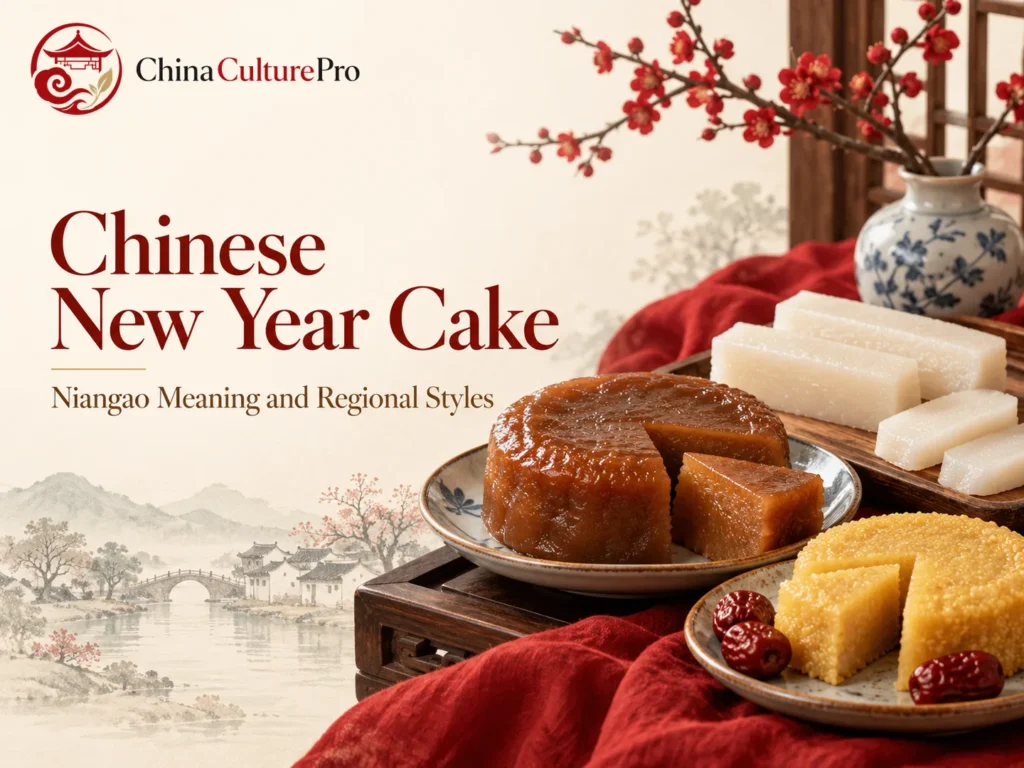
A brown, sweet New Year cake and a packet of white rice-cake bars can look like entirely different foods. Both share a festive name. Understanding the grain, the cake’s own flavor and the way it is served helps explain the variety behind this festive name.
Why Does Nian Gao Symbolize Progress?
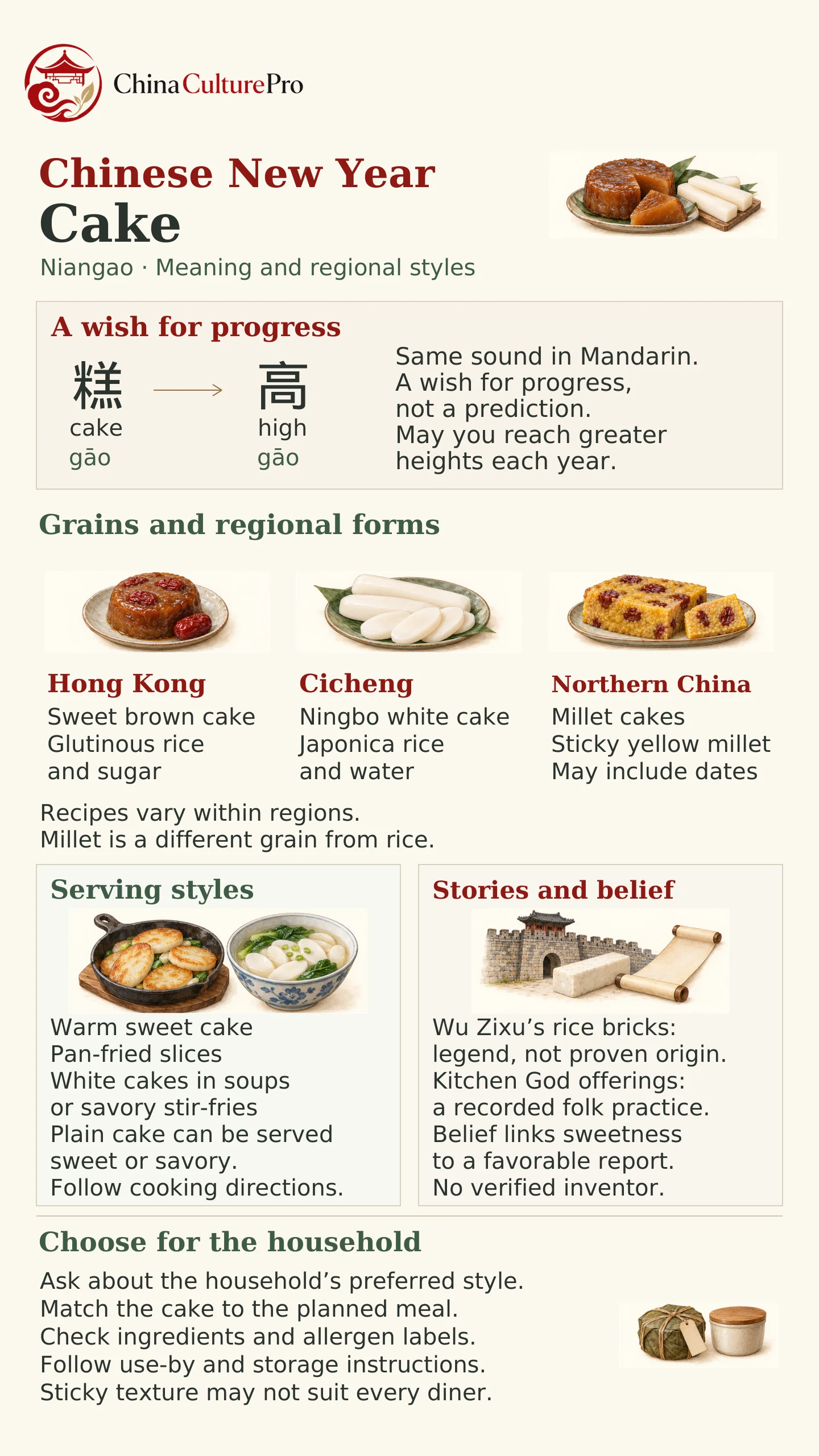
The blessing comes from Mandarin wordplay. Nian means “year”; the word for cake (糕, gāo) sounds exactly like the word for high (高, gāo), including its tone. The food’s name can therefore suggest reaching a higher level in the coming year. “New Year cake” names the food; “greater heights” explains the association.[3]
A familiar wish is 年年高升 (niánnián gāoshēng): “May you reach greater heights each year.” At a family gathering, that might express encouragement for a child’s learning or an adult’s work. It does not predict exam results, promotions or income.
The meaning comes from language rather than a particular cake color or shape. A household can recognize the same progress wish while preferring a different local version. This is one example of the sound-based associations found among Chinese New Year symbols.
What Is Nian Gao Made Of?
The grain matters more than the English label “rice cake” suggests. Glutinous rice (糯米, nuòmǐ) gives many sweet versions their sticky, chewy character. It is not the only possible base.
Traditional water-milled cakes from Cicheng, in Ningbo, Zhejiang, provide a clear counterexample: japonica rice (粳米, jīngmǐ) and water are the documented ingredients. Some northern cakes instead use sticky yellow millet (黏黄米, nián huángmǐ), sometimes with red dates. Millet is a different grain from rice.[2][4]
Sweeteners and other additions are a separate question. Brown sugar, white sugar or dates may sweeten a cake; an unsweetened white cake leaves more of the flavor to its accompaniments. Here, “plain” describes an unsweetened base, not a nutritional claim.
Use these examples to recognize possibilities, then check the actual ingredients. Blended flours and household recipes mean that neither a region’s name nor a cake’s color proves its complete composition.
Regional Nian Gao Styles at a Glance
These examples show useful contrasts rather than a fixed classification. The same region can have several recipes, and a family’s preferred cake may reflect more than one hometown tradition.
| Region or community example | Appearance and cake flavor | Grain or ingredients | Common use and limit |
|---|---|---|---|
| Hong Kong sweet New Year cake | Often a brown, sweet cake, sometimes topped with red dates | Glutinous rice with sugar; brown sugar is a familiar choice | A festive sweet; this does not represent every Cantonese cake.[5] |
| Cicheng, Ningbo | White, smooth, firm cakes, often formed into bars for slicing | The documented traditional water-milled version uses japonica rice and water | Versatile cakes for several preparations; check a packaged product rather than assuming its formula.[4][6] |
| Some northern Chinese examples | Yellow millet cakes, with dates in some versions | Sticky yellow millet; additions vary by locality | Northeastern millet cakes and Shandong date-and-millet cakes are examples, not a rule for every northern household.[2] |
Overseas communities also adapt familiar forms. In Singapore, examples include sweet cakes combining glutinous rice and brown sugar with leaf wrapping and pandan. That is a community example, not a description of everything sold under the name.[3]
How Is Nian Gao Served?
Serving changes what the cake contributes to a meal. An unsweetened white cake can remain the same ingredient while becoming a savory main dish or a sweet snack. Steaming, frying, boiling and stir-frying all appear in regional practice.[6]
- Warm sweet cake: A brown sweet cake may be served softened and warm as a festive treat. Its sweetness is already in the cake, rather than supplied entirely by a sauce.
- Pan-fried slices: Both plain and sweet cakes can be sliced for frying. The finished texture and accompaniments depend on the cake; plain slices may be paired with something sweet or savory.
- A savory meal: White rice-cake slices or strips can accompany vegetables, meat or seafood in stir-fries and soups. In the Ningbo area, such uses extend beyond the New Year season.
These are serving styles, not interchangeable recipes. Check whether a packaged cake is ready to eat or needs cooking before deciding how to serve it.
Stories About Nian Gao: Legends and Evidence
One well-known legend connects the cake with Wu Zixu (伍子胥, Wǔ Zǐxū). In the story, he arranges for rice bricks to be hidden beneath a city wall. When food later runs out, people uncover the edible bricks and survive the shortage. New Year cakes are then said to commemorate his foresight. This is an explanatory legend, not proof that he invented the food.[2]
A different connection concerns the Kitchen God (灶神, Zàoshén). Some households offer sweet brown cake when sending the deity off before New Year. Within the associated folk belief, sweetness encourages a favorable report about the family in heaven. The offering is a recorded cultural practice; the heavenly report belongs to belief.[7]
Keeping those distinctions matters. A story can help explain why a food feels meaningful without establishing when it was first made. Neither account supplies a verified inventor or exact birth date for every cake now called nian gao.
Choosing Nian Gao for a New Year Gift or Meal
Choose for the recipient’s habits and the intended meal. A familiar local cake may be more welcome than an elaborate version chosen only for its presentation.
- Ask about preference: Find out whether the household enjoys sweet cake, plain rice cakes or another local style. A hometown is a useful conversation starter, not a reliable substitute for asking.
- Match the serving plan: A cake intended for a dessert plate may differ from one needed for a savory dish. Neither use makes a cake inherently better for gifting.
- Read the label: Check the complete ingredients and any allergen information, including additions or coatings. Do not infer the contents from “rice cake” alone.
- Check handling needs: Look for intact packaging, the use-by date and storage instructions. Follow refrigeration or freezing directions and pass them on with a gift.[8]
For young children or anyone with chewing or swallowing difficulties, the sticky texture also needs consideration; the festive occasion does not make every cake suitable.[8]
FAQs About Chinese New Year Cake
Is Nian Gao Always Sweet?
No. Some cakes are sweetened, while plain white versions have a mild rice flavor. Their final taste depends on the dish: savory seasonings and sweet accompaniments create different results.
Is Nian Gao Always Made from Glutinous Rice?
No. Traditional Cicheng water-milled cakes use japonica rice, and some northern cakes use sticky yellow millet. Glutinous rice is widespread, but it is not a universal ingredient.[2][4]
Is Nian Gao Only Eaten at Chinese New Year?
No. The festival gives it special symbolic importance, but rice cakes also appear in everyday meals in parts of Jiangnan. White cakes can be a regular ingredient for soups and stir-fries.[6]
Can You Eat Nian Gao Cold?
It depends on the product. Check whether it is ready to eat or requires cooking; follow its storage directions. Refrigerated cooked leftovers should be reheated thoroughly, rather than judged by texture alone.[8]
Is Nian Gao the Same as Turnip Cake?
No. Turnip cake (萝卜糕, luóbogāo) combines radish with a flour-based mixture and savory ingredients. It is a separate festive pudding, even though both foods may appear at New Year.[9]
Sources
[1] Ministry of Education, Taiwan. 年糕 — Revised Mandarin Chinese Dictionary
[2] Guo Mei, Beijing Daily, hosted by the Beijing Municipal Government. 年糕 食俗中的年味儿
[3] Singapore Chinese Cultural Centre. The Educator’s Guide — SINGAPO人
[4] China Intangible Cultural Heritage Network. 舌尖上的非遗 那些年的年味儿
[5] Hong Kong Tourism Board. Traditional Dishes to Eat During Chinese New Year
[6] Jiangbei District Cultural Centre, Ningbo. 慈城年糕展现非遗魅力
[7] Singapore Federation of Chinese Clan Associations. Culture — Festivals
[8] Centre for Food Safety, Hong Kong. Food Safety Tips for Chinese New Year
[9] Food and Environmental Hygiene Department, Hong Kong. Use of Preservatives and Colouring Matter in Chinese New Year Foods