

Quick Answer: What Are Yusheng and Lo Hei?
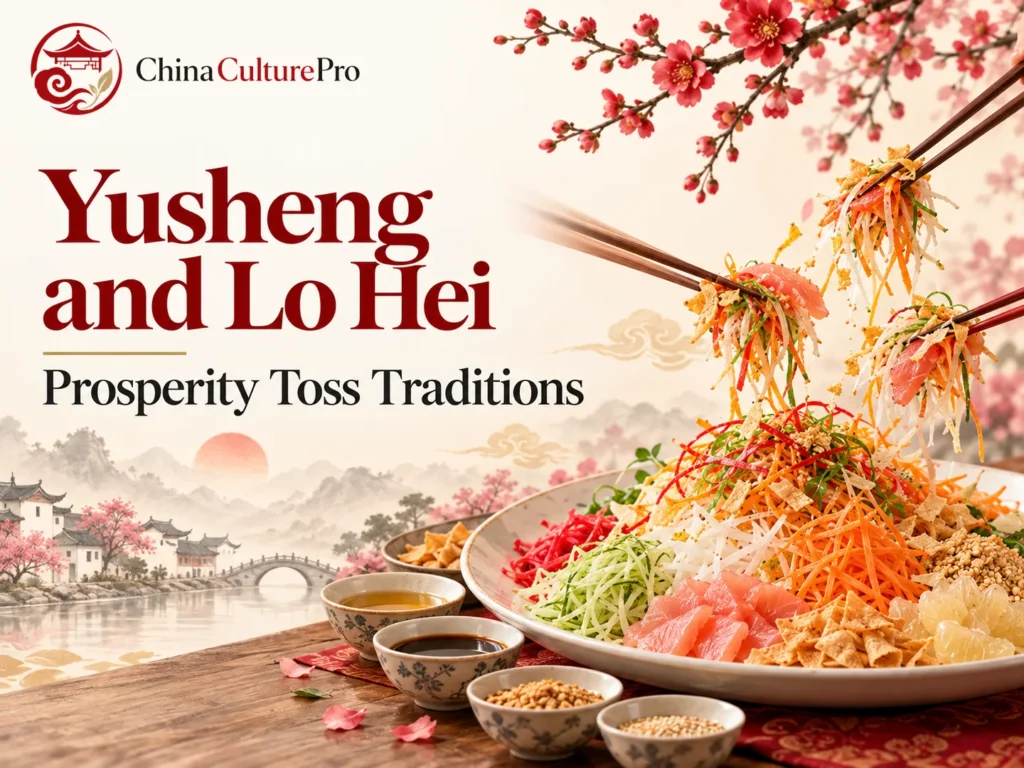
Yusheng (鱼生, yúshēng), also written yee sang, is a festive salad usually combining raw fish, shredded vegetables, dressing and crunchy toppings.
- The dish: Yusheng names the food on the platter.
- The action: Lo Hei (捞起; Mandarin lāoqǐ) names the communal tossing ritual. Lo hei is Cantonese, written lou1 hei2 in Jyutping; lāoqǐ is the Mandarin reading of the characters.
- The setting: The custom is especially associated with Chinese New Year among Chinese communities in Singapore and Malaysia.
Its prosperity wishes are symbolic expressions of hope, with no power to determine anyone’s fortune.
At a Chinese New Year meal, a colorful platter becomes the center of attention as everyone reaches in with chopsticks. For a first-time guest, the unfamiliar part may be knowing when to join in. Understanding the names, spoken wishes and shared actions makes participating much easier.
How the Tradition Developed in Singapore and Malaysia
The modern prosperity toss grew from older ways of preparing and eating raw fish. Cantonese migrants brought their food traditions to Southeast Asia, where ingredients and serving styles changed. Early fish dishes and today’s richly dressed communal salad belong to a connected history, but they are not interchangeable versions of one unchanged ancient ceremony.[1]
In Singapore, the development of the colorful modern salad is closely linked to four chefs: Lau Yoke Pui, Tham Yui Kai, Sin Leong and Hooi Kok Wai. Their version appeared during Chinese New Year in 1964. It combined fish with a wider mix of vegetables, crunchy additions and a sweet-sour dressing. This is the form commonly called qicai yusheng (七彩鱼生, qīcǎi yúshēng), or seven-colored raw fish salad.[1][2]
Malaysia has its own accounts of the dish’s development, including a tradition associated with Loke Ching Fatt in Seremban. Claims about who first created modern yusheng remain contested. Crediting a particular recipe does not establish who invented every later gesture, phrase or dining custom.[1]
Today, the shared experience matters as much as the assembled ingredients. Diners help mix the dish while voicing good wishes, making participation part of the meal itself. In Malaysia, yee sang likewise brings people around a large platter to toss together before eating.[3]
When Is Yusheng Eaten During Chinese New Year?
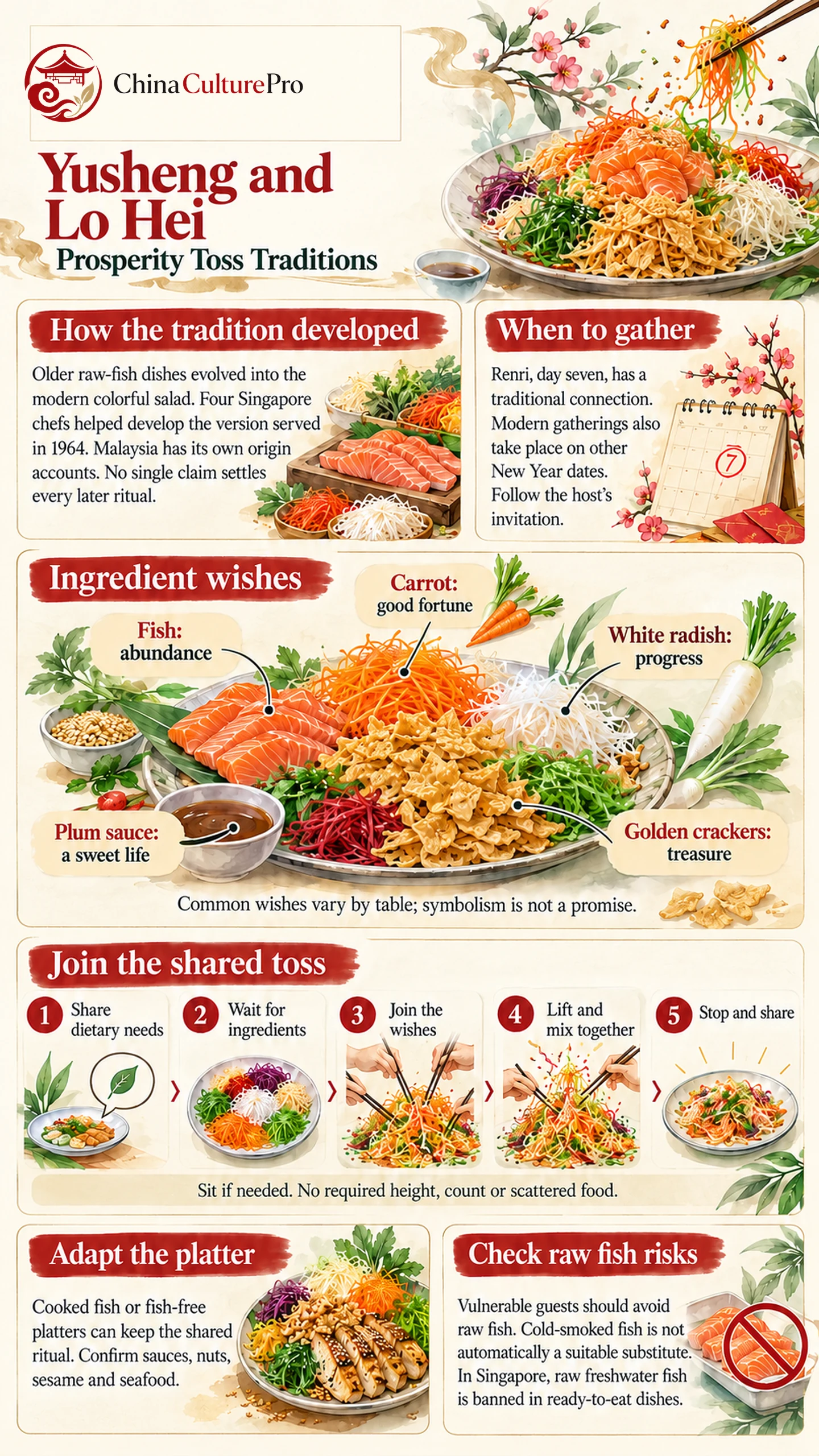
Yusheng has a strong association with Renri (人日, rénrì), the seventh day of the first lunar month, traditionally understood as humanity’s common birthday. That connection explains why the seventh day is often singled out in descriptions of the custom.[1][2]
It is not the only time people arrange a prosperity toss today. Families, friends and colleagues can gather on other convenient dates during the festive season. A restaurant meal or family celebration may include it as an opening dish, rather than as an event confined to one calendar date.[2][3]
If you are invited, follow the host’s schedule. A lo hei gathering can accompany a reunion dinner, but the two are not synonymous: reunion dinner describes the gathering, while lo hei describes one activity within a meal.
Yusheng Ingredients, Auspicious Phrases and Meanings
A typical platter balances crisp vegetables, fish, sweet-tart dressing, nuts, seeds and fried crackers. Malaysian versions may also include preserved winter melon, pickled cucumber, ginger and coriander. These variations give the dish different textures without changing its shared celebratory purpose.[3]
The following pairings are common examples, not a compulsory sequence. The wishes are usually spoken as ingredients are added. Families and restaurants may combine phrases, change toppings or use a shorter script.[2]
| Ingredient | Common phrase, Mandarin pinyin and English wish | Connection |
|---|---|---|
| Fish slices | 年年有余, nián nián yǒu yú — Abundance year after year | Fish, 鱼, and surplus, 余, share the Mandarin sound yú. |
| Pomelo | 大吉大利, dà jí dà lì — Good fortune and success | A customary auspicious pairing. |
| Pepper and five-spice powder | 招财进宝, zhāo cái jìn bǎo — May wealth and treasures arrive | A prosperity wish spoken when adding spices. |
| Oil | 一本万利, yī běn wàn lì — May a small investment bring great returns | A figurative business blessing. |
| Carrot | 鸿运当头, hóng yùn dāng tóu — May good luck come your way | 红, red, echoes 鸿 in the expression for great good fortune. |
| Green radish | 青春常驻, qīng chūn cháng zhù — May youth stay with you | 青 also appears in 青春, youth. |
| White radish | 步步高升, bù bù gāo shēng — May you rise with every step | A wish for progress, not a property of white vegetables. |
| Crushed peanuts | 金银满屋, jīn yín mǎn wū — A home filled with gold and silver | A conventional wealth blessing. |
| Sesame seeds | 生意兴隆, shēng yì xīng lóng — May business flourish | A customary pairing with a business wish. |
| Golden crackers | 满地黄金, mǎn dì huáng jīn — Gold covering the ground | Golden pieces suggest scattered treasure. |
| Plum sauce | 甜甜蜜蜜, tián tián mì mì — May life be sweet | Sweetness supplies the association. |
Some connections are wordplay; others are visual comparisons or familiar spoken pairings. An ingredient does not need an invented ancient explanation to belong on a modern platter. The fish-and-surplus association also appears more widely in Chinese fish symbolism.
For a shorter contribution, choose an expression you understand from these Chinese New Year greetings. You do not need to memorize every line to join the celebration.
How to Join a Lo Hei Prosperity Toss
Follow the person leading your table. A restaurant server may introduce the ingredients; at home, a host or family member may take that role. The following sequence is a practical way to join, rather than a rule that overrides the host’s arrangements.
- Share dietary needs first: Tell the host about allergies, vegetarian requirements or avoiding raw fish before anything is mixed. Gather where you can reach the platter comfortably, with chopsticks ready. Sitting is fine if standing or reaching would be difficult.
- Wait for the additions: Let the leader introduce the fish, seasonings, dressing and toppings. Some ingredients may already be arranged on the platter, so do not expect every item to be added separately.
- Join the wishes: Repeat the leader’s phrases if you can. If you do not speak Chinese, join the repeated call of “lo hei” or offer a simple New Year wish. Enthusiasm does not require perfect pronunciation.
- Lift and mix together: When everyone starts, use your chopsticks to lift and turn the ingredients. Keep your movements comfortable and mindful of neighboring diners. There is no required height or number of tosses, and food need not leave the platter.
- Finish and share: Once the ingredients are mixed, let the tossing stop before taking portions. Follow the table’s serving arrangements and enjoy the salad together.
Raw Fish, Dietary Needs and Modern Adaptations
A cooked-fish or fish-free version lets guests join the same shared activity. A vegetable-and-fruit platter can retain the dressing, crunch and communal mixing. When assembling a festive menu, treat yusheng as one dish among other Chinese New Year foods, with ingredients chosen for the people eating it.
- Avoid raw fish when vulnerable: Pregnant women, young children, older adults and people with weakened immunity should avoid raw fish. Raw fish can carry bacteria and parasites; buying a saltwater species does not remove all risk.[4]
- Check sourcing and handling: In Singapore, raw freshwater fish is banned from ready-to-eat raw fish dishes. Fish sold for cooking should not be treated as suitable for eating raw. Use properly supplied ready-to-eat products, maintain refrigeration and follow package instructions.[4]
- Do not rely on dressing or smoking: Marinating seafood is not a substitute for cooking. Ready-to-eat cold-smoked fish can also pose a risk; pregnant or immunocompromised guests should avoid it unless cooked until steaming hot.[5][6]
- Confirm the whole platter: Ask about peanuts, sesame, fish, shellfish, crackers and sauce ingredients. Check vegetarian or halal requirements with the provider. If an allergen or raw fish has already been mixed in, removing visible pieces does not create a separate suitable portion.
FAQs About Yusheng and Lo Hei
Are yusheng, yee sang and lo hei the same thing?
Yusheng and yee sang are names for the same festive salad. Lo hei refers more precisely to the communal tossing action, although everyday usage sometimes applies it to the whole occasion. The distinction is food versus ritual, not three separate dishes.
Do you have to toss yusheng on the seventh day?
No. The seventh day, Renri, has a traditional connection with yusheng, but modern gatherings take place on other dates during the New Year season. Follow your host’s invitation rather than treating one date as a requirement for participation.
Can yusheng be made without raw fish?
Yes. Thoroughly cooked fish or a fish-free version can be used while keeping the communal mixing and spoken wishes. Check the dressing and toppings too: a platter without visible fish is not automatically vegetarian or suitable for every allergy.
Does tossing yusheng higher bring more luck?
A higher toss expresses hopes for rising prosperity. It does not change the likelihood of success or good fortune. There is no meaningful minimum height, and a comfortable, considerate toss preserves the shared celebration without scattering food unnecessarily.
Sources
[1] National Library Board Singapore. Into the Melting Pot: Food As Culture
[2] Singapore Chinese Cultural Centre. The Ultimate Yusheng Guide (Including Audio)!
[3] Tourism Malaysia. Chinese New Year Delicacies – Yee Sang & Nian Gao
[4] Singapore Food Agency. GBS and the Consumption of Raw Freshwater Fish
[5] Singapore Food Agency. Safety of Raw Marinated Seafood
[6] NHS. Listeriosis