
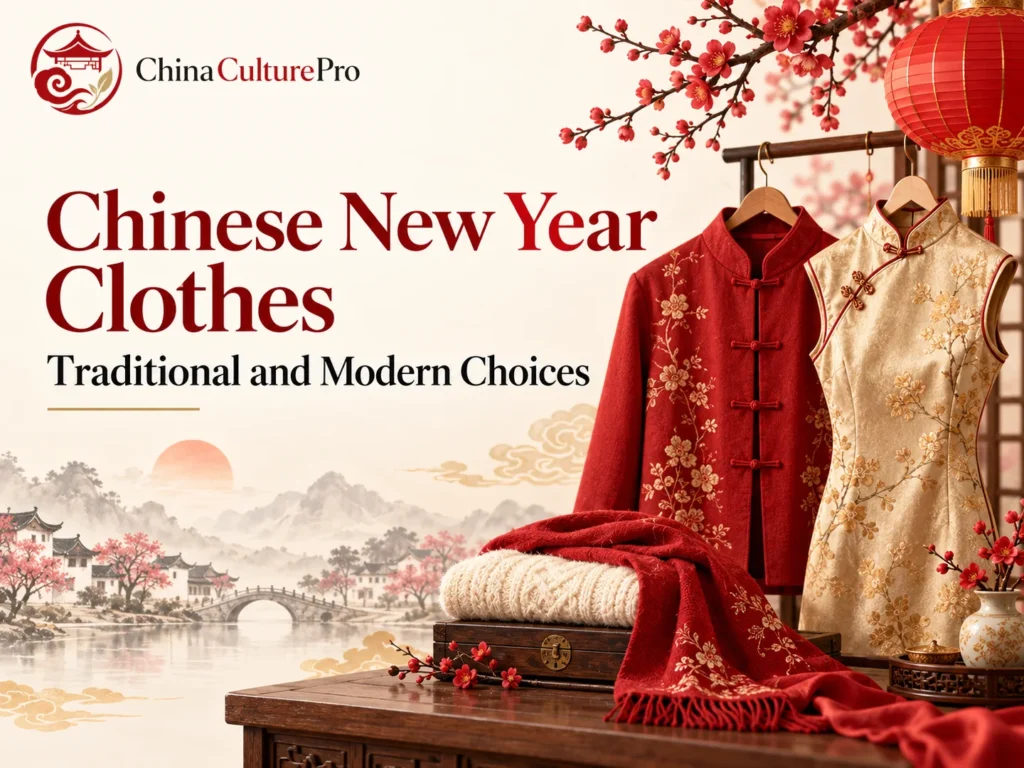

Quick Answer: What Should You Wear for Chinese New Year?
Wear clean, comfortable clothes suited to the invitation, the temperature and your host’s preferences. There is no single Chinese New Year uniform. Three useful options are:
- Modern everyday clothes: A neat sweater or shirt with trousers works for many informal gatherings; a red scarf or small accessory can add a festive touch.
- Traditional or adapted styles: Choose a Chinese jacket, dress or historical-style ensemble if you enjoy dressing for the occasion.
- A mixed outfit: Combine one Chinese-inspired detail, such as knotted fasteners, with familiar everyday pieces.
Traditional dress, an entirely red outfit and newly purchased clothes are all optional. Check any stated dress code before deciding.
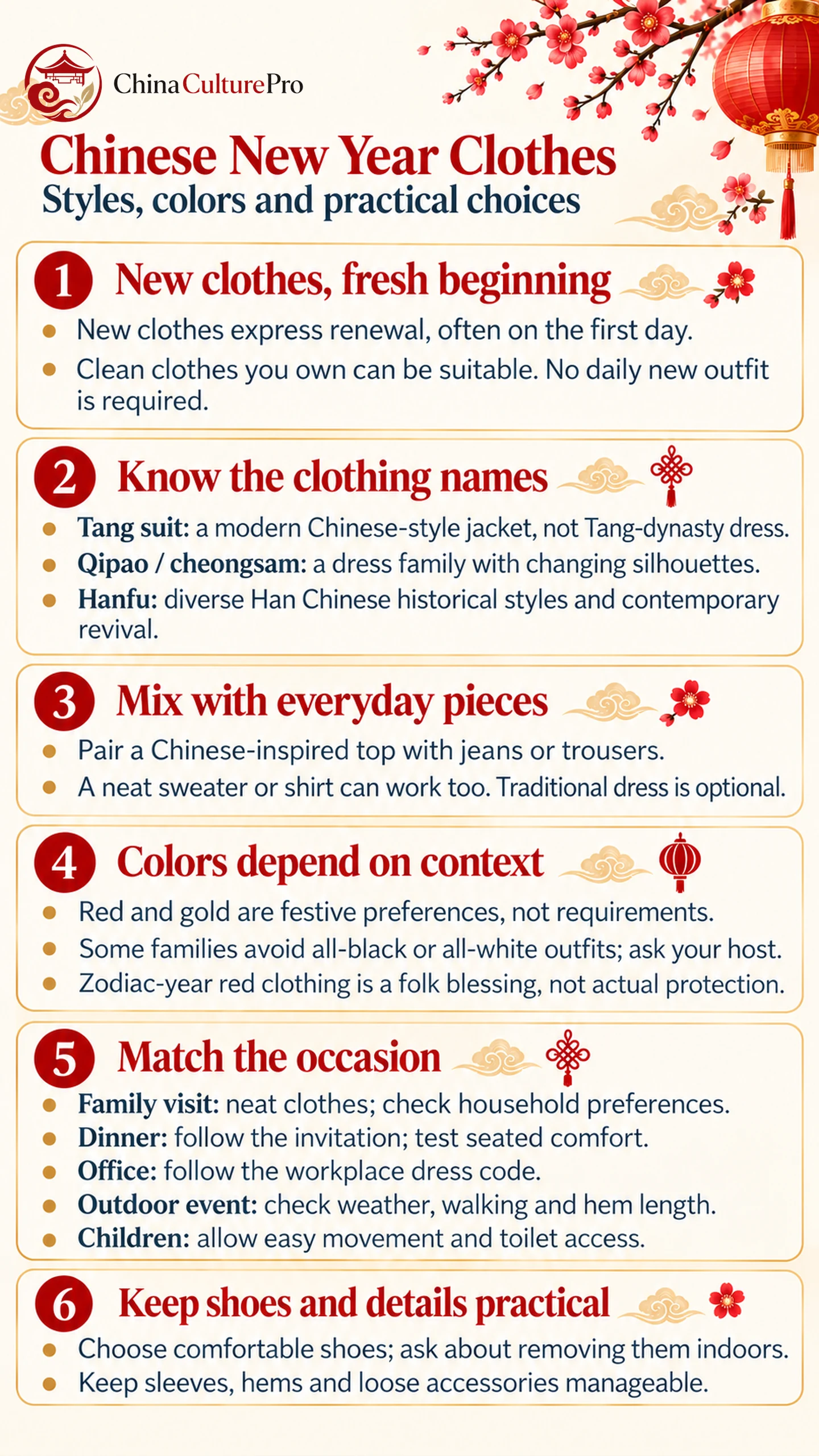
A festive family invitation can leave you wondering how dressed up to be. Is red essential? Will ordinary clothes look too casual? This guide helps you choose an outfit for the gathering, understand the main clothing styles and balance household customs with comfort and weather.
Why Do People Wear New Clothes at Chinese New Year?
New clothes express renewal: putting aside the old year and welcoming a fresh beginning. Wearing them on the first day is a familiar custom, and children may receive an outfit as a seasonal gift. Buying new clothes and shoes also appears among documented Singapore Chinese New Year practices. [1]
The custom does not create a requirement to buy a complete wardrobe. A household might enjoy matching outfits, save one new garment for the first day or simply dress neatly in clothes already owned. Ask what your family or host actually does rather than treating one version as a rule for everyone.
If you already have something suitable, there is no need to purchase an outfit just to attend. Nor does the festival require a different new set every day. For the wider sequence of celebrations, see the Chinese New Year guide; clothing is one part of the occasion, alongside gathering and visiting.
Traditional and Modern Chinese New Year Clothing Options
Tang Suits: A Modern Jacket with Traditional Details
A modern Tang suit (唐装, tángzhuāng) is a Chinese-style jacket, often recognizable by a standing collar, a front opening and knotted fasteners. Brocade is a familiar festive option, but fabrics, patterns and cuts vary. The name does not mean it reproduces clothing from the Tang dynasty.
The jackets worn at the 2001 Shanghai APEC leaders’ meeting offer a documented example. They combined traditional details with modern tailoring, including set-in sleeves and shaped shoulders. This was a documented public example of modern Tang suits, not proof that every jacket bearing the name originated in 2001. [2]
For a dinner, pair the jacket with plain trousers rather than assuming a matching full ensemble is necessary. Try reaching forward and sitting down before choosing it: decorative fasteners and a traditional-looking collar do not guarantee an easy fit.
Qipao and Cheongsam: Names and Changing Silhouettes
The qipao (旗袍, qípáo) is a Chinese dress whose silhouette has changed over time. In English, cheongsam, a name borrowed from Cantonese, often refers to the same dress family; it is not Mandarin pinyin. Standing collars, shaped waists, side openings and decorative fasteners are familiar features, but no single cut represents its entire history.
The movement from late Qing robes through 1930s qipao and later cheongsam styles illustrates this evolution. Calling every version an ancient, tightly fitted gown obscures those changes. [3]
Choose a length and fit that suit the event. For a seated meal, test the waist, arm movement and skirt opening while sitting. A shorter or roomier version may be easier for a long visit, while a formal dress can suit an invitation that calls for it.
Hanfu: Diverse Historical Styles and Contemporary Revival
Hanfu (汉服, hànfú) refers broadly to historical Han Chinese clothing traditions and their contemporary revival. It does not mean only Han-dynasty clothing, and it does not encompass every Chinese ethnic group’s traditional dress. Museum programs distinguish clothing from multiple periods, including the Han, Jin, Tang, Song and Ming. [4]
One specific option is a mamianqun (马面裙, mǎmiànqún), a skirt with overlapping flat panels and pleated sections. Surviving Ming examples help explain its historical construction. [5] A contemporary outfit may follow historical references closely or adapt them; those are different design choices.
Hanfu can suit a festive gathering, lantern outing or photograph, depending on the wearer and event. Check sleeve width, layers and hem length against what you will actually do. A complete historical ensemble is not required for an ordinary family visit.
Everyday Outfits and Modern Chinese-Inspired Clothing
New Chinese style (新中式, xīn zhōngshì) describes contemporary clothing that incorporates Chinese-inspired details into modern outfits. It is a flexible design direction, rather than a single historical garment or fixed collar shape.
A top with knotted fasteners can work with jeans or straight-leg trousers; an embroidered collar can provide the main detail of an otherwise simple outfit. There is no need to combine every recognizable Chinese element at once.
Ordinary clothes are equally useful. A plain knit, comfortable trousers and a chosen accessory can feel appropriate without becoming elaborate. If a garment carries a prominent traditional motif, the guide to Chinese symbolism in clothing explains its cultural context; a motif’s meaning is separate from whether the outfit fits your invitation.
Red, Gold, Black and White: What Do Clothing Colors Mean?
Red commonly expresses celebration and auspicious wishes, while gold is associated with prosperity and richness. These are cultural associations, not effects that wearing a color can produce. A red scarf, socks or brooch offers a small festive accent if an entirely red outfit does not suit you.
Black and white can carry mourning associations, so some households prefer other colors for formal New Year visits. Such preferences are documented in Singapore Chinese festive customs, but they should not be treated as a ban followed by every Chinese family. [1] An ordinary black coat or white shirt does not automatically make an outfit inappropriate.
When unsure, ask whether the gathering has a color preference. Combining a neutral base with a bright accessory is one practical option, rather than a compulsory way to “correct” a color. Do not assume a host’s preference from their age or nationality alone.
Ben Ming Nian (本命年, běnmìngnián) is the return of one’s birth animal in the Chinese zodiac (生肖, shēngxiào), recurring every twelve years. [6] Some people wear red during that year as a folk blessing; a Hakka cultural account, for example, records red clothing in this context. [7] Participation varies. The custom does not make red compulsory throughout the year or provide actual protection. The Ben Ming Nian guide explores that belief separately.
Outfit Ideas for Family Visits, Dinners and Public Celebrations
Start with the activity, then decide how much festive detail to add. These are outfit suggestions, not traditional dress regulations or rules divided by gender.
| Occasion | An outfit to consider | Check before leaving |
|---|---|---|
| Family visit | Neat everyday clothes or a simple Chinese-inspired top with a small festive accent | Ask about household preferences; choose layers for the journey and indoor temperature. |
| Reunion dinner or formal meal | A Tang jacket, comfortably fitted qipao or smart modern outfit | Follow the invitation’s formality; sit down and check sleeves, waist and hem. |
| Office celebration | Usual work clothes with a red scarf, brooch or other modest detail | Follow workplace dress requirements and consider meetings or tasks that day. |
| Outdoor lantern event or community celebration | Comfortable layers, walking shoes and a manageable hem; hanfu is an optional choice | Check the forecast, walking distance and whether you will stand for long periods. |
| Children’s activities | A well-fitting festive top or ordinary clothes with room to move | Check running, sitting and toilet access; keep hems and loose accessories manageable. |
For a cold-weather visit, a black coat with a red scarf can work well; the coat need not match an indoor festive outfit. For a warm-climate celebration, a light shirt or breathable dress may be more suitable than a padded jacket. Even within one trip, an outdoor queue and a heated dining room can call for different layers. Choose for the actual location rather than assuming Chinese New Year always means winter clothing.
Shoes and Accessories: Comfort and Household Customs
Choose shoes for the activity before choosing them for the photograph. A long lantern outing calls for footwear you already know is comfortable; a seated dinner may allow a dressier option. New shoes can be part of the renewal custom, but wearing them is not an entry requirement. [1]
For a home visit, ask whether guests remove shoes. Clean socks and shoes that are easy to take off are useful if that is the household practice; do not assume every host expects removal or provides slippers. Follow their arrangement rather than bringing an elaborate indoor footwear routine.
Keep accessories comfortable around food, coats and crowded spaces. For children, check that long tassels, trailing hems and loose decorative pieces will not interfere with movement. Wearing new shoes, buying shoes during the festival and giving shoes as a gift are separate questions; a rule heard about one should not automatically be applied to the others.
FAQs About Chinese New Year Clothes
Do You Have to Wear Traditional Clothes for Chinese New Year?
No. Clean everyday clothing is suitable for many celebrations. Traditional or adapted styles are optional unless a particular event requests them. Let the invitation and your host’s expectations guide how formally you dress.
Do You Need New Clothes for Every Day of Chinese New Year?
No. Wearing new clothes is associated with welcoming the year, often on the first day, but it does not require daily purchases. You can continue wearing clean, suitable clothes already in your wardrobe.
Can You Wear Black or White at Chinese New Year?
Yes, depending on the gathering. Some families prefer to avoid entirely black or white outfits because of mourning associations. Ask about their preference; there is no universal ban on either color.
Can You Wear Jeans to a Chinese New Year Celebration?
Usually, for an informal home visit or community activity. Choose a neat pair and check the invitation. A formal dinner or workplace event may call for a different level of dress.
Can Non-Chinese People Wear Chinese New Year Clothing?
Yes. An invited guest can choose Chinese-inspired or traditional clothing with care and respect. Understand what you are wearing, follow the event’s context and treat the garments as clothing rather than a comic costume.
Sources
[1] Singapore Chinese Cultural Centre, Festive Fever. Good Luck Guide: Chinese New Year Do’s and Don’ts
[2] Ministry of Foreign Affairs of the People’s Republic of China. Modern Tang Suits Unveiled at the Bank of Huangpu River
[3] Los Angeles County Museum of Art. Fashioning Chinese Women: Empire to Modernity
[4] China National Silk Museum. 2023 Hanfu Festival: Seasonal Celebrations, Call for Participants
[5] China National Silk Museum. Object Series Vol. 11: A Floral Jacket and a Cloud-Patterned Skirt
[6] Taiwan Ministry of Education, Revised Mandarin Chinese Dictionary. Ben Ming Nian
[7] Fujian Provincial Taiwan Affairs Office, Strait Outlook. Hakka New Year Celebrations