

Quick Answer: What Is the Nian Monster?
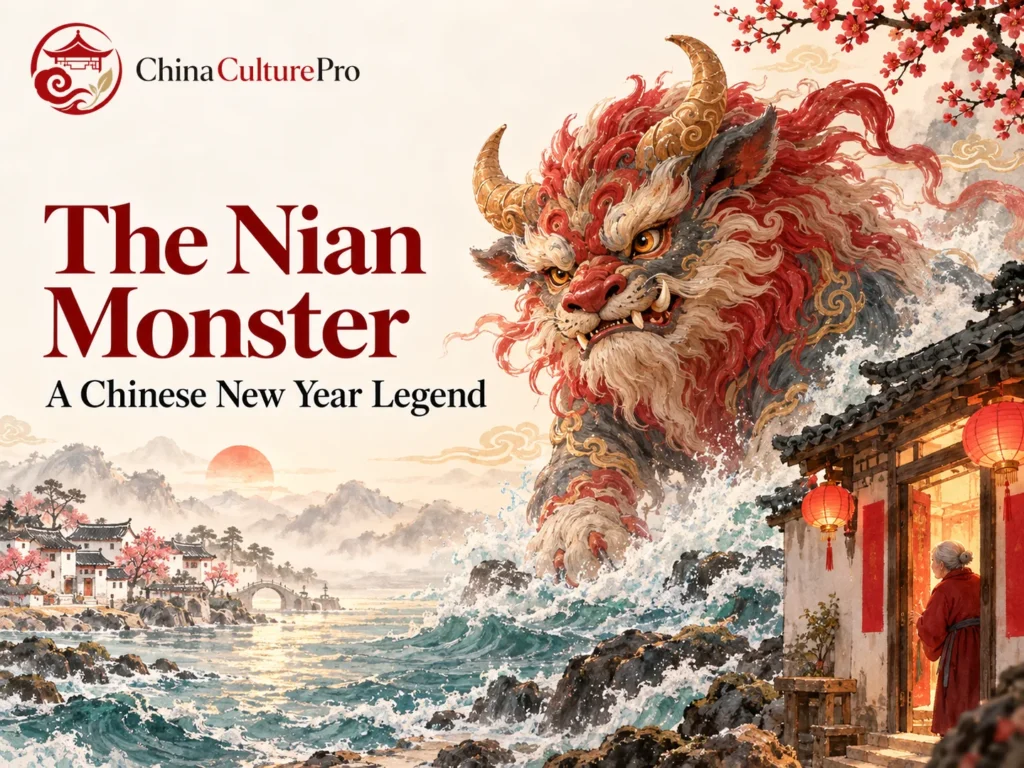
Nian (年, nián), or the Nian monster (年兽/年獸, niánshòu), is an imaginary creature associated with Chinese New Year folklore.
- The visit: In a familiar version, a sea-dwelling beast threatens a village on New Year’s Eve.
- The weakness: Red objects, bright light and loud sounds frighten it away.
- The connection: The tale links those details with festive decorations and noisy celebrations, giving listeners an easy way to remember them.[1][2]
The story describes a fictional encounter, not a real animal or a documented event that created the holiday. Its details vary between tellers; a story set in ancient times is not automatically an ancient record.
Red paper at a doorway, glowing lanterns and a burst of festive noise often bring one creature to mind. The familiar monster tale offers a memorable explanation for these New Year sights and sounds. Reading it as folklore preserves its appeal while keeping the festival’s history clear.
The Nian Monster Story: A Popular Retelling
Here is one familiar version, with the sea-dwelling beast and the mysterious elderly visitor.[1][2]
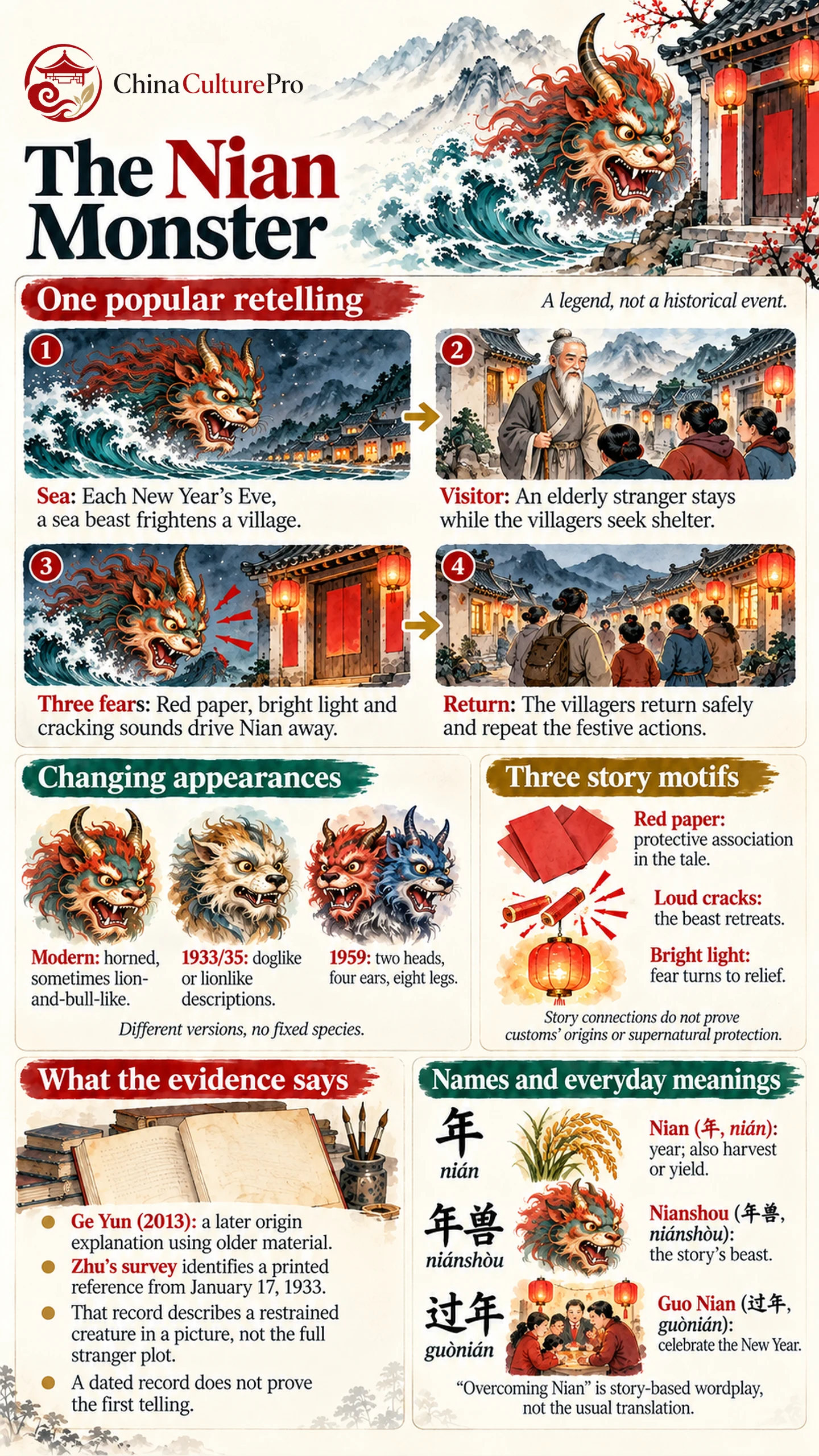
Long ago, a great creature named Nian lived beneath the sea. For most of the year, the village on the shore went about its ordinary business. But on New Year’s Eve, the beast would emerge and disturb the settlement, frightening people and animals. Before darkness fell, families gathered what they needed and made their way into the hills. They left their houses behind and waited for the dangerous night to pass.
One year, as the villagers prepared to leave, a white-haired stranger arrived asking for help. Everyone was hurried and anxious. An elderly woman stopped to give him food and warned him to join the others. Instead, he asked to stay in her house for the night. He said he could drive the beast away. Unable to persuade him to leave, she went up the hill with her neighbors.
At midnight, Nian came ashore. The village was quiet, but one house looked different. Red paper covered its doorway, and bright candlelight shone from within. The creature hesitated. As it approached the courtyard, a sudden series of cracking sounds broke the silence. The stranger appeared in a red robe. Faced with the color, light and noise, Nian turned and fled toward the sea.
The next morning, the villagers returned to find their homes undamaged. The woman recognized that the stranger had kept his promise. Relief gave way to celebration, and neighbors shared the news. In the story, they remembered the red paper, lights and sounds, repeating them at the next year’s end. The frightening night became a tale about welcoming a new beginning together.
What Does Nian Look Like, and Why Do Versions Differ?
Nian has no single standard appearance. Modern educational descriptions include a lion-headed, bull-bodied creature and an enormous sea beast.[3] Earlier written versions add other forms:
| Version or record | Appearance | What the evidence establishes |
|---|---|---|
| Familiar modern retellings | A large horned creature, sometimes combining lion and bull features | A recognizable storytelling image, not a fixed species.[1][3] |
| Newspaper accounts from 1933 and 1935 | An uncertain doglike beast; the later account also invokes a lionlike resemblance | Descriptions reproduced in a researcher’s survey, associated with an image of a restrained creature.[4] |
| A newspaper story from 1959 | Two heads, four ears and eight legs | One particular published version, not the standard form of every later Nian.[4] |
A horn or mane cannot identify a universal original. A modern friendly Nian can also work in a children’s adaptation, provided it is presented as an adaptation rather than the only traditional form.
Why Is Nian Afraid of Red, Loud Noises and Bright Lights?
Within the tale, the three fears turn ordinary festive objects into the means of the village’s escape:[1][2]
- Red: Paper at the entrance and the visitor’s robe become warning signals to the creature. The plot gives red decorations an easily remembered protective association.
- Loud noises: Sudden cracks interrupt the threatening silence. Retellings connect that sound with burning bamboo, firecrackers or other festive noise; the precise object depends on the version.
- Bright lights: The illuminated house stands out from the abandoned village. Light makes the stranger’s preparations visible and helps change the encounter from fear to relief.
Together, these details explain the ending: people repeat what seemed to keep them safe. They do not establish that a real encounter invented each custom, or that red paper and noise offer actual supernatural protection. Read the objects themselves through their wider Chinese New Year symbolism; the monster tale is one cultural explanation, not the complete meaning of every festive decoration.
Is the Nian Legend the Real Origin of Chinese New Year?
The Nian story should not be treated as a factual account of the festival’s creation. A tale set “long ago” does not, by itself, establish when that tale began circulating.
In the published abstract of a 2013 study, Ge Yun interprets the legend as a later origin explanation incorporating older material. That is a scholarly interpretation of how the story works, rather than evidence of a historical monster.[5]
Researcher Zhu Chunxiang identifies a relevant passage published by Sun Yusheng in the Shanghai newspaper Jingang Zuan on January 17, 1933. It describes a creature restrained in a picture, sometimes identified as “Nian.” It does not contain the complete elderly-stranger episode retold above. The writer himself could not establish the allusion’s source.[4]
This gives a dated written record of one version. It does not prove that Sun invented the creature, that nobody told an earlier story, or that the familiar plot already existed unchanged. The record and the inferred beginnings of an oral tradition are different questions. For the broader celebration, start with the Chinese New Year guide; a festival’s development cannot be reduced to one monster’s defeat.
What Do Nian and Guo Nian Mean in Chinese?
The shared wording makes the story memorable, but everyday meanings and a monster’s name need to remain distinct:
- Nian: The character 年 commonly means “year.” It also has harvest or annual-yield senses; its dictionary meanings cannot simply be reduced to “monster.”[6]
- Nianshou: 年兽/年獸 names the beast in the legend. The additional character 兽/獸 means “beast,” making the fictional reference clearer.
- Guo Nian (过年/過年, guònián): This expression refers to passing New Year’s Eve or celebrating the New Year.[7]
“Overcoming Nian” can be a playful story-based reading. It is not the ordinary literal translation of the expression, and it does not prove that defeating a beast gave the festival its name. When translating a family’s plans to “guo nian,” “celebrate Chinese New Year” is usually the useful meaning.
FAQs About the Nian Monster
Is the Nian Monster Real?
Nian is a fictional being in folklore. Written accounts show that people told stories about it; they do not demonstrate a living or extinct animal corresponding to the creature. Treat its appearance and powers as storytelling details.
Who Defeats Nian in the Story?
In the version told here, an elderly stranger frightens Nian away using its weaknesses. Other retellings differ. The helper does not need to be given one fixed divine identity, and driving the beast away is different from killing it.
Is Nian a Dragon or a Lion?
Neither label defines every Nian. Illustrators and storytellers may borrow a mane, horns or other animal features. Those resemblances help create an imaginary creature; they do not make it an ordinary lion or a universally defined Chinese dragon.
Is Nian One of the Chinese Zodiac Animals?
No. Nian is absent from the twelve-animal Chinese zodiac (生肖, shēngxiào). Its New Year encounter belongs to a different story from the animal race. A festival illustration can include Nian without identifying the animal of that year.[8]
Sources
[1] Confucius Institute for Scotland. The Legend of the Beast Nian – Origins of Chinese New Year
[2] Beijing Tourism. Legend of the Monster Nian
[3] Museum of Chinese in America. Lunar New Year Family Festival!
[4] Zhu Chunxiang. 年兽传说探源
[5] Ge Yun. 从文字训诂的角度考辨春节起源与年兽传说
[6] Ministry of Education, Revised Mandarin Chinese Dictionary. 年
[7] Ministry of Education, Revised Mandarin Chinese Dictionary. 過年
[8] Museum of Chinese in America. The Great Zodiac Race