

Quick Answer: What Flowers and Plants Are Used for Chinese New Year?
New Year plants, often called nianhua (年花, niánhuā), include more than flowers. Three display groups help identify them:
- Branches and cut flowers: Peach blossom (桃花, táohuā) and other flowering stems bring seasonal color into a vase.
- Potted flowers: Narcissus (水仙, shuǐxiān) and the moth orchid (蝴蝶兰, húdiélán) offer different flower forms, fragrances and growing requirements.
- Fruit and foliage: Kumquat (金橘, jīnjú) and lucky bamboo (富贵竹, fùguìzhú) are valued for their fruits or leafy stems.
These are practical groupings, not three official traditions. Families need not collect every type. Auspicious meanings express cultural wishes; no plant guarantees wealth, relationships or good fortune.
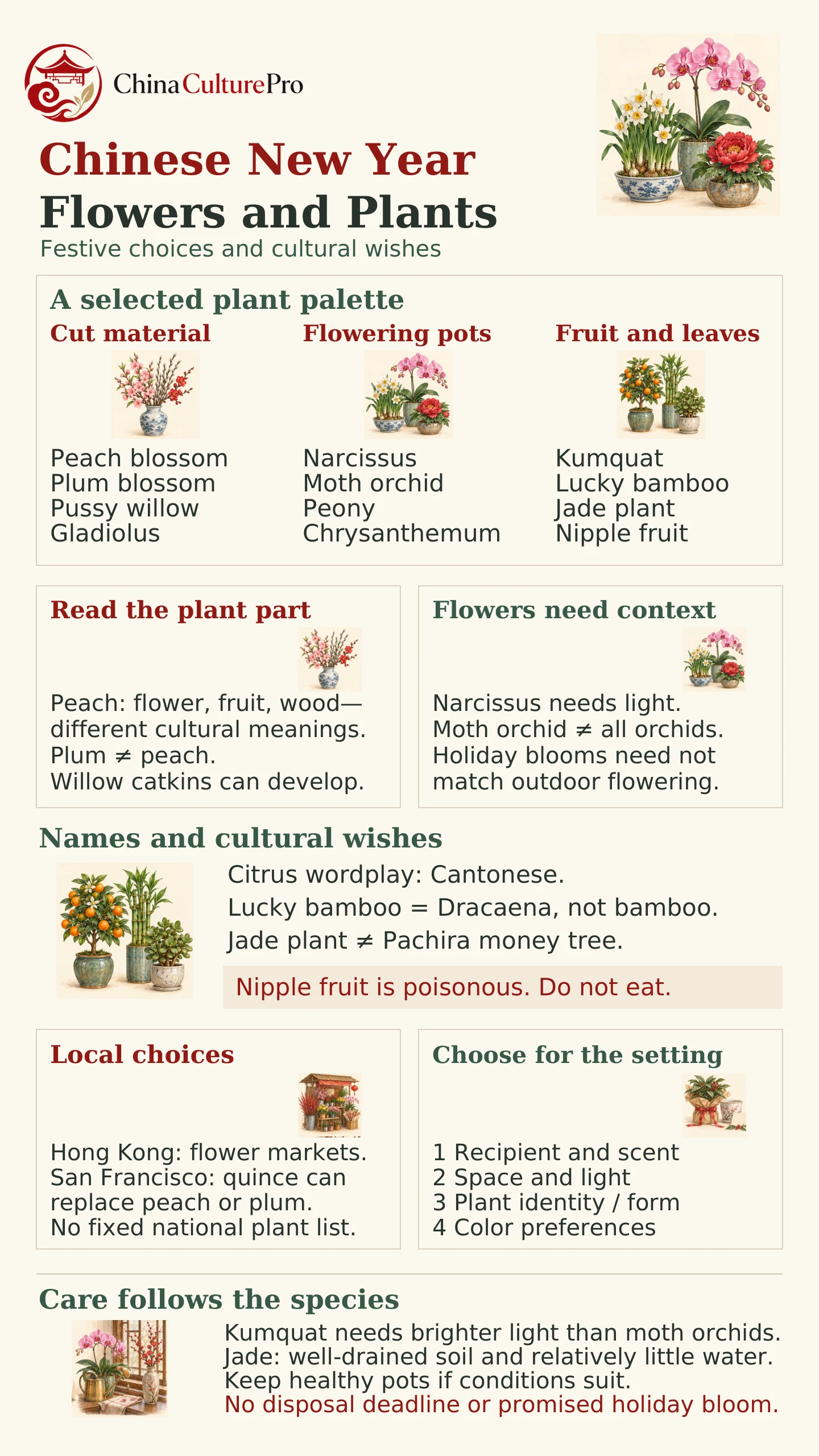
At a Chinese New Year flower stall, a vase of bare branches may stand beside a flowering pot and a miniature fruit tree. They serve different decorative purposes. This guide helps you recognize common choices, understand their festive associations and select a display that suits its setting.
Chinese New Year Flowers and Plants at a Glance
This selected list identifies common display forms, rather than prescribing twelve essential purchases. Some plants appear in more than one form: a flowering tree may be sold rooted in a pot or as detached branches. The short associations below need the context explained in the following sections. [1][2][3]
| Plant and Chinese name | Recognizable form | Festive association and useful limit |
|---|---|---|
| Peach blossom, 桃花 (táohuā); Prunus persica | Flowering branches or a potted tree | Spring and renewal; distinguish blossom from longevity-themed fruit |
| Plum blossom, 梅花 (méihuā); Prunus mume | White, pink or red flowers on woody stems | Perseverance and renewal; not the same species as peach |
| Narcissus, 水仙 (shuǐxiān); Narcissus tazetta | Bulbs, strap-shaped leaves; often a shallow water dish | An auspicious seasonal display; white petals are familiar |
| Orchids, 兰花 (lánhuā), including moth orchids, 蝴蝶兰 (húdiélán) | Flowering pots; Phalaenopsis has broad, moth-like blooms | Refinement and celebratory abundance; orchids are a diverse family |
| Pussy willow, 银柳 (yínliǔ); Salix species | Stems carrying soft, silvery catkins | New growth; dyed stems are decorative treatments |
| Peony, 牡丹 (mǔdān) | Large, layered blooms; pots or cut flowers | Riches and honor; holiday availability need not reflect natural flowering |
| Chrysanthemum, 菊花 (júhuā) | Many flower shapes and colors; pots or cut stems | Longevity or festive color; gift preferences vary |
| Gladiolus, 剑兰 (jiànlán) | Tall flowering spikes, often sold as cut stems | Upward progress; its Chinese name does not make it an orchid |
| Kumquat and other ornamental citrus | Small trees bearing orange or yellow fruits | Prosperity wishes; different citrus plants share the display role |
| Lucky bamboo; Dracaena sanderiana | Green canes, straight, curved or arranged in tiers | A prosperity-themed name; not true bamboo |
| Jade plant, 玉树 (yùshù); Crassula ovata | Thick, fleshy leaves on branching stems | Wealth associations; identify it beyond a “money plant” label |
| Nipple fruit, 乳茄 (rǔqié); Solanum mammosum | Yellow ornamental fruits with distinctive protrusions | Family-continuity wishes in some displays; fruit is poisonous, not food |
The poisonous-fruit distinction matters even when an arrangement is presented as an auspicious gift. [8]
Blossoming Branches: Peach, Plum and Pussy Willow
A detached branch and a rooted tree may look similar in a festive photograph, but one is a temporary vase display and the other is a living plant with continuing needs. Identify which form you have before deciding where to place it or how long to keep it.
Peach symbolism changes with the part of the tree. Blossom can suggest spring and, in Hong Kong festive displays, wishes for good relationships; peach fruit is prominent in longevity imagery, while peach wood belongs to separate protective traditions. A New Year vase of blossoms should not automatically inherit every meaning associated with the fruit or wood. Those protective readings are historical beliefs, not properties of the material. [1][12]
Plum blossom is a different species, associated with perseverance through cold and the return of growth. Color alone cannot distinguish it from peach. Flowering also depends on cultivar and climate; there is no reliable rule that northern households display living trees while southern households use only cut branches. [1]
Pussy willow adds texture through its soft, silvery catkins. Young growth supports its renewal association. Untreated catkins may develop further and leafy shoots may emerge. Dyed colors are decorative treatments, not evidence of a separate species; follow the instructions supplied with treated or dried stems. [2]
Narcissus, Orchids and Other Festive Flowers
The classic shallow-dish narcissus display combines visible bulbs, upright leaves and fragrant blooms. “Water Fairy Flower” is a cultural nickname; “Chinese sacred lily” is another English name, not evidence that the plant belongs to the true lily genus, Lilium. White flowers with yellow cups are a familiar New Year sight, which already makes a blanket ban on white flowers misleading. A water-grown bulb still needs suitable light. [2]
Orchid meanings also need context. The refinement associated with orchids in Chinese art should not become a fixed promise of fertility or success for every modern hybrid. Moth orchids are recognizable contemporary festive pots, but they are one group within a much larger family. Their long-lasting flowers do not make them suitable for a dark corner. [3][7]
Other blooms introduce different choices. Peony carries a riches-and-honor association, yet a flower available for the holiday may have been grown under managed conditions; its presence does not establish the local outdoor flowering season. Chrysanthemum preferences depend on color, arrangement and recipient. Gladiolus is frequently sold for vase display, but the plant can also be grown in containers: “commonly a cut flower” does not mean “incapable of growing in a pot.” [2][10]
Citrus, Lucky Bamboo and Jade: Names Are Part of the Meaning
Kumquat combines golden-looking fruits with a Cantonese auspicious-name association. In Cantonese, 桔 and 吉 can both be read gat1 in Jyutping, supporting the good-fortune wordplay. Mandarin 橘 (jú) and 吉 (jí) differ in their final sounds, although both have the second tone. The Cantonese connection should not be relabeled as an exact Mandarin homophone. [4][11]
A fruiting display may instead contain another ornamental citrus. Identify the actual plant rather than calling every orange-fruited pot a kumquat. Also separate botanical edibility from whether a particular ornamental crop was supplied for eating: ask before treating its fruit as food.
Lucky bamboo belongs to Dracaena, not the true bamboo group. The word “bamboo,” its green stems and a tower-shaped arrangement can suggest prosperity or upward movement, but traditional plant symbolism is not automatically transferable between different plants. Stalk counts and woven shapes carry varying interpretations; they are not a universal formula. [5]
Jade plant is a succulent with fleshy leaves. The money tree (发财树, fācáishù), commonly sold as Pachira aquatica, is distinct from jade plant. Shared commercial English names do not mean they need the same watering or growing conditions. [3][6]
Nipple fruit is another case where a festive label can obscure identity. “Five generations under one roof” (五代同堂, wǔdài tóngtáng) expresses a family wish attached to the display. The yellow fruits remain poisonous regardless of the auspicious name. Keep them away from children and anyone who might mistake the arrangement for edible fruit. [3][8]
Flower Markets and Regional New Year Customs
Flower markets are a recognizable part of New Year preparations in Guangdong and Hong Kong, but no fixed set of four plants defines every family’s celebration. Hong Kong’s Mong Kok Flower Market offers a concrete setting: its festive displays include fruiting citrus and leafy prosperity-themed plants. Permanent flower-market streets and temporary New Year fairs are different kinds of venue; neither establishes a universal purchasing date. [9] A 2019 account also records peach blossoms, citrus and ornamental nipple fruit at Victoria Park’s New Year fair. [12]
Overseas choices also adapt to local availability. In San Francisco, flowering quince (贴梗海棠, tiēgěng hǎitáng) has served as a substitute for peach and plum branches. Locally available branches allow the seasonal display to continue with a different species. [1]
Local climate, availability and family preferences help explain these differences; they do not form a mandatory national plant list.
How to Choose Flowers or Plants for a Home or Gift
- Start with the recipient: Ask about scent preferences, available space and willingness to care for a plant. Where children or pets live, check the species rather than assuming every festive arrangement is suitable.
- Match the conditions: Assess the actual light and temperature. A small pot can fit a small room while still needing brighter conditions than that room provides.
- Confirm the form and identity: Distinguish cut material from rooted plants. Check an unfamiliar common name and whether decorative fruit is intended for consumption.
- Consider the whole arrangement: Follow the household’s preferences about colors and presentation. White narcissus, a white chrysanthemum bouquet and a mixed festive display are not automatically interchangeable gifts. Pairs and fixed stalk counts are optional conventions.
For a small home with suitable bright, indirect light, a compact moth orchid or lucky bamboo arrangement may fit better than a large flowering tree. A fragrant narcissus bowl is another choice only when both the light and the household’s scent preferences suit it.
Caring for the Display During and After the Festival
Use the plant’s identity, not its auspicious label, to decide its care:
- Cut material: Follow the instructions for the particular stems; a vase arrangement has different needs from a rooted plant. Treated or dried decorative stems may need different handling again.
- Rooted plants: Lucky bamboo can grow in water or soil, whereas jade plant needs well-drained conditions and relatively little water. A water-grown narcissus bowl is not a model for every flowering pot. [5][6]
- Light: A moth orchid such as Phalaenopsis amabilis needs filtered conditions; fruiting kumquats need much stronger light. “Indoor display” does not mean “shade-loving plant.” [4][7]
After the holiday, a healthy potted plant can continue growing where the conditions suit it. There is no universal Lantern Festival disposal date. Nor can a bulb or branch guarantee flowers precisely on New Year’s Day: cultivar, development stage and the growing environment all matter.
FAQs About Chinese New Year Flowers and Plants
What Are the Most Popular Chinese New Year Flowers?
Narcissus, moth orchids and peach blossom are familiar choices, alongside fruiting citrus and leafy plants. Popularity varies between communities, suppliers and households; there is no single national ranking or mandatory collection.
Can You Give White Flowers for Chinese New Year?
Yes, depending on the flower and recipient. White narcissus is a familiar festive display. Ask about household preferences rather than assuming every white bloom, bouquet or arrangement has the same associations.
Are Peach Blossoms and Plum Blossoms the Same?
No. Peach blossom comes from Prunus persica and Chinese plum blossom from Prunus mume. Both can have pink flowers, so color alone is not a dependable way to identify them.
Is Lucky Bamboo Actually Bamboo?
No. Lucky bamboo is a Dracaena, commonly identified as Dracaena sanderiana, rather than true bamboo. Its popular name and ornamental form do not change its botanical identity or growing requirements.
Can You Keep Chinese New Year Plants After the Festival?
Yes, when a rooted plant is healthy and its conditions remain suitable. Cut branches are temporary displays, while pots may continue growing; there is no shared deadline for discarding every festive plant.
Sources
[1] Asian Art Museum, Terese Tse Bartholomew. Fruits and Flowers for the Chinese New Year
[2] Cornell Botanic Gardens. Lucky Plants for the Lunar New Year
[3] UBC Botanical Garden. Auspicious Plants Information Lunar New Year 2025
[4] National Parks Board, Singapore. Citrus japonica cv
[5] National Parks Board, Singapore. Dracaena sanderiana
[6] National Parks Board, Singapore. Crassula ovata
[7] National Parks Board, Singapore. Phalaenopsis amabilis
[8] Hong Kong Hospital Authority. Atlas of Poisonous Plants: Solanum mammosum
[9] Hong Kong Tourism Board. Flower Market
[10] Royal Horticultural Society. How to grow gladioli
[11] Chinese University of Hong Kong. Cantonese Pronunciation Database: final at, tone 1
[12] Xinhua, published by the Liaison Office of the Central People’s Government in Hong Kong. 香港年味何处寻?